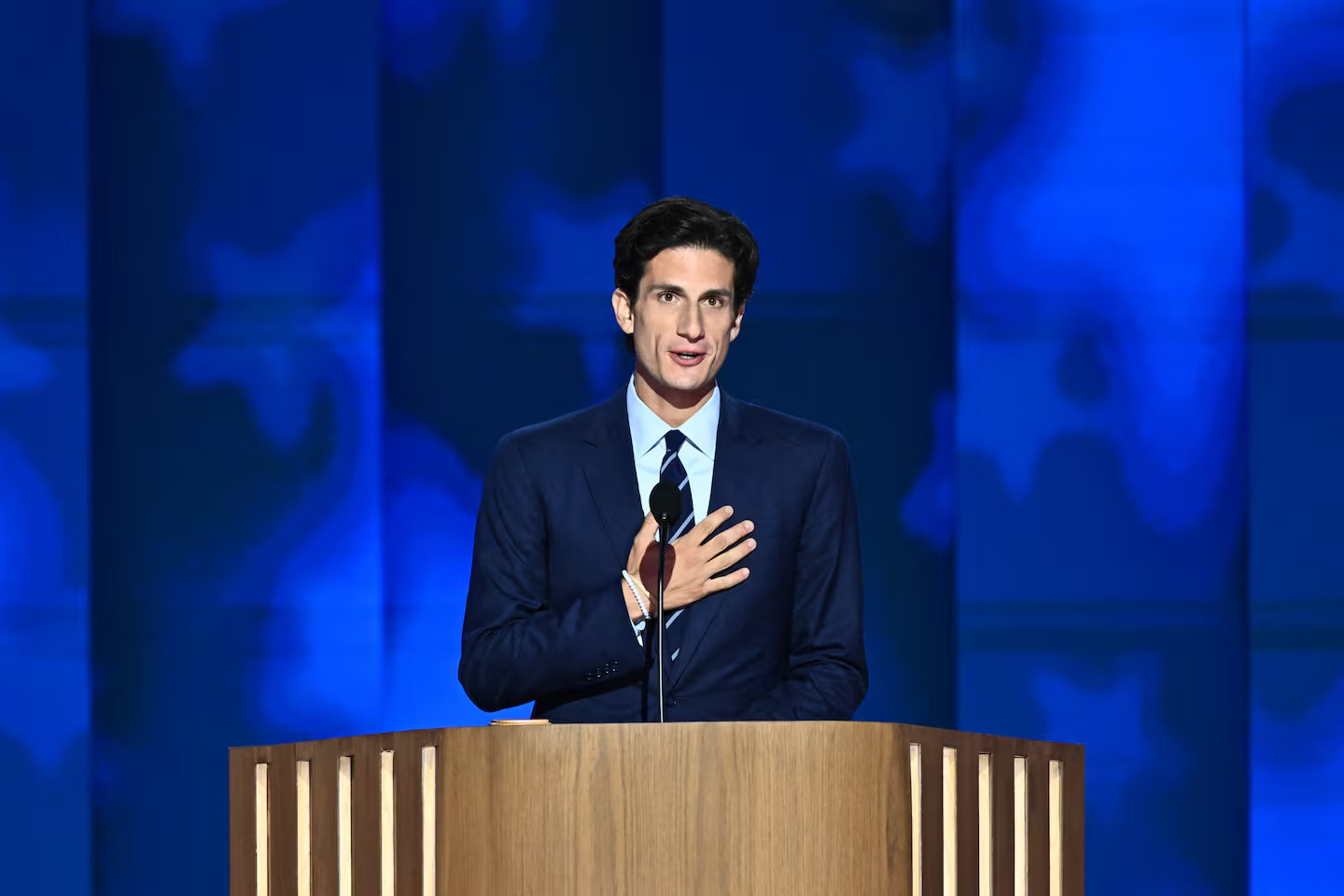
Inside Jack Schlossberg’s chaotic campaign to revive a political dynasty
NEW YORK — Reviving a political dynasty is best not left to chance. So on the morning that Jack Schlossberg, the grandson of John F. Kennedy, announced his campaign for a House seat in New York City, his team had a carefully choreographed plan.
Aides teed up calls with frenzied media outlets, Democratic luminaries and a roster of wealthy donors. The goal was to show that Schlossberg, a 33-year-old heir known for his good looks and madcap social media musings, was a serious candidate ready for what promised to be a grueling race.
But just hours into his Day 1 launch, the candidate abruptly announced a change of plans, according to three people familiar with the events. Forget dialing for dollars — Schlossberg said he needed a nap. He then effectively disappeared for the day, leaving his team reeling.
The incident would be unusual for any candidate for high office, especially one representing the beating heart of Manhattan. For Schlossberg, a first-time candidate with little traditional work experience, it was evidently par for the course.
In the months since, Schlossberg has translated his fame, charisma and creativity into a narrow polling lead before June’s Democratic primary, and has been endorsed by Democratic titan Nancy Pelosi. But behind the scenes, a group of fellow Democrats, family friends, union leaders and others with direct knowledge of the campaign described an operation so erratic and plagued by turnover that it raises questions about how he might handle himself as a member of Congress.
Especially early on, Schlossberg would regularly blow off weekly strategy meetings called for his benefit, and he made a habit of disappearing for long stretches with little notice or explanation. (He did carve out time to swim or paddleboard in the Hudson most days.)
He has pushed boundaries on social media — so far, in one case, that a sitting member of Congress privately complained that Schlossberg had mimicked his Instagram commentary about President Donald Trump and Venezuela without crediting him.
And Schlossberg has churned through staff at a head-turning pace. In the six months since he entered the race, he has had at least two campaign managers, two field directors, a handful of advisers and a rotating cast of consultants.
Some he fired after just weeks. Others inadvertently stayed on for weeks after Schlossberg decided to dismiss them, because he never bothered to tell them.
Jorge Muñiz Reyes, a canvassing coordinator, left the campaign last week, citing frustration with Schlossberg’s lack of engagement with community issues and the campaign’s management. Muñiz Reyes compared the campaign to a “dollar-store flower bouquet.”
“The colors might be nice to look at for a few days,” he said, “But since the flowers lack roots, they can’t last very long.”
Others who spoke to The New York Times about Schlossberg’s campaign agreed to do so only on the condition of anonymity, citing deference to Schlossberg’s famous family, but also concerns that he could turn his sometimes acerbic social media posts against them.
Schlossberg’s current aides and allies pushed back on aspects of this account, saying that sharp reversals are frequently a feature of political campaigns. Paige Phillips, who is now serving as his campaign manager, said Schlossberg was campaigning “amid a deeply, deeply personal tragedy”: the death of his sister Tatiana Schlossberg, in December.
“If an anonymous source thought he ‘disappeared’ at any point, they should remind themselves of that fact,” she said, without addressing the specifics of his campaign launch. She added that “no one works harder, cares more, or shows up like Jack Schlossberg.”
Read more Game 43: Phillies at Red Sox lineups and notes
A stranger to the professional world
Schlossberg was crisscrossing the country in a van last fall, filming a short-lived YouTube show (he described it as “serious — and insane. Just like me.”) when Jerry Nadler, the district’s longtime representative, announced he would retire.
The news created a rare opening for a coveted, safely Democratic seat. Encompassing midtown and the Upper East and West sides, it includes more Fortune 500 companies and highly educated voters than any district in the country.
Other candidates jumped in, including two state Assembly members, Alex Bores and Micah Lasher; a global vaccine expert, Nina Schwalbe; and George Conway, a former Republican turned Trump antagonist and cable news commentator.
Schlossberg was never going to be a conventional candidate.
The son of ambassador Caroline Kennedy, he had grown up in elite political circles. But he made his name and accumulated millions of followers as a confounding social media presence whose scathing critiques of his cousin, Robert F. Kennedy Jr., were interspersed with videos of himself dancing shirtless or claims that he was “having a son” with the wife of the vice president.
And as he set out to build a congressional campaign last fall, Schlossberg had relatively little experience in a professional workplace.
After he earned undergraduate, law and business degrees at Yale University and Harvard University, one of his longest work engagements appears to have been a few months as a political correspondent for Vogue covering the 2024 campaign. He wrote six short articles, and a spokesperson for the publication said he was considered a freelancer, not a staff writer.
Schlossberg likes to mention his work at the State Department, where he helped plan a conference on oceans, but his tenure there as a staff assistant under Secretary John Kerry, a family friend, lasted less than four months, according to a department spokesperson.
And on the financial disclosure form that Congress requires candidates to submit, Schlossberg reported no earned income for 2025, but did disclose trust funds and other assets worth as much as $32 million. (Phillips said Schlossberg “refused roughly $1 million in brand deals last year.”)
Schlossberg has bristled when questioned about his qualifications on the campaign trail.
At a recent candidate forum, for example, the candidates were asked to name their top accomplishments in public service. Schwalbe said she had distributed 500 million COVID-19 vaccines; another candidate discussed helping launch a ferry service in the East River.
Schlossberg pointed to his current campaign, saying it had excited voters. When a moderator followed up to say that his answer might “raise flags” about his experience, Schlossberg grew visibly irritated.
He said he had volunteered on campaigns since 2008 and as an EMT in college; cited his State Department stint and his role helping his family hand out an award each year; and added that he had passed the bar exam “in the top 1%.”
“While you may not think that content creation and building a following based on speaking out for what you believe in at a time when others were unwilling, taking on your family members, traveling the country to every single swing state, serving as a delegate at the DNC, is an experience, I do,” Schlossberg told the moderator.
This article originally appeared in The New York Times.


Post Comment