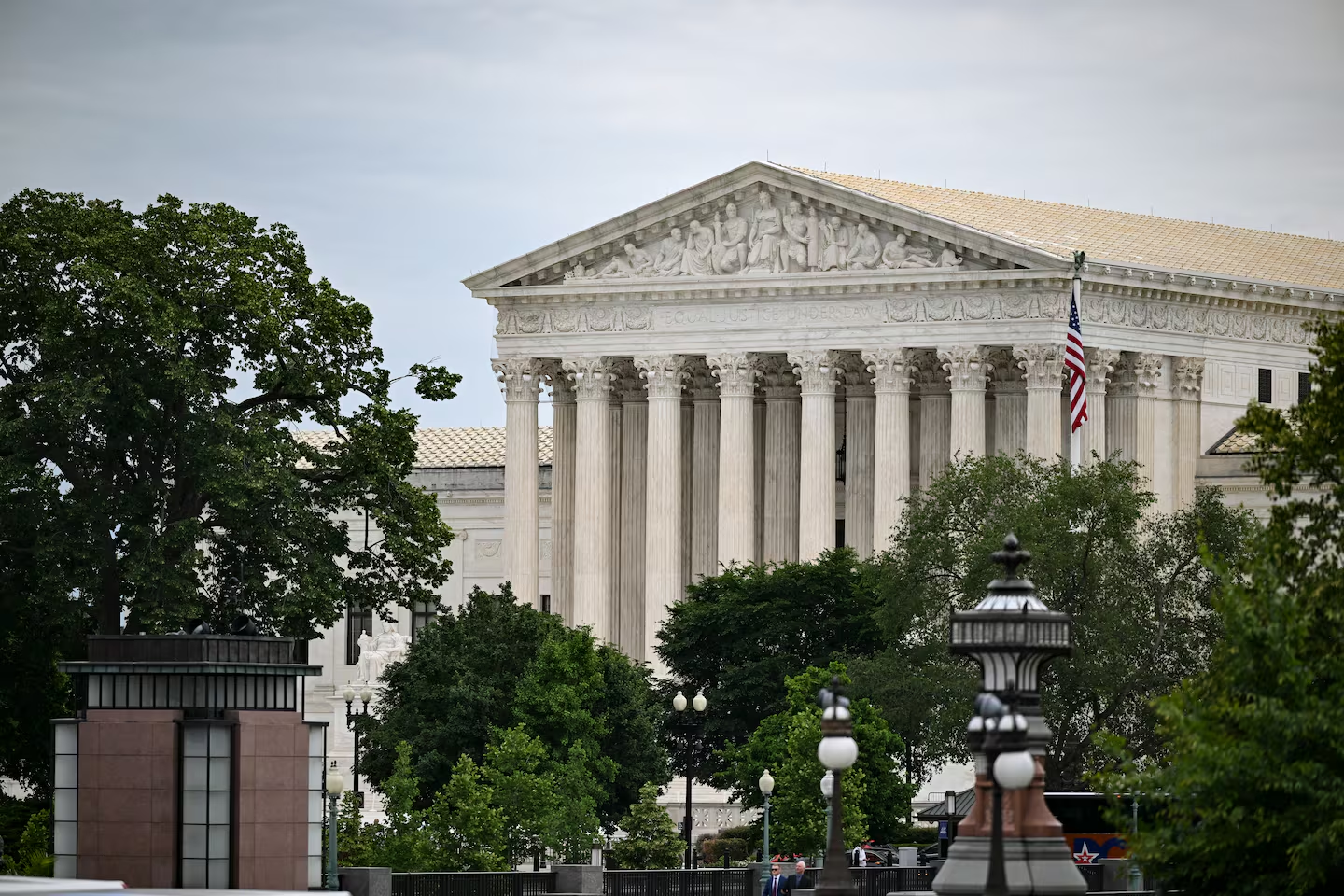
Birthright citizenship, mail ballots, and presidential power: What’s left on the Supreme Court’s docket this term
There are only a few weeks left in June, which means it’s decision season for the Supreme Court.
Read more Most Americans see freedoms under threat but core to nation’s identity, AP-NORC poll finds
Justices are expected to hand out several rulings before their current term ends at the end of the month or early July. And more than one of those decisions could impact the Trump administration’s agenda on issues including immigration, election laws, and presidential power.
Here’s a rundown of some of the major cases still on the court’s docket as we enter the “June boom.”
Birthright citizenship: Trump v. Barbara
Perhaps the court’s most consequential decision this term could be over President Trump’s executive orderendingbirthright citizenship. Signed on his first day in office, Trump’s order declares that children born to parents who are in the US illegally or temporarily are not American citizens.
Trump’s movewas quickly challenged by advocacy groups in several states. Last July, a federal judge in New Hampshire found that it likely violated the 14th Amendment of the Constitution.
The Supreme Court heard arguments on the injunction in May, with Trump present in the courtroom — the first sitting US president to do so. Both conservative and liberal justices cast doubt on the legality of Trump’s order, which could impact more than 250,000 babies born every year in the US.
Temporary Protected Status: Mullin v. Doe, Trump v. Miot
Justices also areexpected to rule on the Trump administration’s push to end legal protections for migrants fleeing war and natural disaster.
Arguments were heard in April over cases that focus on immigrants from Haiti and Syria who have been granted Temporary Protected Status, or TPS, as the humanitarian program for immigrants from troubled countries is known. The federal government is appealing a lower court order that blocked the Department of Homeland Security from immediately ending the program.
Several conservative justices appeared to be leaning toward the Trump administration in April, which argued that federal law limits what courts can do with TPS. The Supreme Court’s decision will technically not be a final ruling on the program but could have immediate impacts on up to 1.3 million people from 17 countries, including exposing them to potential deportation.
The ruling carries profound implication for many residents in the Greater Boston area, which is home, for instance, to the third-largest Haitian population in the US, a number of whom are here thanks to TPS.
Mail ballots: Watson v. Republican National Committee
As Trump continues to spread misinformation about election security, his administration is targeting state laws that allow mail ballots that arrive after Election Day to still be counted.
The Supreme Court heard arguments in March in a case involving Mississippi election laws. Fourteen states and the District of Columbia allow mail ballots to be counted as long as they are postmarked by Election Day.
The Trump administration argues that federal law sets a single Election Day and requires ballots to be cast and received by officials on that date. In March, lawyers for Mississippi noted during their arguments that the White House has yet to submit a single exampleof voterfraud due to late-arriving mail ballots. Conservative justices appeared to lean toward the federal government during the hearing.
Presidential firing power: Trump v. Slaughter, Trump v. Cook
Two cases on the Supreme Court’s docket could impact how much power the president has over independent federal agencies.
One case involves Trump’s firing of a Democratic member of the Federal Trade Commission, Rebecca Slaughter, whom Trump fired in March 2025. The court heard arguments on the case in December, and conservative justices appeared ready to limit a 1935 landmark decision that prohibits the president from removing the heads of independent agencies without cause.
The other pending case involves Trump’s attempt to fire Federal Reserve governor Lisa Cook on allegations that she committed mortgage fraud, which she denies. Justices sounded much more skeptical of Cook’s firing during arguments in January, including conservative Justice Brett Kavanaugh, who said that allowing the firing to go forward “would weaken, if not shatter, the independence of the Federal Reserve.”
Transgender athletes: Little v. Hecox, West Virginia v. B.P.J.
The Supreme Court is weighing a decision on state laws that ban transgender athletes from school athletics, as Republicans and the Trump administration push policies that limit LGBTQ+ rights and access to gender care.
Justices heard arguments in January on laws in Idaho and West Virginia, where state bans on trans student athletes were blocked by lower courts. Conservative justices appeared ready to agree with the states that the bans don’t violate the Constitution or Title IX law, which prohibits sex discrimination in education.
More than two dozen states currentlyban transgender athletes from school athletics. Justices previously blocked a law in California that banned schools from telling parents if their children identify as transgender without the student’s approval. The Supreme Court also ruled against a law in Colorado that banned conversion therapy for LGBTQ+ minors, arguing that the form of talk therapy was protected under freedom of speech.
Campaign spending: NRSC v. FEC
Justices heard arguments in December over a GOP push to lift federal limits on how much political parties can spend in coordination with congressional and presidential candidates.
A ruling for Republicans in the case could swing campaigning power from so-called super PACs,which can raise and spend unlimited money advocating for candidates but cannot directly donate to or coordinate directly with campaigns, toward official political parties. It could also allow parties to spend huge sums from big donors directly on candidates, potentially expanding the influence of wealthy donorscompared with small-dollar contributions from everyday people. Democrats in recent years have done better than Republicans at winning smaller donations.
In December, both liberal and conservative justices seemed skeptical of paring back campaigning laws. Liberal Justice Sonia Sotomayor said at the hearing, “Every time we [the Supreme Court] interfere with the congressional design, we make matters worse.”
Read more For Red Sox, dismal divisional performance has season in jeopardy
Material from the Associated Press was used in this report.


Post Comment