Unions helped Maura Healey become governor. Some worry they are no longer a priority.
Governor Maura Healey rose to the governor’s office four years ago on the backs of labor. She rallied alongside unionized teachers, and often recounted stories of her family’s own deep labor roots. Even in deep-blue Massachusetts, she united workers behind her in unusual shows of support.
Read more The new wave of redistricting wars is throwing the 2026 midterms into uncertainty
Now, some of her once most fervent supporters question if they recognize the person they helped put in office.
As Healey seeks a second term,some labor officials have taken umbrage with her administration’s perceived embrace of artificial intelligence in state government, her opposition to a labor-backed ballot question targeting the MCAS exam, and messaging that leans heavily toward business, not labor interests.
A number of the state’s biggest umbrella unions have yet to hand out their endorsements, even as Healey — the incumbent Democrat — faces little, if any, competition for their support. They include the Massachusetts Teachers Association, the Massachusetts Nurses Association, and the SEIU Massachusetts State Council, all of which endorsed her four years ago.
While Healey is likely to ultimately earn a slate of labor endorsements over one of her Republican opponents, it will come weighed down by behind-the-scenes tension and a lack of enthusiasm among many labor folks for a reelection bid that’s largely become a referendum on the state’s economic health, according to Globe interviews with more than a dozen labor leaders.
“It feels like the fox is in the henhouse, and it’s hard to think of her as a potential partner,” said one union leader, who spoke on the condition of anonymity to speak freely about the union’s relationship with the Democratic administration.
To be sure, some powerful union leaders have publicly embraced Healey and say their members strongly back her for a second term. She earned their endorsement, labor leaders said, because of her staunch support of project labor agreements, her appointment of experienced leaders to run the MBTA, and her availability to unions who want the governor’s ear.
“We were silenced and kept outside the door by the [Charlie] Baker administration for eight years,” said Frank Callahan, president of the Massachusetts Building Trades Council, which endorsed Healey at its convention in March. “Working with this administration has been a breath of fresh air.”
But that view isn’t held in all labor circles. Those who have not endorsed in the race cited a litany of grievances, including Healey’s 2025 attempt to close a residential hospital for disabled children in Canton, which would have put some 225 jobs in limbo and, workers said, separate patients from their families.
Some lament a dormant labor advisory council she created, or cringe when she touts being the first governor to cut taxes in decades.
Others have been rankled by the administration’s approach to reining in health care costs, particularly a move by the Group Insurance Commission — which covers nearly 500,000 public sector employees and their families, and is made up of gubernatorial appointees. The changes would hike premiums and scrap coverage for items like GLP-1 weight loss drugs.
“We want to be partners with anybody who is going to find a solution,” said Katie Murphy, president of the Massachusetts Nurses Association. “We still feel like there is a long way to go.”
Harris Gruman, a leader at acommunity coalition known as Raise Up Massachusetts and a top SEIU official, said Healey has met with local unions individually, including after her administration sought, and then backtracked on a plan, to shutter a beloved children’s hospital. The attempt spurred an uproar among labor leaders and was admittedly a “hard moment,” Gruman said.
“The next six weeks are going to be very important,” Gruman said of the ongoing SEIU’s endorsement discussions. “Hopefully, they will strengthen our relationship with the governor, but you never know.”
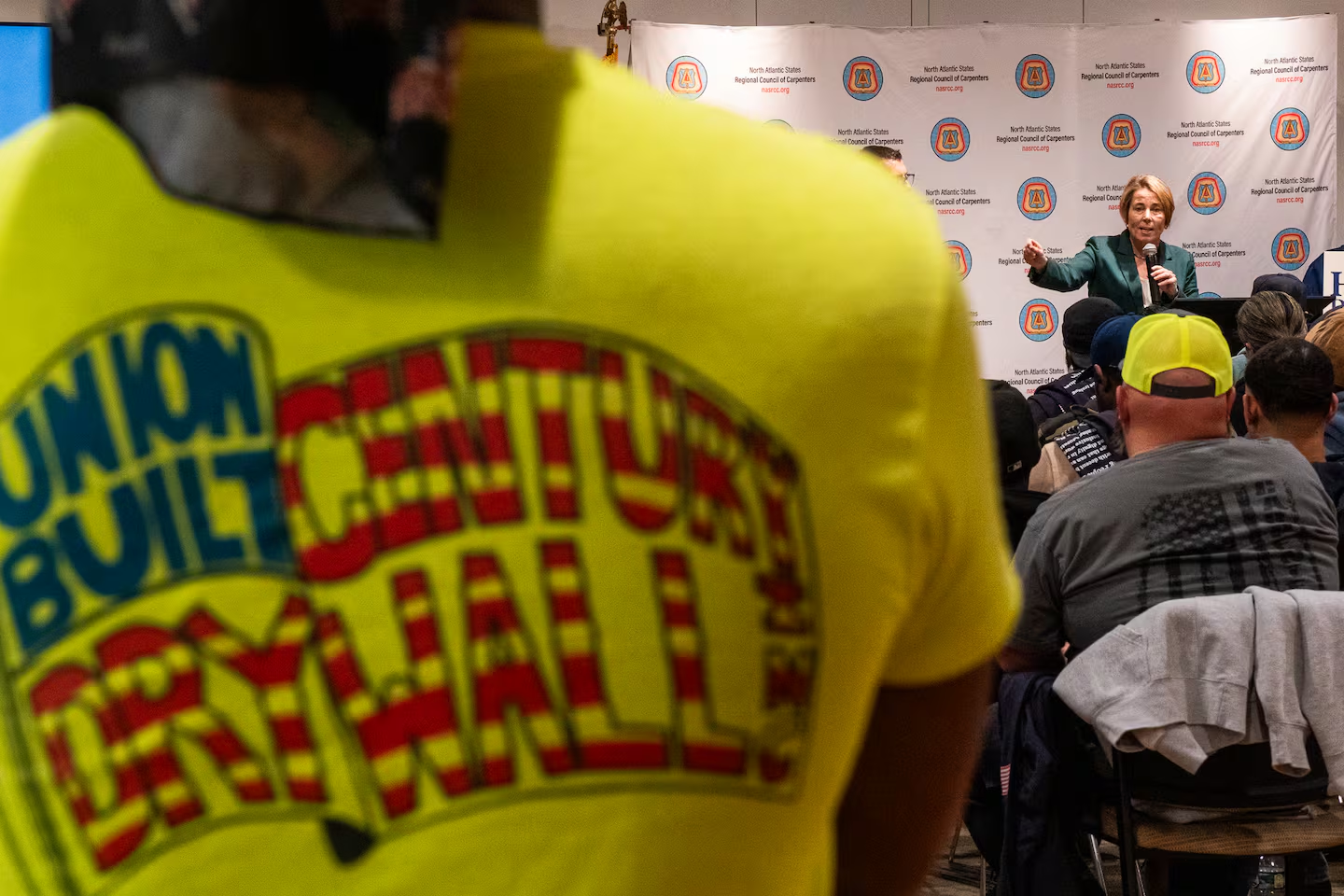
Recently, Healey nabbed an endorsement from the North Atlantic States Regional Council of Carpenters, which hosted her at its state-of-the-art training facility in Dorchester for an event announcing its support on April 30. The 30,000-worker union said it would “greatly benefit from another four years” of Healey in office.
When asked at the event about her campaign’s relationship with other, larger unions this cycle, Healey was circumspect. “You have to talk to the campaign about that,” she told the Globe.
In a statement, Healey campaign spokesperson Kerry Lyons said her track record with workers is “unmatched,” citing her time fighting wage theft as attorney general, support for project labor agreements to bargain with unions for public works projects, and legislation that proposed new investments in job-creating public infrastructure projects on college campuses. Lyons also said the state funneled hundreds of millions of dollars into research and development jobs.
“Workers recognize her commitment to lowering costs for working families, and it’s why she is the only candidate in this race to earn the endorsement of organized labor,” Lyons said.
Healey, of course, has long enjoyed support from the state’s powerful unions as the state’s de facto Democratic leader. During her 2022 gubernatorial run, she quickly accumulated labor endorsements amid what was then a still-competitive primary against state Senator Sonia Chang-Díaz.
By late April that year, the SEIU Massachusetts State Council, one of the state’s largest umbrella unions, threw its support behind Healey, marking the first time in 20 years that all six SEIU local unions under the council had collectively endorsed a single candidate in an open gubernatorial primary.
Healey’s endorsements do include a list of building trade-focused unions, including those who represent carpenters, bricklayers, ironworkers, plumbers, and pipefitters.
Jim Evers, president of the Boston Carmen’s Union Local 589, said Healey’s hiring of general manager Phil Eng has benefited his members. He also citeda bill Healey signed into law that increased penalties for those convicted of attacking transit employees.
“She fully staffed the T and gave workers the tools to do their jobs,” he said.
Jim Durkin, the legislative director at AFSCME 93, pointed to a recent visit Healey made to Cape Cod, where she met with human services workers for more than 90 minutes, taking questions until there weren’t any left, he said.
“We are able to pick up the phone and call her directly, that is very important to us,” said Durkin, whose union will take up endorsements at its meeting in late June. “We have had some battles with the governor, but it’s no different than any other administration, Democratic and Republican.”
But some union members said they have a long memory for ways in which the administration has let them down.
Last year, Healey proposed saving $31 million by closing the Pappas Rehabilitation Hospital for Children and transferring many residents to another facility in western Massachusetts, more than 100 miles away. The proposal caused an uproar, and the administration ultimately walked back its plans.
It still left bad feelings. In March, workers belonging to three unions representing Pappas staff members announced an overwhelming vote of no confidence in Dr. Robbie Goldstein, Healey’s appointed public health commissioner.
Nancy Silva, president of AFSCME Local 1517, said at the time that admissions were declining at the facility because of DPH officials and “their inaction, neglect, and shortsighted policy changes.” Healey’s office said the accusations “represent an inaccurate, unhelpful escalation.”
Healeywas alsoat odds with the state’s top teachers union, which once roundly supported her, when she came out against a successful 2024 ballot question that eliminated the MCAS exam as a high school graduation requirement.
The Massachusetts Teachers Association is finalizing its questionnaire for candidates and expects to make endorsements in late June, union president Max Page told the Globe.
Other union leaders said they haven’t had the communication they’ve hoped for from Healey. Healey’s 20-member Labor Advisory Council, the first convened in more than 50 years, hasn’t met in nine months, said members, who feel that they are sometimes the last to know about major policy decisions or budget actions affecting unions.
For example, last year the governor weighed offering buyouts of up to $20,000 to state employees — her administration ultimately never did —and prolonged an existing hiring freeze across the executive branch, setting state employees on edge.
Others felt that the use of AI in state agencies, such as the state’s sprawling Health and Human Services secretariat, should have been bargained over, including employing AI to summarize health care benefits or help process Medicaid claims. There are also active requests for information, or RFIs, out for liability programs and AI data consulting services that could focus on the health care sector that go beyond Healey’s plan to roll out a ChatGPT-powered AI assistant for state workers.
“We can’t bargain the future,” said one union leader, who requested anonymity to speak because of ongoing contract negotiations with Healey administration officials.
Tatishe Nteta, a University of Massachusetts Amherst political science professor and director of the UMass poll, which regularly gathers voter viewpoints on state issues, said the reticence on the part of unions — and, perhaps, other voters — could be felt most acutely when Healey tries to marshal supporters this fall against either Republicans Mike Minogue or Brian Shortsleeve, the former of whom has already poured more than $13 million into this campaign.
“One of the things that unions do really effectively is mobilize,” Nteta said. “When they are noncommittal, that becomes a fundamental problem.”
Read more Eastern Mass. boys’ lacrosse: Players of the Week for May 6-12
Catherine Carlock of the Globe staff contributed to this report.


Post Comment