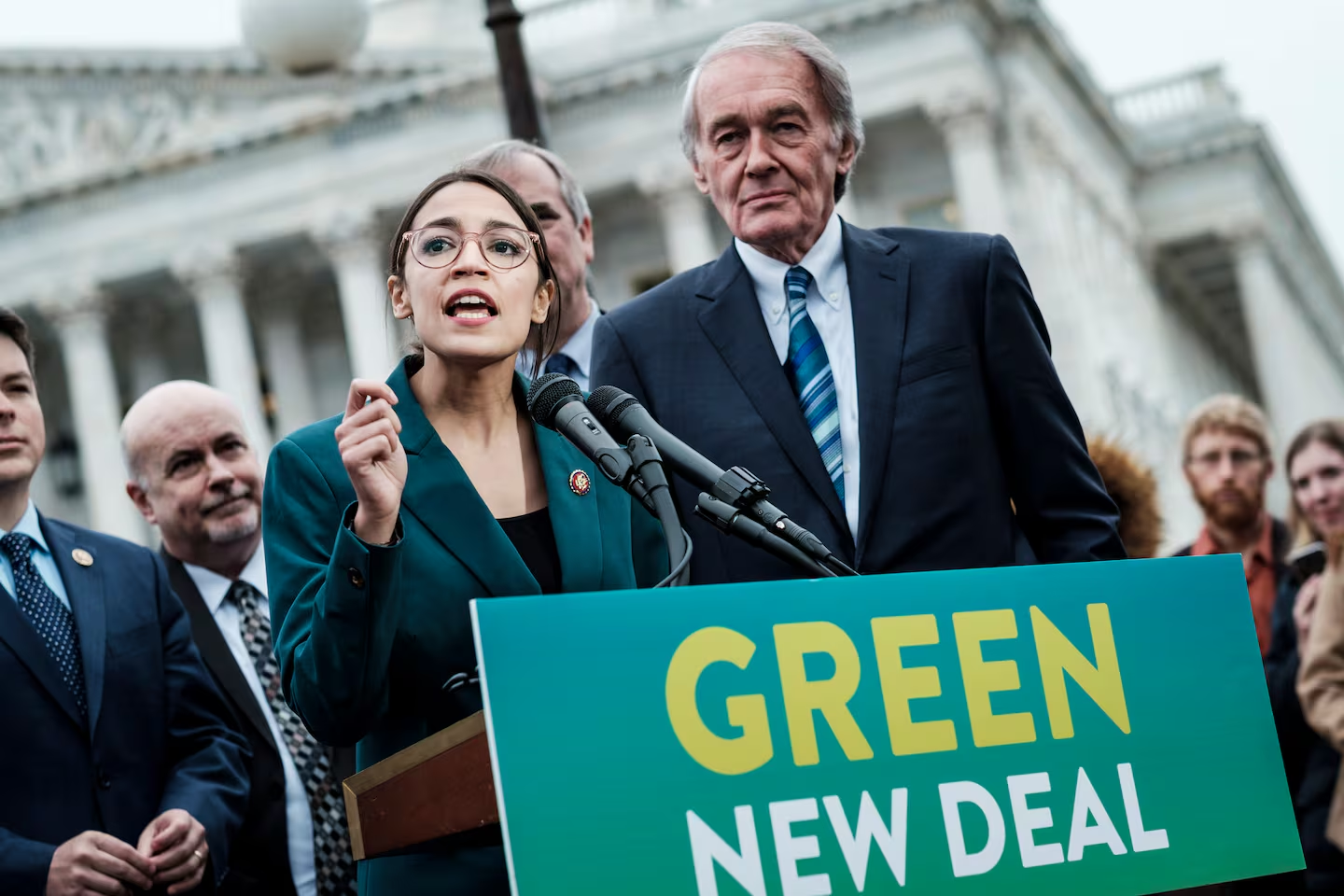
The ‘Green New Deal’ was the foundation of Markey’s last campaign. Six years later, it’s nowhere to be found.
WASHINGTON — When he faced a stiff primary challenge in 2020, Senator Ed Markey bet his career on a soaringly ambitious package of climate bills with a catchy name.
Read more Eastern Mass. boys’ lacrosse: Players of the Week for May 6-12
The Green New Deal, Markey’s signature policy in Washington, was the core of his winning pitch against then-Representative Joe Kennedy III. In his closing campaign ad, the senator even boastfully branded himself the “Green New Dealmaker.”
Six years later, however, the Green New Deal is looking more like a piece of vintage Markey memorabilia than a campaign centerpiece. As he seeks his third full term this year, facing another primary challenge from a Democrat, Markey has stopped campaigning on, or even really mentioning, the marquee climate package that he did so much to popularize.
Strikingly, after introducing the original Green New Deal resolution in the Senate in 2019, and re-introducing it in 2021 and 2023, Markey did not put the legislation forward in this session of Congress.
On his campaign website, Markey lists 36pieces of environment- and climate-focused legislation that he wrote or cosponsored. The Green New Deal is not among them, nor is it mentioned specifically on the site at all. It was similarly absent from Markey’s first big primary advertisement released last month. Also missing are mentions of major climate benchmarks, such as a net-zero emissions goal, a pillar of the Green New Deal.
It’s still possible to buy a Markey-branded Green New Deal T-shirt or tote bag on Markey’s campaign website. Those items, however, are listed along with other staples of his 2020 campaign, such as a shirt that proclaims “tell ya fatha!” — a call-out to Markey’s viral debate stage dig against Kennedy.
A longtime environmental advocate, Markey hasn’t necessarily changed his positions. But his sidelining of his former campaign rallying cry is a broader reflection of how significantly the political dynamics around climate issues have changed in six years.
When the Green New Deal first captured the zeitgeist in 2018, Democrats were alarmed over President Trump’s dismantling of climate protections and wanted aggressive action. The movement has been reeling since Trump’s return to office and subsequent gutting of much of former president Joe Biden’s climate agenda.
Meanwhile, with cost-of-living concerns dominating voters’ minds, Democratic politicians are competing to put forward the most ambitious visions not on climate, but on affordability, with figures such as New York Mayor Zohran Mamdani gaining traction on promises for free transit and rent freezes.
In a statement to the Globe, Markey spokesman Jonathan Ng said the Green New Deal is still the senator’s “framework to addressing the existential threats of climate change” as well as for lowering utility bills, creating jobs, and expanding public transit.
“Senator Markey helped turn that roadmap into the largest climate investment in American history, and now he is fighting to protect that progress from Donald Trump’s attacks and meet this moment with the urgency it demands,” he said.
Affordability, and Trump, have so far defined messaging in the Massachusetts primary battle. The Malden Democrat, 79, has emphasized his fitness to “fight” Trump and his plans to lower costs — as has his main rival, Representative Seth Moulton of Salem.
The simplest answer for Markey’s shift in tone is probably the correct one, said Emily Becker, director of communications for the climate and energy program at Third Way, the center-left think tank.
“You’ve got an electorate that’s cost burdened. If I’m Ed Markey and dealing with an uphill battle with my age, I want to give people red meat, and that’s a focus on affordability and anti-corruption,” she said.
Climate advocates argue that, more broadly, the nature of this political moment means they must frame their policy agenda differently than they did at the peak of the Green New Deal movement.
Representative Jared Huffman, a California Democrat, called the policy an “important contribution” but argued “that doesn’t mean we have to keep calling things we do by the same name, or that we can’t do many of the same things under different framing.”
“Ed Markey’s values and priorities have not changed,” Huffman added. “I see him, like any good leader, being nimble, and framing our values and priorities in the language that has the most impact right now, not what we might have done five or six years ago.”
But, when it comes to the influence of the oil and gas industry in politics, Markey has apparently not enforced a key pledge from his 2020 campaign: the “no fossil fuel money” promise, which asked candidates to swear off donations from entities with links to the oil, gas, and coal businesses.
Read more Trump’s talk of 51st US state met with near-silence in Venezuela
In 2019, Markey refunded nearly $50,000 in donations from Democratic lobbyists whose firms had worked for fossil fuel interests. However, since 2021, his campaign has taken $21,600 in contributions from lobbyists whose checks were returned in the last race, and another $21,000 from lobbyists who worked for firms prohibited under the climate pledge.
Ng said that the Markey campaign remains “fully committed to the No Fossil Fuel Money Pledge” and is currently reviewing these donations. “Any contribution found to be in violation of the pledge will be returned,” he said.
Markey is hardly the only Democrat to have put the Green New Deal on the backburner, or to have shifted how he talks about climate issues. Representative Alexandria Ocasio-Cortez of New York, his House cosponsor of the Green New Deal resolution, did not introduce it this congressional session, either.
According to an Axios report last year, congressional Democrats only said the term six times in a three-month period across social media and floor speeches — the fewest mentions since 2018. Republicans, meanwhile, mentioned it 337 times, a reflection of how the GOP has weaponized the slogan as a campaign bogeyman.
“Senator Markey reads these political signals very well, and that’s why he’s not waving the climate flag,” said Aseem Prakash, a professor at the University of Washington who studies environmental policy and public opinion. “He’s not the only one; every Democratic politician is shying away from openly backing climate issues.”
That Markey specifically stepped away from the Green New Deal, however, is notable, given how integral it has been to his political success.
In 2019, Markey partnered with Ocasio-Cortez, who would later become a key campaign ally, to turn activists’ demands for a New Deal-scale approach to the climate crisis into legislative text.
One of Markey’s first viral moments in the 2020 primary came when he talked at a forum about the energy the Green New Deal “unleashed” among young voters. It signaled what eventually became a core element of his successful strategy: championing the policy and harnessing the youth energy behind it to blunt Kennedy’s argument for generational change.
In 2022, the pent-up energy among Democrats culminated in Biden’s enactment of the Inflation Reduction Act, which contained historic provisions but still fell short of the biggest goals. Afterward, Becker explained, as there was no obvious next goal for the climate movement; then, Trump’s dismantling of the IRA has made this “effectively a moment of rebuilding for a lot of folks in the environmental space.”
There’s a growing understanding that a slogan-ready legislative plan with massive ambitions simply doesn’t suit the political dynamics of 2026.
“The value of the Green New Deal was it’s aspirational and easy to understand,” Becker said. “The problems we face right now are complicated, and there’s no single narrative that explains what we’re dealing with and how to combat it.”
Moulton hasn’t identified himself as closely with the climate cause as Markey — even though he was an early endorser of the Green New Deal, publicly backing it in late 2018. (He has, however, made support of high-speed rail expansion a big part of his pitch.)
The climate groups that were integral to Markey’s victory in 2020, such as Sunrise Movement, have all endorsed him again. Denae Avila-Dickson, a Sunrise spokesperson, told the Globe: “The Green New Deal was never just about getting one bill passed.”
“The things that we’re talking about in the Green New Deal, like jobs and affordability, are still the things that we are talking about now,” she said.
If Markey wins, and Democrats take Congress this fall and then the White House in 2028, Avila-Dickson expressed confidence the party will “absolutely” bring the Green New Deal into a new era.
“It could very likely be a Green New Deal,” she said, “that is going to be bigger and bolder than what was even first conceptualized.”
Read more Ship is reported seized off the coast of the UAE and is heading toward Iran


Post Comment