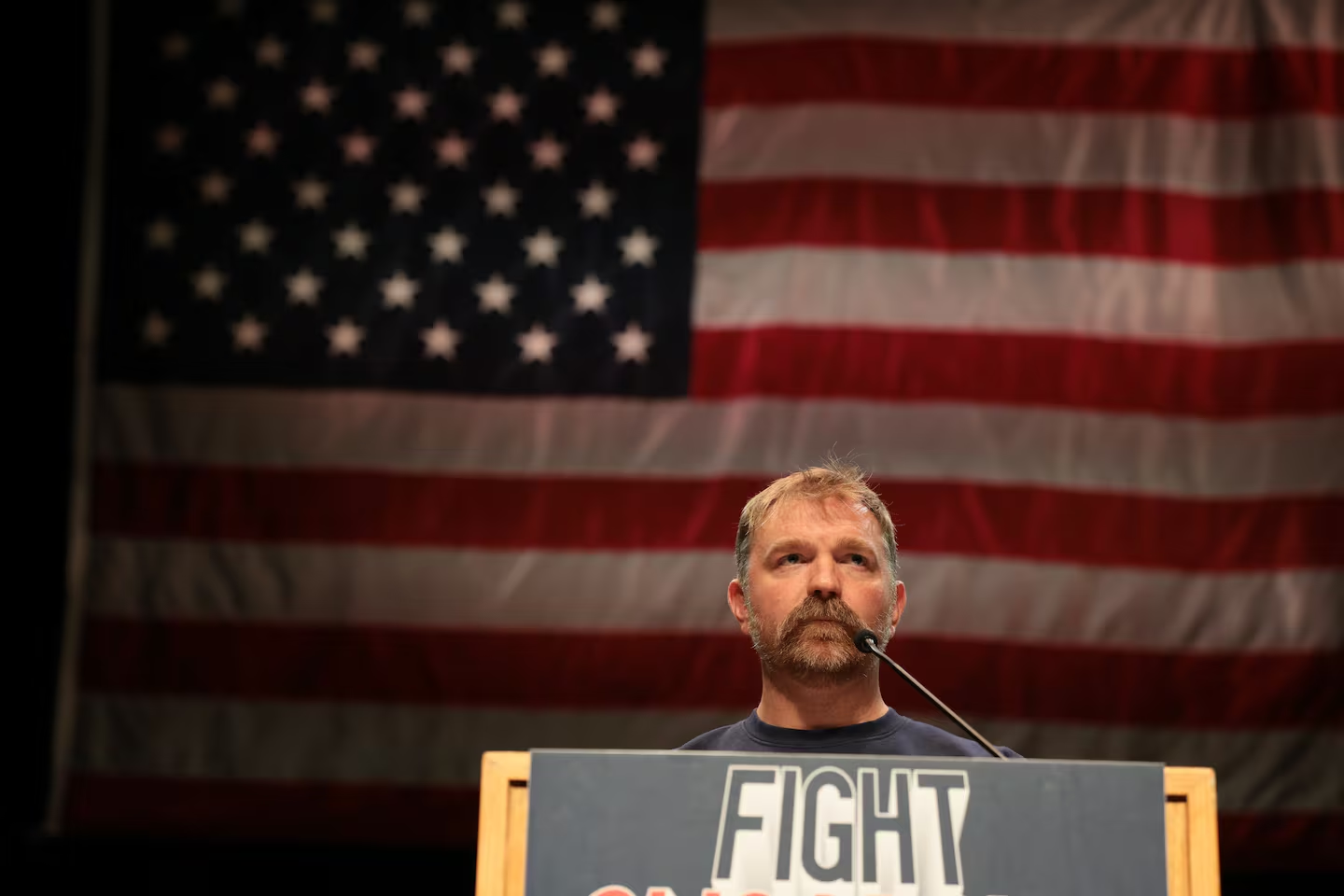
Graham Platner took on the Red Sox in a since-pulled ad. Then, came the political ‘Jiu Jitsu.’
Interested in political news delivered with urgency and voice, five days a week? You can sign up here for our new political newsletter, The Scrum, coming next month.
Read more Trump undergoes a physical exam at Walter Reed
When Graham Platner, the presumptive Democratic nominee for US Senate in Maine, looked to roast Boston Red Sox ownership during a Red Sox game with an advertisement that was slated to run on a network the team also owns, his campaign appeared to know the risks.
On Thursday, one day before the ad was scheduled to air, a consultant for Platnerreached out to Barstool Sports founder Dave Portnoy looking to set up an interview about the spot in which Platner alleged that private equity has been “stripping” the team “for parts.”
“An added wrinkle is that Fenway Sports Group owns NESN and the Sox — so there’s a world in which they don’t want to run it, but a fun problem to have,” the consultant wrote in an email to Portnoy, who subsequentlyposted the exchange online.
The prediction ended up being correct. NESN — of which Fenway Sports Group is its majority owner — took the ad down during the game against the Minnesota Twins, according to Platner. NESN later said the network cut the ad over an intellectual property violation. (John Henry, Fenway Sports Group’s principal owner, also owns The Boston Globe.)
But the ad ended up taking off online when Platner took to social media to cry foul, charging in a post on Saturday the ad was taken down midway through the game, before adding, with a bit of dramatic flair, “And then the Sox blew a 4-0 lead.”
While the ad may not have reached the baseball fans who tuned in to the cable network for the Sox’s sorry showing, it might still have achieved its ultimate goal, albeit with a cost: getting attention for Platner.
Not all of it good, however. Portnoy publicly blasted the campaign’s interview request, and repeatedly referred to the controversy surrounding his tattoo of a widely recognized Nazi symbol that Platner only recently had covered up.
Platner’s campaign did not directly respond to questions Tuesday, pointing instead to a previous statement reiterating his claim that private equity “is making everything in our lives worse.”
The campaign “might’ve been running it more as a news play,” said Mark Longabaugh, a partner at the media consulting firm Devine, Mulvey, Longabaugh.
Longabaugh pointed to the infamous Willie Horton campaign ad that ran during the 1988 presidential election, attacking then-Massachusetts governor and Democratic presidential nomineeMichael Dukakis as being soft on crime. Horton, a Black man who was convicted of murder and granted weekend furloughs under a state program that existed while Dukakis was governor, was convicted in 1987 of raping a woman after he fled during one such furlough.
The Horton ad “didn’t run very much,” Longabaugh said.“The whole impact of that ad was the explosive media coverage. It made national news.”
Michael Franz, a professor at Bowdoin College who co-wrote a book on political advertising in the US, said Platner’s ad appears designed to have that same “provocative goal.”
“And NESN seemed to take the bait on that,” he said.
It also provoked Portnoy, who, in the email exchange he posted online, responded to the campaign by saying he would “be happy to talk to [Platner] about that tattoo and him being a Nazi.”
Platner has said that when he got the skull and crossbones tattoo two decades ago, he wasn’t aware it has been associated with Nazism. He has since had the tattoo inked over.
Read more Trump’s self-indulgence deepens GOP fears in midterms
“What Portnoy did is Jiu Jitsu, flipping the ad to attack Platner,” said Tobe Berkovitz, a professor emeritus of advertising at Boston University.
Platner’s ad has earned him national attention, while also sparking questions about NESN’s decision to pull it.
Because NESN is a cable channel, the network has the right to decide which advertisements it runs on a given day, according to Franz. That differs from a broadcast network, which must broadcast bona fide campaign ads, per federal regulations.
Since the public owns the broadcast airwaves, there are equal time rules for candidates and their opponents and other regulations around disclosure and time allowed.
In short, broadcast stations have “a really, really difficult time” refusing to air an ad from a legally qualified candidate, said Travis Ridout, co-director of the Wesleyan Media Project, which studies and tracks political advertising, and author of “Political Advertising in the United States.”
”The rules as they apply to broadcast are pretty clear,” he said. “Rules as they apply to cable are less clear, and so that gives those cable stations a little more wiggle room.”
NESN didn’t respond to the Globe’s inquiries Tuesday, but said in a statement to The New York Times that the advertisement was removed because the content included “unauthorized use of third-party intellectual property and did not comply with NESN’s advertising standards.”
The 15-second clip Platner also posted to social media featured graphics of a baseball stadium that appears to be Fenway Park, mentions the Red Sox in a news headline, and includesmen in striped suits holding bats, but there was no clear branding on either the stadium or the uniforms.
“Private equity is destroying our favorite baseball team… buying up our homes, our sports and our lives,” Platner says, promising to “reverse the private equity curse.”
Intellectual property “not a clear cut area,” Longabaugh said. “There are some lawyers that will argue that some things are in the public domain, and if your imagery is in the public domain, it’s usable. Other lawyers take a more restrictive view.”
While NESN may be within its rights to pull the ad, the claim of copyright infringement is “bogus,” said Berkovitz.
“It’s hardly a reason to cancel an ad,” said Berkovitz, who has consulted on presidential, senatorial, congressional, and gubernatorial campaigns. Berkovitz said even so, the ad still garnered plenty of attention, thanks to the headlines around the cancellation and Platner’s own promotion of NESN’s decision.
“The saying goes that there is no such thing as bad press,” Berkovitzsaid. “This will be a great way to find out.”
Read more Supreme Court reverses ruling in immigration judges’ free speech lawsuit


Post Comment