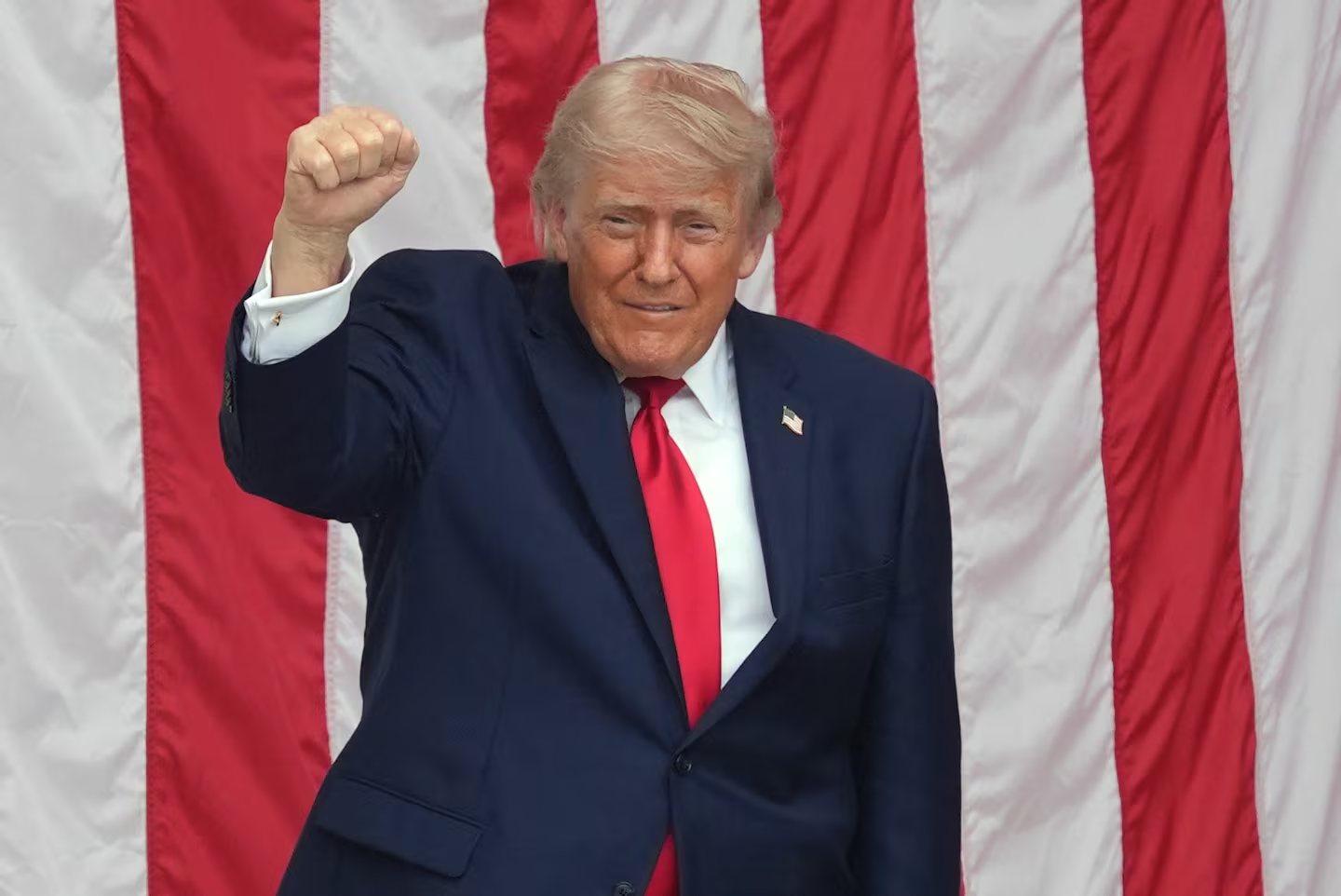
Trump’s self-indulgence deepens GOP fears in midterms
A little more than five months before the midterm elections, President Trump seems to be focused on virtually anything other than keeping Republican control of Congress.
Read more Supreme Court reverses ruling in immigration judges’ free speech lawsuit
He endorsed a MAGA challenger over Texas’ senior Republican senator, ignoring warnings that he could endanger the seat. He has boasted almost daily about his expensive and expansive new White House ballroom. He has minimized rising gas costs, waving off spiking prices at the pump as “peanuts” last week compared with what he is pursuing in Iran. And even as he engaged over the weekend in negotiations to end the Iran war that he began, Trump has made plain that he prioritizes his record abroad above domestic affordability, which he has dismissed repeatedly as a Democratic “hoax.”
For many, a new jaw-dropper came last week when Trump created a $1.8 billion fund to pay people who say they have been victims of “weaponization and lawfare,” including those who attacked the Capitol and law enforcement officers there, on Jan. 6, 2021.
Incensed Senate Republicans, many of whom lived through that day, returned home vexed by a president who appears set on pursuing his personal priorities before the November midterm elections, even if doing so undermines his own party. They angrily abandoned Washington on Thursday without funding the president’s immigration crackdown or the $1 billion he wants for his ballroom.
Republicans know that their party’s fate rests with the president, according to interviews with numerous officials in recent weeks. Yet they also know there is not much any of them can do to make him help them.
“The president was elected to juice the economy, to bring down inflation, to stop illegal immigration and to get away from woke culture,” said Whit Ayres, a Republican pollster. “If his highest goal were to maintain control of Congress, he would not be doing what he is doing.”
Ayres called the $1.776 billion fund — the figure is a reference to the nation’s 250th anniversary — “a whole new level of brazenness.” Sen. Thom Tillis, R-N.C., who is not seeking reelection, spoke out against it, calling it “stupid on stilts,” earning him a rebuke from Trump on social media Friday. The president called him “weak and ineffective” and a “Nitpicker.”
“We need Republicans to do well in November,” Tillis replied, “but the stupid stuff is killing our chances!”
Trump has long been a self-indulgent political leader who trusts his own instincts, even when that means veering off message. But, in his second term, he has surrounded himself with a senior team of loyalists who mostly acquiesce to his impulses. The institutional guardrails that once kept him in check are weakened or gone, with his Cabinet and Republicans largely proving pliant to his demands over the past 16 months.
Along the way, the president’s overall approval rating has slumped to an all-time low, leaving congressional Republicans alarmed at their fall prospects. A string of wins in GOP primaries — in which Trump helped oust those who have disagreed with him — appears to have emboldened him to remain focused on his pet projects, including attacking those he deems insufficiently loyal.
Unpopular presidents typically give lawmakers in difficult elections some leeway to distance themselves from the White House. Trump, though, has demanded that members of his party pull ever closer.
On Wednesday, the morning after the primary defeat of Rep. Thomas Massie of Kentucky, a top Republican critic, Trump singled out Rep. Brian Fitzpatrick of Pennsylvania, the only House Republican to survive in a district that Trump lost in 2016, 2020 and 2024.
“He likes voting against Trump,” Trump said in an unprompted warning shot. “You know what happens with that? It doesn’t work out well.”
Trump certainly brings some advantages, including a super political action committee with a $350 million war chest that allies are anxious for him to start spending. He has also shown an ability to get out the vote unlike anyone else, though the party has suffered in the last decade when he has not been on the ballot.
But even some of Trump’s Republican allies are growing frustrated by what they see as his Trump First agenda, though most are skittish of openly crossing a president with thin skin and a long memory, according to interviews with multiple Republican officials who spoke on condition of anonymity to avoid the president’s ire.
Read more Five races to watch in the Texas runoffs on Tuesday
Trump’s influence on those still seeking office was clear in the remarks of the Republican nominee to replace Tillis, Michael Whatley, whom Trump had once appointed to a post as chair of the Republican National Committee.
Without hesitation, Whatley lined up behind the president and his $1.8 billion fund.
“The Department of Justice under Joe Biden was completely weaponized,” Whatley told Fox News on Friday. “It went after the president. It went after his allies. That can absolutely never happen again.”
What Trump has been prioritizing of late has been more than even some loyal Republicans had bargained for.
He is the builder-in-chief, plowing ahead on construction of the new White House ballroom, painting the Lincoln Memorial Reflecting Pool on the National Mall, pressing forward with a triumphal arch to be built along the Potomac River and transforming a public golf course in Washington into a “championship-level course.”
He is the self-promoter-in-chief, with his administration putting his face inside passports, on currency, on banners outside federal buildings and on national park passes.
At the same time, Trump has been disdainful of discussions about affordability, even as polls show that the economy is the top concern for voters. In the recent New York Times/Siena poll, only 28% of respondents said that they approved of Trump’s handling of the cost of living. A remarkable 77% of crucial independent voters disapproved.
On Friday, the University of Michigan said that its consumer sentiment index, a survey that dates to 1952, had fallen to an all-time low. The average price of gas Sunday was about $4.52 per gallon, according to AAA, up from $3.19 a year ago.
When Trump has waded more directly into politics, it has been to the frustration of many Republicans, including his endorsement on Tuesday of Ken Paxton, the MAGA-aligned challenger to Sen. John Cornyn of Texas, whose nomination Republicans have said for months could put the Senate seat in play.
Republican officials have warned that they might have to spend $100 million to lift Paxton, who has been dragged down by past scandals, including his impeachment over corruption charges and a messy divorce from his wife. The primary runoff between Paxton and Cornyn is Tuesday.
The combination of Trump’s Paxton endorsement, the defeat of Sen. Bill Cassidy of Louisiana in a primary on May 16 and Trump’s insistence on the $1.8 billion fund to potentially benefit his allies have unusually ruptured his relationship with Senate Republicans.
“It’s his decision,” Sen. John Thune, the Republican majority leader, said at the Capitol last week after Trump backed Paxton, throwing up his hand in a gesture of exasperation.
But notably it was those headed to the exits speaking out the loudest.
Thune’s predecessor as leader, Sen. Mitch McConnell, R-Ky., even adopted the Democratic line of calling it a “slush fund to pay people who assault cops,” and Tillis scoffed at the idea of paying those who “assaulted” law enforcement.
Read more PWHL Players Association discloses salaries for the first time
“How absurd does that sound,” he said, “coming out of my mouth?”
This article originally appeared in The New York Times.


Post Comment