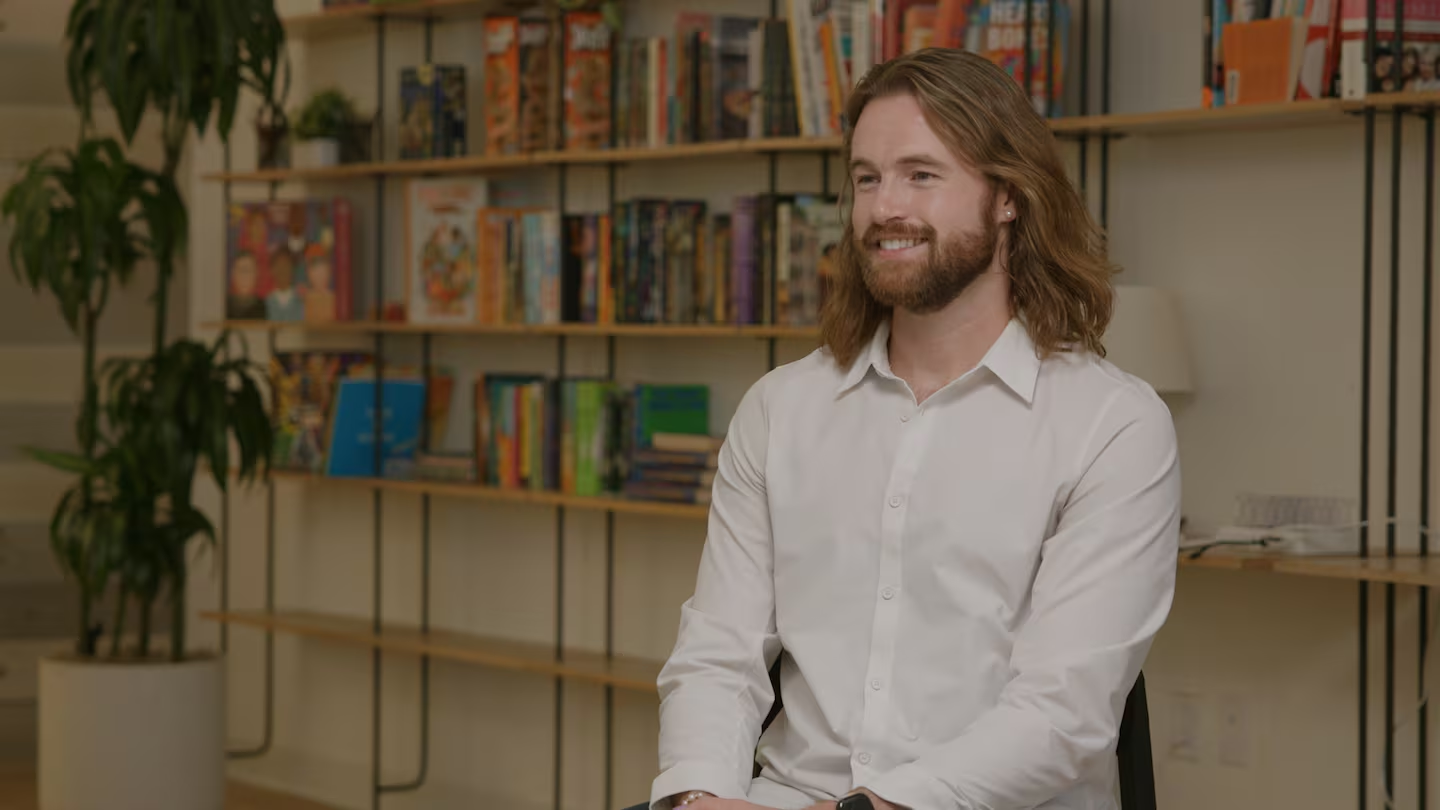
How Breaktime’s Connor Schoen hopes to tackle youth homelessness in Boston
Globe reporter Janelle Nanos sits down with leaders in the city’s business community to talk about their career paths, work and accomplishments, as well as their vision for Boston’s future.
In a five-story officebuilding in the heart of Downtown Crossing, Connor Schoen is bringing his lifelong vision to fruition. And his life hasn’t evenbeen all that long.
Read more Early cancer detection is key to survival, and for area hospitals it’s an increasing focus
Schoen, 27, is the cofounder and chief executive of Breaktime, a nonprofit serving homeless young adults. The organization is less than a decade old, but in 2024, it bought an underused office building on Franklin Street for $6.3 millionand converted it to a wraparound service center for clients.
Today, the building acts as a resource hub for these young adults, with washers and dryers for laundry, showers, and toiletries, a fully outfitted kitchen with prepared meals, and a closet where they can get clothes for job interviews. Over the past several months, since moving into the space, Schoen said Breaktime has more than doubled the young people it is able to serve.
In the latest episode of Bold Types, Schoen sat down with Globe business reporter Janelle Nanos to talk about his path into nonprofit leadership and what it means to run a public service organization in 2026. This interview was condensed and edited.
Tell me a little bit about Breaktime and what you do here.
This space is not just a building. It is really a reimagination of how systems should work for young people. This is our hub for solving young adult homelessness. And we really see this as a space where young adults experiencing housing insecurity in our city can come to not only access Breaktime’s resources, but also connect to all the other resources and services they need to thrive.
You got started in the nonprofit world when you yourself were a young person growing up in Westborough. How did you know this was your path?
My journey in public service started way back in eighth grade. I was a middle schooler, you know, just discovering myself, and was selected one day to be part of this organization called Project 351. It selects one eighth-grader from every city and town in Massachusetts to represent their town and lead service projects in their hometown. It completely changed my life because it empowered me to have the opportunity to see myself as a service leader.
While at college at Harvard, you continued that work at a homeless shelter. Now you work with young adults experiencing homelessness. How did that work influence what you’re doing now?
What I heard from young people over and over again is, ‘We need more support and figuring out how to start a career, how to build savings, how to build credit,’ all the skills that you need to know to be an adult that no one really teaches you, right? They don’t have that margin of error. They don’t have that safety net that I was afforded. And so I started to really get obsessed with this question of, how do we support young people in having the skills they need to be an adult?
All the young people at that shelter, just like me, were ambitious young people discovering their identities, discovering who they were. Right at that time, I was also going through my own process of coming out — roughly a third of the people I was working with also identify as LGBTQ+ — and some of them had been kicked out of their homes after coming out.
You started Breaktime as a nonprofit while still in college, with plans of opening a cafe where homeless youth could work. But you had to pivot due to the COVID-19 pandemic. Can you explain how that led to your current model?
We were able to quickly pivot to what our current model is: economic mobility. We were able to set up partnerships with other employers across the region, whereby Breaktime would hire a young person onto our payroll, but sort of staff them at other employers for a three-month job placement. The job site reimburses us for half the wages, really creating a subsidized opportunity to help a young person get into the workforce without us having to create the jobs from scratch. We set up job placement partnerships with all these different entities and started to scale.
You also work to help young people learn “soft skills” that help them navigate the workforce. Tell me more about why that’s important.
Growing up, my mom was a recruiter and she worked from home, and so I was sort of steeped in an environment where I was learning how to speak professionally and learning what a job interview looked like.
Most of the reasons why young people would lose a job after getting it were very preventable things that were rooted in soft skills. You showed up late. You didn’t communicate it effectively to your manager. You just did not show up with the right attitude for work. These are the real-world situations we navigate with our young people before starting the job.
I know there’s also a financial literacy component to your training, too. How does that work?
Breaktime pays you as an associate, $20 an hour to work at one of our employer partners, or to be placed in a credentialed educational program and treat that as your job for three months. We’re really creating this subsidized entry step into getting in the workforce.
After that, we offer three years of long-term case management wraparound support and financial support. And we actually pay our young people $100 a month for three years just for staying in touch with their case manager. Many of our young people, especially those that are parenting, they can’t afford to do anything that is not making money to support their child or themselves.
You recently spent $6.3 million to purchase your building. What has it meant for the young people you serve? And what does it mean for the future of downtown?
I was hearing repeatedly from our young people: “It feels like a full-time job to travel around the city all day to access the resources I need just to survive.” Downtown Boston is the transit heart of our state and of the city, a place we can all get to. And coincidentally, at that time, we had seen a significant drop in commercial real estate values.
We wanted a space that was equipped for what our young people need, a space that we could own so that we could control our own destiny and make decisions that put our own people first. When it comes to Breaktime’s Resource Hub, we want you to feel like you’re just steps away from whatever you need.
Read more Boston still runs on Dunkin’. But a new coffee culture is taking hold.
Olivia Yarvis of the Globe staff contributed to this report.


Post Comment