Boston still runs on Dunkin’. But a new coffee culture is taking hold.
Squished between a Dunkin’, a Starbucks, and a Caffè Nero, the bar Merai in Brookline is known for funky cocktails. But on a recent Sunday morning, customers packed inside for pour-over coffee served in stemlessglassware.
Read more LNG tanker exits Hormuz for India for first time since war began
Theywere lined up for a high-end pick-me-up from Newbery Street Coffee Roasters, a Thai coffee pop-up that has taken over Merai’s space on weekend mornings for the past year. Its owner, Pack Katisomsakul, sauntered from table to table like a sommelier discussing wine, fielding questions about his 12 roasts.
Katisomsakul’s passion for coffee is fairly new. In 2020, a friend back home in Thailand mailed him a bag of coffee beans. It tasted like cherry juice and pomegranates, and had low acidity, unlike the instant coffee he was used to.
“I never thought coffee could taste like that,” the 35-year-old said.
He’s been trying to convince Boston of the same ever since.
Katisomsakul is part of a new generation of immigrant and Asian American entrepreneurs rethinking the traditional cafe with scrappy pop-ups and temporary concepts inside bars, gyms, and galleries across Boston. Together, they’re trying to transform a city long defined by convenience coffee into one driven by craft and cultural identity, even as the economics of Boston are increasingly stacked against them.
Even as independent operators like Katisomsakul are multiplying, commercial rents are soaring and chains are quickly adapting to trends.
But while Boston may still run on Dunkin’, its next generation of coffee drinkers increasingly wants something else.
Nearing closing time at Newbery, there was hardly an empty seat. Customers sipped light roasts, lingering over them like tea. Next door, Dunkin’ didn’t have a single customer sitting inside.
“The coffee scene is changing,” said Katisomsakul. “The industry has been ready for it. Finally, so is Boston.”
Whether Boston’s new wave of independent operators can survive may be another question entirely.
“At this rate, it’s going to be a whole lot of major corporations versus an army of independents,” said Tam Le, owner of Càphê Collective, a new Vietnamese cafeattached to a Cambridge art gallery. “National brands are knocking on Boston’s doorsteps. Those players will always have the marketing budgets, consultants, and ability to quickly add new items.”
Boston’s current coffee boom didn’t emerge out of nowhere. The city’s most recent coffee movement arrived in the 2000s and early 2010s, when specialty shops such as George Howell Coffee, Thinking Cup, Pavement Coffeehouse, and Barismo introduced single-origin beans and meticulous pour-overs.
But while craft coffee has long flourished in other Northeast cities, these previous spurts struggled to penetrate beyond Boston’s affluent neighborhoods. Some locals viewed $8 pour-overs as elitist and for yuppie newcomers, while Dunkin’ remained synonymous with the city’s working-class identity.
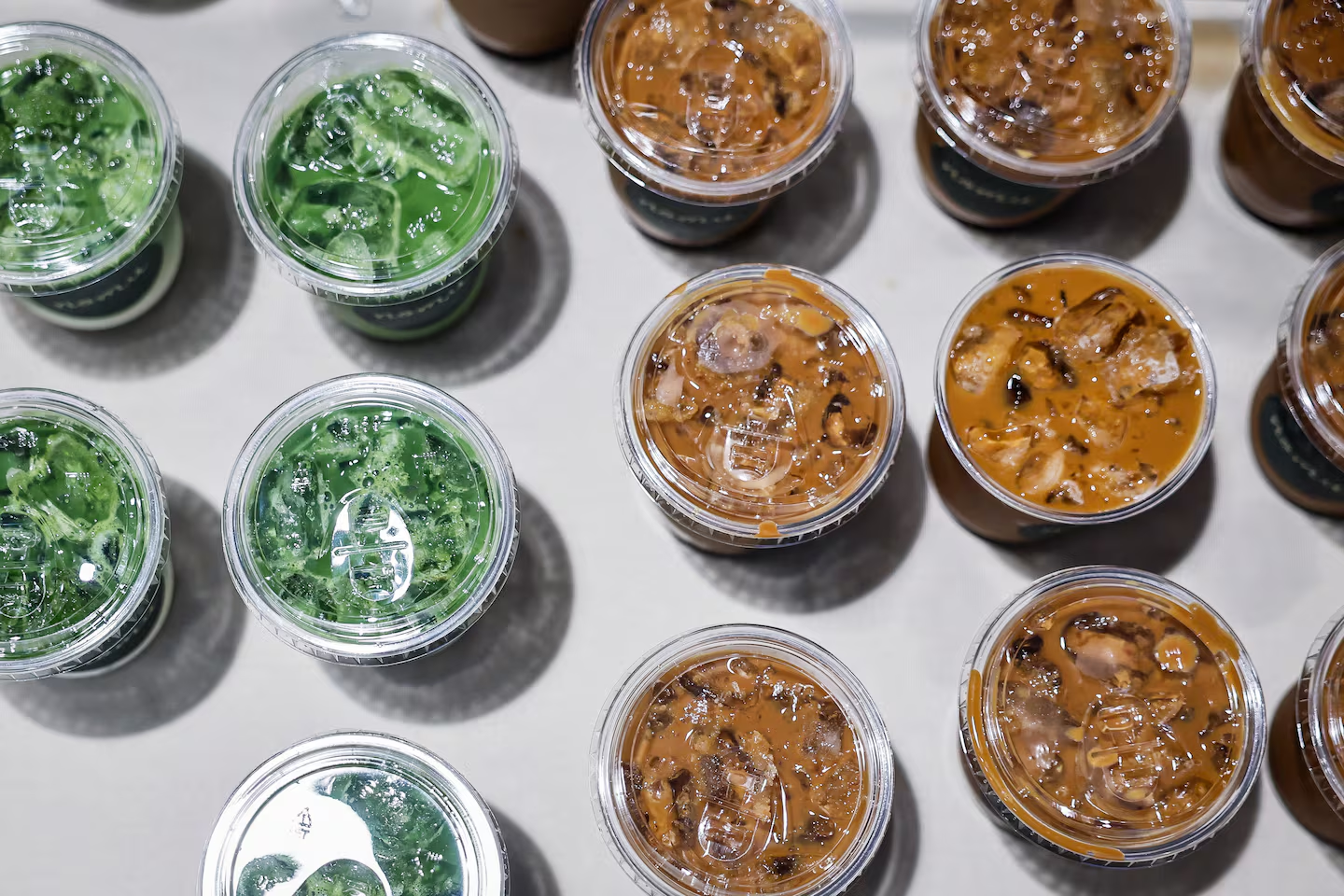
Today’s wave reflects a broader shift toward Thai beans, Vietnamese coffee, Japanese matcha, and social media-driven aesthetics where bright colors, white fluffy cold foam, and sweeter flavors reflect the tastes of a younger, more diverse Boston.
“Starbucks created coffee culture. But Generation Z and millennials don’t know anything other than coffee culture,” said Brian Warrener, director of the Center for Beverage Education & Innovation at Johnson & Wales University.
He said the region’s younger generation isn’t ashamed to swap the “difficult to consume” drinks such as bitter black coffee, hoppy IPAs, and dry wine with lots of tannins, for lighter, smoother, and sweeter choices.
“Starbucks and Dunkin’ now represent a commoditization of that culture. These generations expect more, and want everything to be an experience,” he said.
Americans are drinking more coffee, with 66 percent of adults reportedly drinking a cup every day. A recent Toast analysis found a bump in barista-crafted drinks that many people don’t have the skills or time to make at home. Latte orders rose 4 percent in 2025, while regular drip coffee sales fell by nearly the same amount.
Read more One killed in exchange of gunfire with Secret Service near White House
Many of the same trends driving Boston’s indie coffee boom are also being rapidly adopted by the chains the newcomers are taking on.
Blank Street Coffee, the venture capital-backed chain that’s expanding rapidly, has embraced Gen Z-focused matcha drinks, now accounting for 50 percent of its business.
Starbucks and Dunkin’, which is attempting to go public for a third time, still dominate the market. But both chains have recently closed underperforming stores, are reconsidering their retail footprint, and introduced trendier items, such as dirty soda and protein-rich drinks.
Many of Boston’s newest coffee businesses don’t have a permanent address as owners avoid costs of traditional storefronts. Even established operators said Boston is becoming increasingly difficult.
“The challenge is finding locations and rents that actually can sustain an independent business,” said Andy LoPilato, CEO of Pavement Coffeehouse, a local chain still owned by its founder.
For many entering Boston’s coffee scene, the math behind opening a traditional cafe no longer works.
“We looked at different places all over Boston and surrounding areas, and it all ranges from $6,000 at the lowest to $22,000 a month,” to rent a retail space, said Najma Mohamed, who cofounded Espresso East, a yellow coffee truck that’s parked along the Neponset Greenway Trail, behind a CrossFit in Dorchester. It’s not visible from the street, but customers line up for lattes with flavors like maple sea salt, pistachio, Dutch cookie, and even baklava.
The coffee truck also serves a fig matcha that uses tea from a Japanese farm the owners have traveled to. That’s a menu that would have been considered nearly unthinkable at an indie shop two decades ago when French vanilla, mocha, and hazelnut were largely the only flavors. Then, being an aficionado meant being a purist.
Mohamed and her sister, who were born in Kenya, started planning Espresso East in 2023, in their early 20s. They pulled personal loans, credit cards, and their savings to make it happen. Opening a truck dramatically lowered the barrier. The sisters now own the truck debt-free. A brick-and-mortar would have required a weightier upfront investment between rent, build-outs, utilities, permits, and staffing.
“We stopped doing the math as soon as we saw the monthly lease amount alone,” said Mohamed.
On a recent Saturday, Simon Ngo and Tiffany Zheng were in Kenmore Squareat The Handle Bar, vigorously whisking matcha powder to serve dozens of sweaty young peoplewho had just finished a workout class. This spring, they launched Nomu, a roaming pop-up cafeserving ceremonial-grade Uji matcha, after traveling to Japan and learning about the tea.
Sarah Chan, 25, snagged one. “It’s nice to get matcha from an Asian-owned business by people who know what they’re doing,” said Chan.
Young Bostonians “see rising prices and want to actually know where the ingredients are coming from,” said Ngo, an East Boston native whose parents immigrated from Vietnam. “If they’re paying seven to eight dollars for a drink, they want to know it’s one of the best things they’re going to find in Boston.”
Le, of Càphê Collective, also owns Lê Madeline in Quincy.Heremembers a moment after opening his first shop in Dorchester a decade ago where “typical blue collar Dunkin’ customers” first tried Vietnamese coffee.
“They were converted,” said Le.
Back at Merai in Brookline, Katisomsakul will soon take Newbery Street down a more traditional route, poised to open a storefront this summer. It’s a feat he never could have imagined — or afforded — when he started hosting pop-ups last year.
“I got my start selling coffee bags on a corner,” said Katisomsakul. “I think this is the beginning for coffee in Boston. I’m just a small piece of the movement.”
Read more Trump says he doesn’t want US to ‘rush’ into deal with Iran


Post Comment