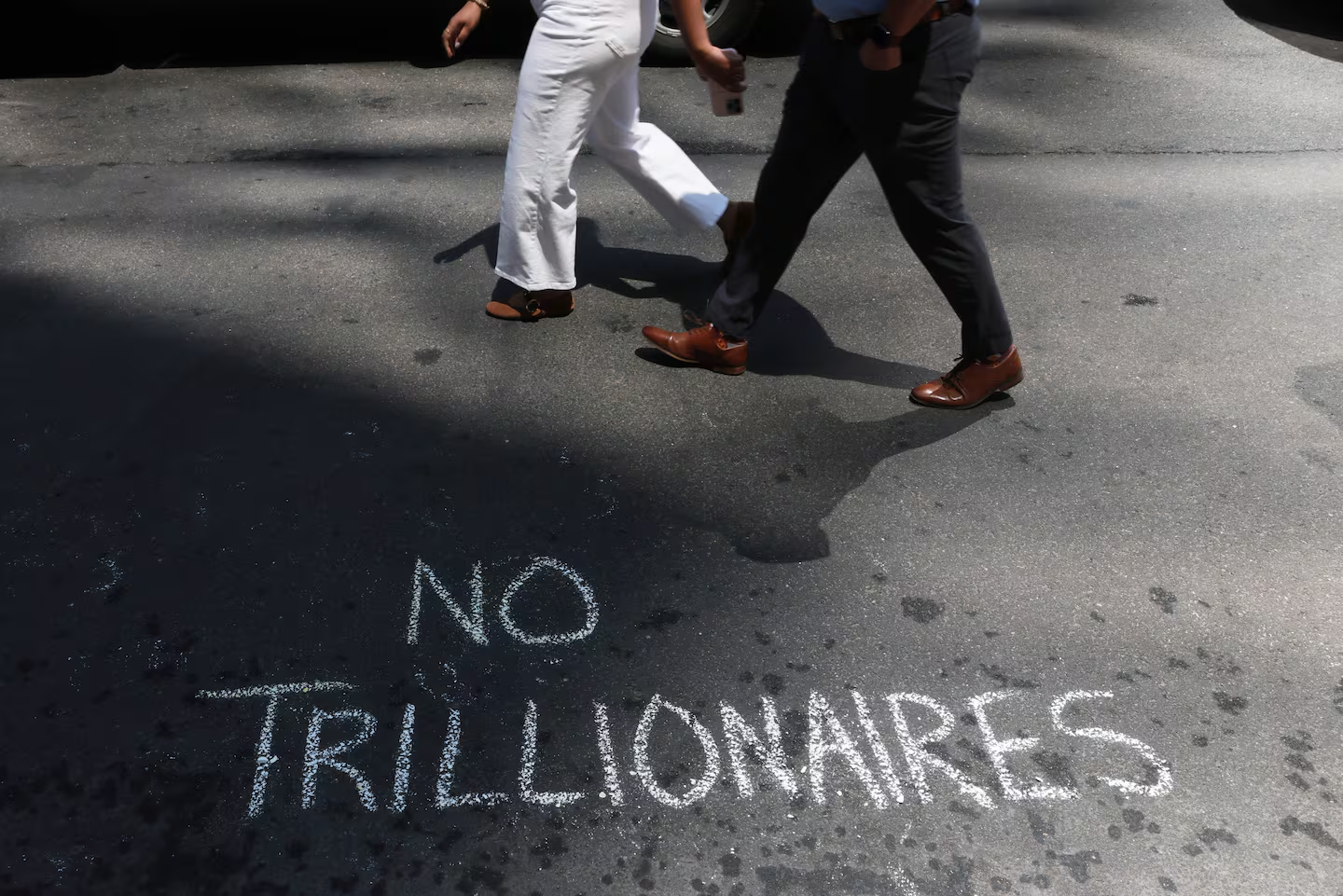
Elon Musk, trillionaire and avatar of the AI Gilded Age
This column is from Trendlines, my business newsletter that covers the forces shaping the economy in Boston and beyond. If you’d like to receive it via email on Mondays and Thursdays, sign up here.
Read more Fox to buy streaming pioneer Roku in a $22 billion deal
Dr. Jekyll and Mr. Musk were inescapable last week as SpaceX’s record-shattering initial public offering made Elon the world’s first trillionaire.
The good Musk is a visionary who has pulled off what many thought impossible — turning Tesla into the world’s most valuable car company and pushing the frontiers of the space economy with SpaceX’s rockets and internet satellites.
The bad Musk is a shameless troll who traffics in hate and conspiracy theories. He’s the man who spent $44 billion to buy Twitter (now X), gut it, and turn it into a virtual neo-Nazi night rally and a cesspool of AI-generated porn. And he’s a fan of authoritarian leaders here and abroad.
He is, in other words, the perfect avatar of our new Gilded Age: someone to idolize or despise, depending on how comfortable you are with an economy increasingly controlled by a cabal of right-leaning tech and media oligarchs.
The latest: Musk retains a loyal following on Wall Street and among individual investors even as his transformation from electric-vehicle prophet to edgelord made him a hugely divisive figure.
The demand for the SpaceX IPO was many times more than the $75 billion supply of shares, the largest amount ever raised in an IPO. The stock climbed 19 percent on its first day of trading Friday, yielding a $2.1 trillion market valuation.
The gain was a perfect IPO pop — big enough to please investors who got shares at the initial price, but not too big that SpaceX left a lot of money on the table.
Still, many individual investors were left out in the cold. They submitted IPO orders for $100 billion in shares, according to Bloomberg, but were set to receive roughly $15 billion.
This unmet demand should help support the stock in the coming days, as should SpaceX’s accelerated inclusion in the Nasdaq-100 and FTSE Russell indexes. The shares gained 5.5 percent in early Monday trading.
Faith vs. financials: The efficient market hypothesis says stock prices reflect all known facts. The AI boom, on the other hand, has been fueled by what investors hope will be true.
Read more Rhode Island is about to see a massive political reshuffling
SpaceX is unprofitable and is bleeding cash. Its shares trade at more than 100 times last year’s revenue, compared with about 23 times revenue for Nvidia, the most valuable company in the world.
To be a long-term investor in SpaceX is to believe that Musk will deliver a sci-fi future in which humans colonize Mars and orbiting data centers power artificial intelligence.
That faith is rooted largely in Tesla’s stock, which has risen an average of 44.5 percent a year since its 2010 IPO, three times the return of the Standard & Poor’s 500 index. It discounts Musk’s disastrous acquisition of Twitter and his Grok chatbot’s also-ran status in the AI world. Both were bailed out by SpaceX.
Historical echoes: Americans have long resented, if not outright loathed, the uber wealthy, even if we’re fascinated by how they make their fortunes.
John D. Rockefeller, the first man widely considered to be a billionaire, was reviled as a ruthless monopolist. His biggest source of wealth, Standard Oil Trust, led to the first US antitrust laws. Henry Clay Frick’s violent suppression of striking steel workers made him one of the country’s most hated industrialists.
Henry Ford was lauded as a business genius for his introduction of the moving assembly line and adoption of the $5 workday. Yet his legacy was irrevocably damaged by his personal beliefs.
Ford was a rabid antisemite, a hatred he promoted through his newspaper, The Dearborn Independent. The parallels with Musk are obvious though not exact.
Final thought: The wealth inequality that separated Gilded Age robber barons from the rest of the country pales in comparison to today’s oligarchy.
From The New York Times over the weekend:
At the height of the Gilded Age at the end of the 19th century, the richest handful of Americans had a net worth equivalent to about 3 percent of the country’s annual economic output, according to data compiled by the French economists Gabriel Zucman and Emmanuel Saez. Today, the fortunes of the same 0.00001 percent — about 20 individuals — make up roughly four times as large a share, equivalent to 12 percent of annual output.
No wonder anti-billionaire sentiment is roiling. Eight of the 10 richest people in the world founded tech companies. AI has made them unfathomably wealthy, while ordinary Americans worry that the technology will put them out of work. The anger, for some, is stoked by the many of the oligarch’s backing of President Trump. (See: Mark Zuckerberg and Larry Ellison attending the White House Ultimate Fighting Championship cage match on Sunday night.)
Read more Photos: Tartan Army marches on Fenway for Scottish Celebration Night
This is the US economy in mid-2026. Elon Musk is its poster boy.




Post Comment