Early cancer detection is key to survival, and for area hospitals it’s an increasing focus
If you could know your risk for developing cancer, would you want to?
Increasingly, people are saying yes. Personalized cancer screening and detection tests have surged in recent years, and accessing them is easier than ever.
As the impending divorce between longtime partners Dana-Farber Cancer Institute and Brigham and Women’s Hospital, now a part of the Mass General Brigham system, barrels toward finality, local hospitals are pouring time and resources into cancer care — and getting in on the early detection action.
In the last few years, MGB and Dana-Farber have each formed centers dedicated to finding and researching cancers at their earliest stages — when they’re easiest to treat. Doctors at the centers are coordinating not only which screenings patients would benefit from, but what, if anything, they should do with the results.
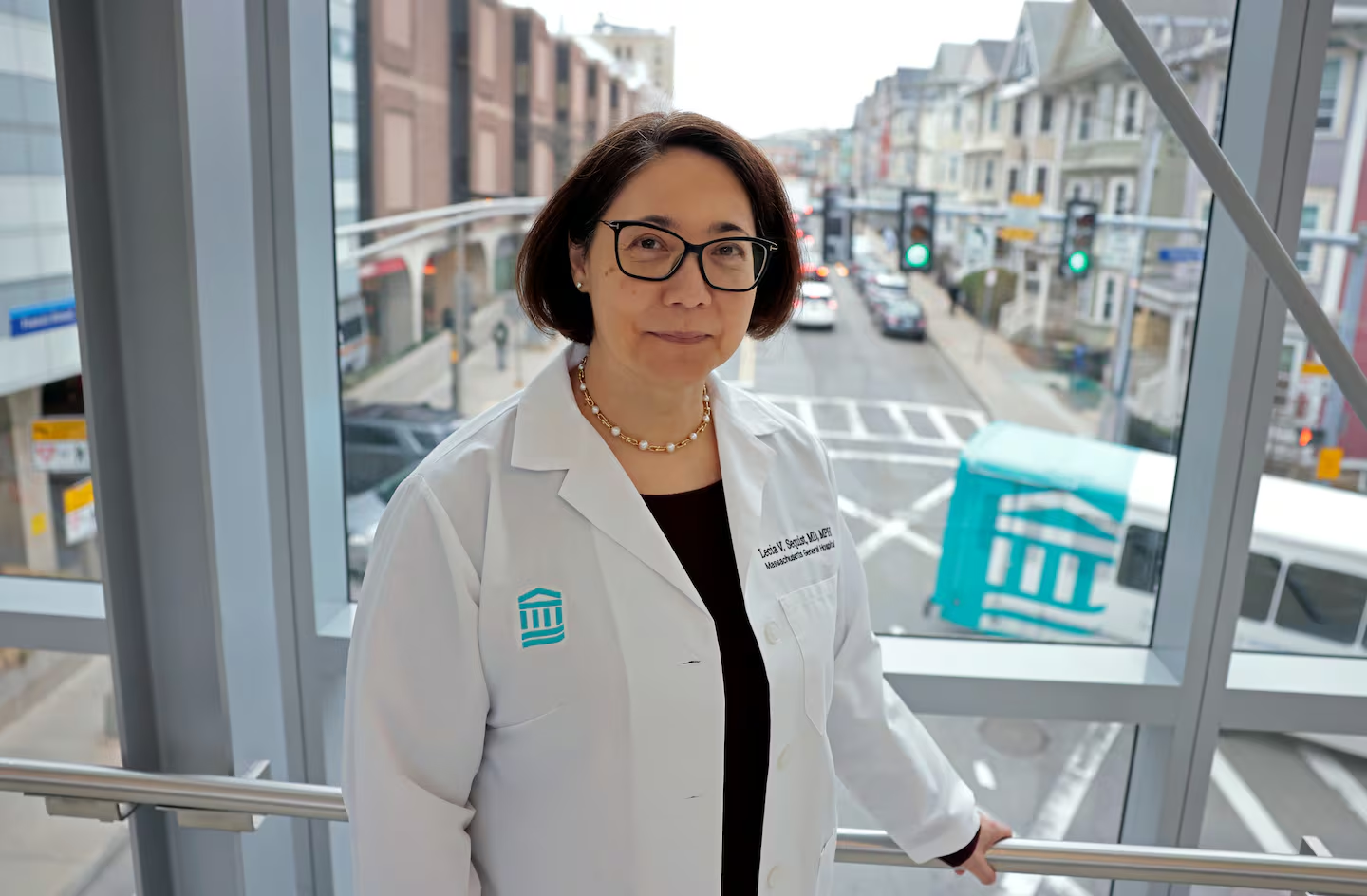
“There are multiple companies who are trying to develop blood-based screening tests where you could maybe screen for multiple cancers with a single test,” said Dr. Lecia Sequist, an oncologist and director of the MGB Cancer Institute Early Detection and Diagnostics Program.
But she said not all of those tests have been confirmed to be effective. “It’s really important for us to make sure to explain to patients what is still experimental and what has really been proven.”
Big picture, the statistics are clear: The earlier a case of cancer is found, the easier it is to treat and the better chance a patient has at survival.
More than 99 percent of women diagnosed with breast cancer at the earliest stage live for another five years or more, compared to only 33 percent of those diagnosed when the cancer at its most advanced stage, according to Centers for Disease Control and Prevention data. The five-year survival rate for colon cancer is more than 90 percent when the cancer is only in the colon. When it spreads, that survival rate drops to just 13 percent, the American Cancer Society reported.
But not everyone needs to be screened for cancer, and the tests themselves can cause harm. CT scans expose patients to small amounts of radiation, while being put under anesthesia for a colonoscopy carries its own risks. Sometimes, screenings identify growths that aren’t actually dangerous, leading to unnecessary and expensive procedures.
The question remains, however, just how much early detection is worthwhile, for both patients and payers. Cancer screening can be anxiety-inducing, uncomfortable, and costly.
John McDonough, a professor at the Harvard T.H. Chan School of Public Health, said it’s unclear whether early detection centers add value to patients or serve as revenue drivers for massive health systems — at the expense of insurers and patients alike. Like many aspects of health care, it’s probably a combination of both.
“It’s almost certainly going to be something that increases the total health care spending in the state,” McDonough said. “There’s no question about that.”
For hospitals that treat it, cancer is a money-making enterprise worthy of investment. MGB announced in 2025 that it plans to spend $400 million in the next four years augmenting its own cancer center.
Preventive screening and early detection options — ranging from blood panels that evaluate genetic mutations to full-body scans meant to detect tumors in their earliest stages — are multiplying. The market for multicancer early detection tests is expected to double in size to $2.86 billion by 2030, according San Francisco research and consulting firm Grand View Research.
In April, Dana-Farber received a $5 million gift dedicated to cancer prevention and early detection.
MGB, the state’s largest health system, just expanded its Early Detection and Diagnostics Program in Waltham to an additional space at Brigham and Women’s Hospital in Longwood.
“We want to take good care of patients actually diagnosed with cancer. We want to have the cutting-edge treatments and clinical trials available for people who have been diagnosed with cancer. But the journey actually starts way before that,” Sequist said.
Most patients who visit the early detection program at MGB are referred there by a primary care physician who noticed potentially troubling risk factors or physical symptoms. As recently as 10 years ago, doctors would only refer patients with obvious and striking medical histories, like several family members with cancer diagnoses, Sequist said. Now, patients can be seen with lesser family histories or because they work in fields with higher cancer risk, such as firefighting or the military.
Read more Boston still runs on Dunkin’. But a new coffee culture is taking hold.
That’s how 24-year-old Jessica Reilly found herself in the MGB’s Early Detection office in Waltham.
Reilly, who lives in New York City but grew up in Wayland, knows intimately what cancer can do to a person and their family. Despite being a nonsmoker, her mother died of lung cancer in 2007, when Reilly was in kindergarten. Then, about four years later, her dad was diagnosed with blood cancer. He has been in remission for more than a decade.
“I remember his fatigue the most,” Reilly said. “Chemo was really, really hard on his body. Physically seeing that, knowing that they experienced that, I would do anything not to go through that myself.”
Based on her family history, Reilly was a good candidate for genetic testing, but the results were still surprising. Reilly had a BRCA-1 gene mutation, making her much more likely to develop breast or ovarian cancer. It was a curveball, considering Reilly’s dad encouraged her to get genetic testing specifically to look for genetic mutations related to lung cancer.
Things moved quickly after that. Reilly met with doctors in New York to discuss her options. She doesn’t have cancer, but Reilly’s risks are so elevated — she had an 80 percent chance of having breast cancer in her lifetime — that she decided to undergo a preventive double mastectomy.
“I put myself in [my parents’] shoes,” said Reilly, who is recovering from her first of three surgeries. Her parents, she said, would have wanted to know that they were going to develop cancer, if it meant they could have prevented it or lessened its consequences.
“Anyone that has gone through cancer I think would make that decision” if they could, Reilly said.
Screening and diagnostic technology has improved rapidly in recent years, MGB’s Sequist said, especially with the introduction of blood tests that were initially developed to detect certain cancer markers in people who had already been diagnosed.
It can be difficult for patients to distinguish what each test or scan is for, Sequist said. Some tests measure someone’s future risk of cancer, while others measure whether that person has cancer at the moment of the test. Sequist’s team often helps patients parse through which options make sense, and which ones would be a waste of money.
“I think these technological advances have really put it more into the public’s mind,” Sequist said. “Along with increasing sensational stories about young people getting cancer who may be too young for traditional screening.”
Despite increased attention on the disease in younger populations, cancer mortality in people under 50 decreased for every cancer other than colorectal cancer, according to a recent study by the American Cancer Society.
Cancer mortality has improved because of a number of factors, including better treatment and more prolific screening for common cancers like breast and lung.
Testing still has a long way to go, said Dr. Betsy O’Donnell, co-director of Dana-Farber’s Centers for Early Detection and Interception.
Figuring out which tests work best for which cancers is an ongoing process that requires the same caution and care as evaluating different cancer treatments, O’Donnell said. Early detection programs can play an instrumental role in that process.
“We’re holding the BlackBerry and iPhone 1 in our hands right now, and the BlackBerry may be gone in the next couple years, and we’ll be onto the iPhone 18,” said O’Donnell. “I’m willing to be a part of interactive science to make it better, because I think there’s such a huge unmet need here.”
Read more LNG tanker exits Hormuz for India for first time since war began




Post Comment