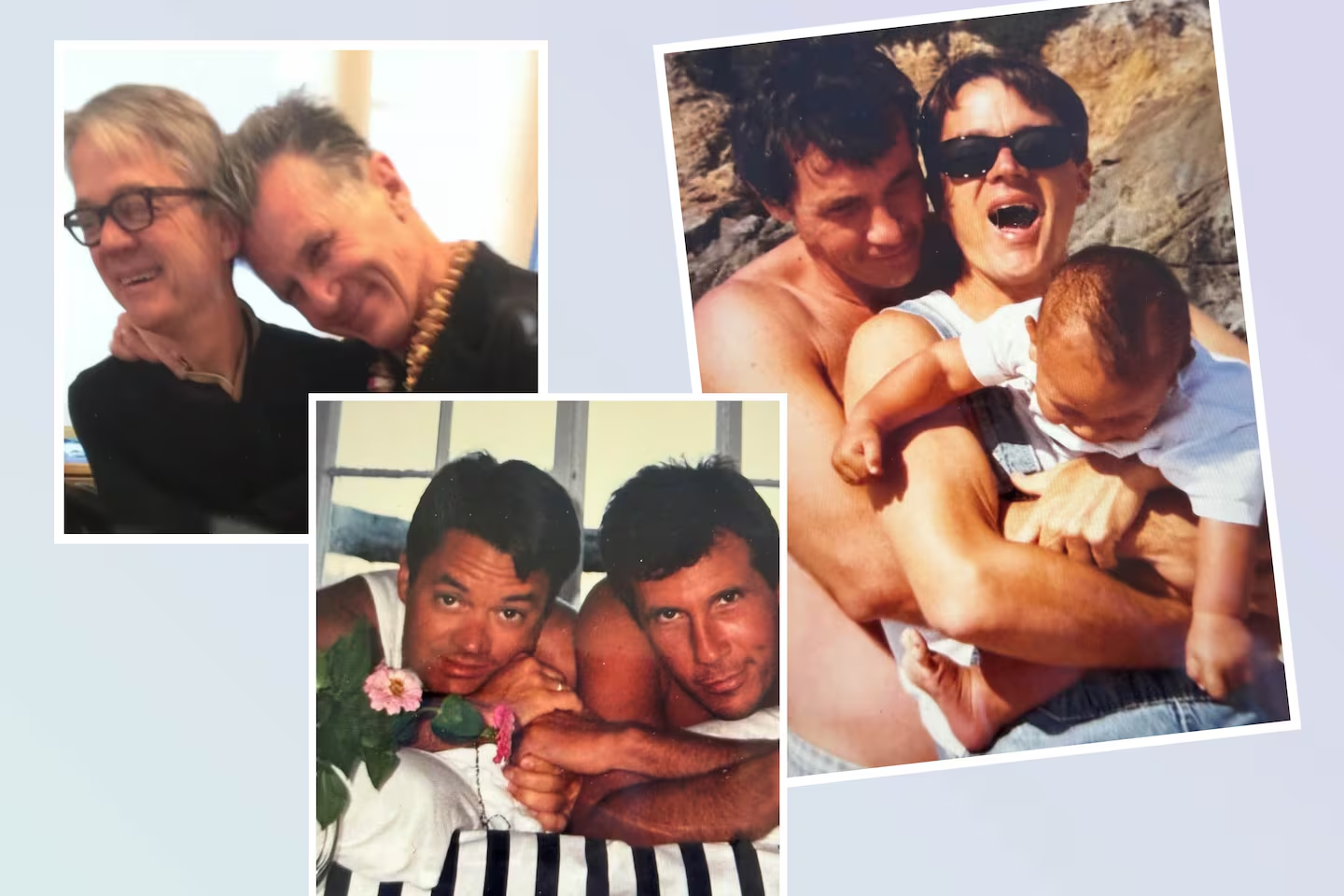
‘The Hours’ author Michael Cunningham on finding the love of his life
Thomas and Joseph were men of indeterminate age, though they were both well into their 70s, and possibly beyond.
Read more On the big screen, movies have rarely been too kind to their little TV sibling
They often had people, many of us young men, over for brunch, or cocktails, or dinner. They never went out. Their house, on its rise overlooking Provincetown Harbor on Cape Cod, smelled of furniture polish and a clean, wintery residue — hints of snow and ice — that the summers never quite scoured away. The rooms were not dark, but they were kept in a perpetual shade, arbored, dimmed.
In the living room, an ancient upright piano sat piled with haybale-sized stacks of yellowed sheet music; the bookshelves, crammed to capacity, overflowed into piles of books on the floor. Thomas and Joseph had lived there for almost 50 years.
I was one of several young men who were invited regularly to their brunches and dinners. I was always received with a frivolous intimacy that implied decades of friendship (Oh, my dear, get in here right this second), even though I’d known them for less than a year and, like most young people who passed through Provincetown, would be leaving soon.
I always arrived with a bottle of the least-bad wine I could afford, wearing a paisley thrift-store tuxedo jacket over a T-shirt and jeans, the closest I had to formal wear. Thomas and Joseph (never Tom, never Joe) dressed like Connecticut housewives: oversized white shirts and slacks at dinner, sweat pants and polo shirts at brunch. They inhabited their own private hair-reality: Joseph dyed his hair a color I can only call chipmunk; Thomas felt that a comb-over consisting of roughly 30 strands was preferable to baldness.
They were gracious hosts, and fantastic cooks. Food was their primary point of contact with the ongoing world. They’d become experts at Northern Italian and Basque cooking. There was always a moment of disconnect when Thomas, the dominant force in the kitchen, emerged, comb-over in place, from a kitchen unaltered since the 1960s, beaming proudly and carrying plates of brasato al Barolo or cod basquaise that would not have been surprising in a Michelin-starred restaurant.
Thomas and Joseph, having dispatched one or two of the requisite stories (cocktails with Tennessee Williams, the night Judy Garland belted out a few at the Atlantic House), were not given to further reminiscences. They wanted to know about me, particularly about my erotic adventures. Which must sound exploitative and salacious. Which it probably was, but Thomas and Joseph’s affect was more that of grandmothers than horny old men.
I’d offer whatever tales I could muster. I exaggerated, sometimes to the point of fiction, though I always based them, however loosely, on actual experiences, out of a nagging sense of obligation to the relative truth.
In the stories I emerged as an Alice in Wonderland figure — my overall tone could be called curiouser and curiouser. Among the tales I remember telling, over the course of a year, are: That’s right, he was a high school teacher with a dungeon in his basement, derived from a night on which I declined to be handcuffed to a bed. He was the first drag queen in history who looked even better as a girl, based on a man who, on the night I met him, wore eyeliner and a pink wig.
Thomas’s and Joseph’s responses were so grandmotherlike — Oh my and I’m sorry to say we didn’t do things like that in our day — that I remain unembarrassed still about evenings spent telling hyperbolized stories about myself, chronicles of a plucky, charming boy who always got lucky, who was never ignored by a handsome stranger, who’d never gotten halfway out of a bar with a boy who suddenly changed his mind, who’d never struck out and gone home wondering if those Chinese leftovers in the refrigerator were still OK to eat.
A confession: I enjoyed being the person I was to Thomas and Joseph. It mattered that they were amused but never appalled. It was a chance for me to be shameless about a life considered, not only by grandmothers but by the majority of the population at large, to be shameful. If I conjured, and briefly inhabited, a lustier version of myself, I did it to hold their interest. … And I did it to re-create myself, for myself, as a romantic scoundrel, the twentysomething I’d once hoped to become. I got to be that person approximately one night a week, with Thomas and Joseph. I left that version of myself at their house, along with the sheet music and the books, the crackled mirror in the entryway, and the collection of miniature globes they’d amassed during their own youth.
After my writing residency in Provincetown ended, I moved to New York. I’d learned that I didn’t do well in small towns, however calming the mournful notes of a foghorn on the breakwater. I was ready to meet artists and philosophers in bars and coffeehouses, drag queens, political activists, movie stars, whomever.
It was while I was living downtown that I met Ken Corbett, known to his friends as Kenny.
Our meeting was so coincidental as to have led me to wonder how many lifelong relationships we all might miss because we went to the laundromat an hour too late, because we left the party 20 minutes too early.
I’d gone to Provincetown for the weekend. I was glad to go back during the summers, when the town came to life again. I had a few friends who lived in town, Thomas and Joseph among them. They always invited me to their dinners, which were precisely as they had always been, in the house so unaltered I could have sworn that the wooden spoon on the kitchen countertop had been there, in that exact position, when I was last there.
Provincetown became my escape from New York. Ironically, in Provincetown, during the summers, I met more intellectuals, drag queens, political activists, and movie stars than I had in New York.
My friend David had opened a small art gallery on the east end of Commercial Street. The galleries of Provincetown tended almost exclusively to seascapes, floral still lifes involving flowers that did not grow in or anywhere near Provincetown, and portraits of fishing boats. Amongst all that, David showed drawings of malformed mutants from the 23rd century, all-black paintings encrusted with black sequins, and abstracts in violent, clashing colors.
Whenever I was in town, I’d sit with David in his gallery for an hour or two. As tourists approached, David and I would bet on how long it would take them to get a quick look at the art, and flee.
“A minute.”
“I’d say more like 30 seconds.”
One of us was always right, until the day we saw a lithe, trimly handsome man in his early 30s coming toward the gallery.
David said, “Last summer, this guy bought something.”
“Somebody bought something?”
It was Kenny. We talked for almost an hour. He admired, but did not purchase, a drawing of a 23rd-century mutant. Like me, he was visiting Provincetown from New York. He was smart and funny. He was cute, boyish, animated. He was possibly David’s only customer, ever.
We had a good time together. We were effortlessly interested in each other.
When Kenny and I met, I was dating someone back in New York. In Provincetown, my romance sensors were turned off. I said goodbye to Kenny and didn’t think much more about him, beyond the fact that, although I had a boyfriend, some entity in the universe seemed to keep producing attractive, intelligent gay men I couldn’t date.
And then, when I got back to New York, the boy and I broke up, over dinner in an Italian restaurant. It was notably undramatic.
Him: “It sounds like P-Town was a lot of fun.”
Me: “Yeah, I’m sorry you couldn’t come. It’s such a buzz kill, you having a job.”
Him: “It’s the busy season.”
Me: “I know.”
It was an ordinary conversation. That, I suppose, was the problem. Three months in, and it was as if we’d just been introduced.
I experienced a mini epiphany that night. The boy in question was attractive, he was nice enough, but I wasn’t urgently interested in him, or he in me. An aperture opened. I walked through it. During a pause in the conversation:
Read more Game 104: Blue Jays at Red Sox lineups and notes
Me: “This isn’t really working out, is it?”
Him: “I guess maybe it isn’t, really.”
We agreed that we’d skip dessert. After we’d left the restaurant, after we’d said a brief, not unfriendly goodbye, I resisted, if only barely, the urge to turn around and run after him.
“You’re great. I’m such a fool. It’s just my fear of commitment. I sabotage things when I start to have feelings.”
It would, at best, be in the vicinity of the truth. If I held to it, it might turn into the truth.
I thought I’d call him when I got home. I decided I’d call him in the morning.
I didn’t call him in the morning. I never saw him again.
In the morning, I called Kenny instead.
When I was an undergraduate, a professor told me that in fiction, if you depict people falling in love, you need a falling-in-love moment, which could be anything from a shared devotion to an obscure musician to catching a glimpse of the other at a moment when they don’t realize they’re being watched — the sensation of witnessing them in their privacy. What the professor meant was, apply that weariest of maxims — show, don’t tell — not only to the dance hall chandelier or a lightning storm in a desert but to an experience as ineffable as the inception of love.
Years ago, Kenny and I got caught in a storm. It was mid-April, one of the New York City days that was, technically, early spring but was, in reality, locked into a seemingly endless condition of late winter, with a low steel-colored sky and scraps of sooty snow still plastered to the curbs.
We were blocks from our apartment when a rainstorm blew in, as suddenly as if somebody somewhere had hastily cranked the rain dial from zero to high.
By the time we reached Washington Square Park, which was shallowly flooded with opaque brown water (we didn’t dwell on what must have been in the water), we couldn’t have gotten any wetter. Drapes of rain blew noisily across the plaza and, for a touch of the surreal, the fountain in the center was gushing, about 50 feet high, so that Kenny and I were passing through a sequestered world of water, where it flowed both down and up.
I don’t remember which of us held out his arms for a dance. It probably matters that it doesn’t matter. What I do remember is the conviction that each of us had had the same idea at the same moment. We waltzed, I awkward but ardent, Kenny suavely practiced, as we were battered by rain.
That was not, however, our falling-in-love moment. It was too obvious. It contained too much of Here we are, dancing in the rain.
When we got home, we fell into spasms of laughter, the laughter born of relief after you’ve survived catastrophes both major and minor, intensified, for us, by the way in which our minuscule apartment, with its air shaft views and its bathtub in the kitchen, felt, for a few minutes, like a sanctuary, a demonstration of our good fortune, which was not the impression it made on a more regular basis.
The apartment was ludicrously inexpensive by New York City standards, because it was a sixth-floor walk-up, because its windows opened onto an air shaft, and because it was only slightly larger than the interior of a 1960s Oldsmobile. It was, for all its limitations, a lucky break for us. Kenny hadn’t yet finished graduate school. I was living on what little I made from freelance journalism.
On that stormy day, we peeled off our soaked clothes and got towels from our only shelf. We were joyfully content. We had been delivered into a place that, however generally inadequate, was warm and dry.
Kenny toweled my chest. I had him turn around so I could towel his back.
I thought suddenly of an old black-and-white photo I’d seen — Kenny at the age of 4, freshly emerged from a bath. His mother was drying him off with a towel. The photo had been taken in the glare of a flashbulb, which gave Kenny’s mother a strangely glamorous black-lipped smile, a black pageboy, and skin as pale as a forest nymph’s. In the photo, Kenny is laughing with the pure delight particular to young children. There he is, with his mother, wrapped in a warm, dry towel in the bathroom of a tidy Midwestern house that will do, for his purposes, as the world itself.
As I dried Kenny’s back, with its constellation of moles on the right-hand shoulder blade, which I call his personal Pleiades, I fell into a wormhole.
I was in the present, in our apartment, and in the past, standing behind Kenny’s father when he snapped the shutter, so simultaneously that the difference between past and present was rendered negligible. I entered both presents, one of which was occurring decades earlier. In the house in Illinois, I whispered to Kenny, I’m here, I’m waiting, you’ll be as loved in the future as you are right now.
It ended in a moment. I didn’t see at the time, but I see now: that was when I crossed the love line. That was when I first understood that, whatever awaited Kenny and me, he could never again become unimportant.
Thomas and Joseph, my friends from Cape Cod, died decades ago, within six months of each other. I wrote notes for a short story about them, but when I’d finished the first draft, it struck me as a violation of our shared privacy. I was protecting them, and myself. I wouldn’t have rendered them, not entirely, as the clever, cultured roués they’d have preferred to be.
Thomas and Joseph lived so long, contentedly and companionably, in a snug house with a garden and a view, which suited them, but which, when they were younger, had meant choosing between that and more public lives, in which they’d have posed as aging bachelors or, had they been less discreet, would have risked their lives if they went out together after dark. There was no way of knowing whether they’d aspired to their days and nights of gardening, reading, and throwing intimate little dinner parties for young men, or whether they’d adapted to the less onerous of their options. The following is a draft of a story I didn’t publish. Thomas and Joseph’s ashes were strewn over their garden almost 50 years ago. I’m still alive, but I barely resemble the boy they knew, who arrived in a ratty tuxedo jacket, ready to tell them all manner of sexy stories that could just as well have been true.
Two elderly men have been living together for decades, in a shingled house on a hilltop from which they can see the tops of a birch forest and, beyond the forest, the shimmer of the Atlantic. They’re as married to their routines as they are to each other: the morning eggs and toast, the walk in the garden, the afternoon nap, the preparation of elaborate dinners (they’ve agreed never to descend to the convenient or the microwavable). Each is always searching out new recipes to make for the other. Reading and cooking are the substance of their days. In sleep, one always slings his arm over the chest of the other.
As it turns out, one of them died a while ago, and the other has stayed, to keep the ghost of his loved one company. He holds the other’s hand consolingly, assures him that he’s not alone.
We come to understand, though, that they’re both dead. Each believes himself to be alive, and attending to the other. One of the dead men drapes a crocheted blanket over the other, who’s fallen asleep on the couch after dinner. The other dead man keeps a small bunch of wildflowers in a drinking glass on the bedside table.
Eventually, they’ll begin to fade, though each will think it’s happening only to the other. For reasons they can’t explain, neither of them mentions it. It seems somehow indiscreet, even unkind. Each of them knows that their time together has always been limited. Each of them dreads the prospect of a life alone, here in the house. What will he do when he wakes up alone?
They both fade away during an afternoon nap. Each of them knows that the other is about to vanish. Neither of them speaks, though they do take each other’s hands.
Michael Cunningham is the Pulitzer Prize-winning author of The Hours and a professor of creative writing at Yale University. This excerpt is adapted from his new book, Unsayable. Copyright © 2026 by Mare Vaporum Corp. Published on July 21, 2026, by Random House, an imprint and division of Penguin Random House LLC. All rights reserved.
Read more How’s Christopher Nolan’s adaptation of the ‘The Odyssey’? We asked classics scholars.
Send comments to [email protected].





Post Comment