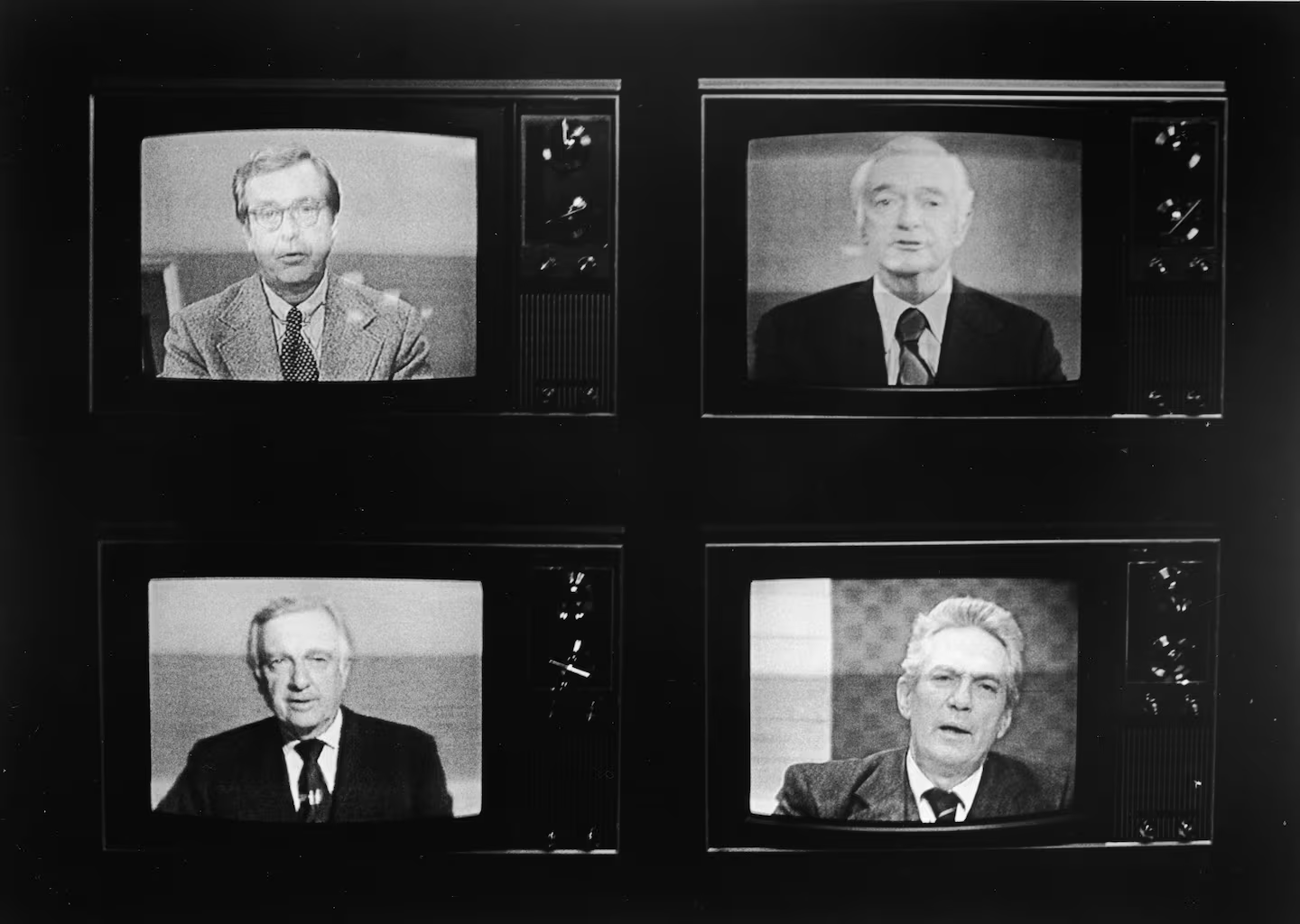
On the big screen, movies have rarely been too kind to their little TV sibling
The movies once viewed television as an existential threat, and it’s not hard to see why. Suddenly, here was this beguiling new box that provided entertainment in the comfort of the living room. In 1950, nine percent of American homes had a TV. By 1960, that figure had ballooned to 90 percent. The bigger, older sibling responded with 3-D, widescreen formats, and other technologies that offered up an implicit jibe: “Oh yeah? Bet you can’t do this.”
Read more Game 104: Blue Jays at Red Sox lineups and notes
The relationship is nowhere near as contentious today, when creatives walk through a perpetually revolving door between big screen and small, and you can stream almost any movie you want at the touch of a keyboard. But the movies have long offered a jaundiced take on TV, especially in its depictions of television news and its discontents.
This contentious relationship will be the subject of a screening series, TV Goes to the Movies, running for five Wednesdays in August and September at the Brattle Theatre. (I helped curate the series and will introduce most of the screenings and lead a discussion of “Network” on Aug. 5,) The movies run the gamut from comedy (“Anchorman: The Legend of Ron Burgundy”) to horror (“The Howling”), from the 1950s (“A Face in the Crowd”) to the 2010s (“Nightcrawler”). They take different routes to arrive at a similar conclusion: TV newsrooms are often vipers’ nests of egomaniacs and dubious ethics, where the quest for the truth queasily coexists with the imperative of high ratings.
But not always. Take “Good Night, and Good Luck” (2005, directed by George Clooney). In telling the story of how Edward R. Murrow (David Strathairn) and his CBS News team took on Sen. Joseph McCarthy’s communist witch hunt, “Good Night,” which was also adapted into a 2025 Broadway play, dramatizes TV news’ unique ability to speak truth to power for the benefit of millions. It also shows how TV journalists have often battled with their corporate overlords — in this case CBS chief executive William S. Paley ( a marvelously foreboding Frank Langella) — who have financial and political motivation to toe the line.
If that dynamic brings to mind current doings at CBS news under editor-in-chief Bari Weiss, another film in the TV Goes to the Movies series gets even closer. “The Insider” (1999, directed by Michael Mann), starring Al Pacino as “60 Minutes” producer Lowell Bergman and Russell Crowe as Big Tobacco whistleblower Jeffrey Wigand, examines the sacred bond between journalist and source, and the perils of putting corporate interests ahead of reporting the news. Here CBS corporate gets cold feet over taking on the tobacco industry, especially as the network plans a $5.4 billion merger with Westinghouse Electric Corporation. This should sound familiar.
“The Insider,” one of the best movies of its era, allows you to celebrate the ground troops of TV news even as you decry the corporate compromise. It also gives cause to mourn how far “60 Minutes” has fallen.
Read more How’s Christopher Nolan’s adaptation of the ‘The Odyssey’? We asked classics scholars.
If that all sounds rather serious, have no fear. OK, you can have a little fear, especially if you come out to watch “The Howling” (1981, directed by Joe Dante). Dee Wallace plays a TV newswoman who takes refuge at a secluded retreat after a close call with a serial killer. It seems the place might be, could be, the headquarters of a werewolf cult. Dante (“Gremlins,” “The ‘Burbs”) never has his tongue far from his cheek, so “The Howling” has some laughs to go with the shudders. But not as many as “Anchorman” (2004, directed by Adam McKay), the Will Ferrell local news send-up that doesn’t get enough credit for being strange as well as silly. Stay classy, Boston. (If you’re an “Anchorman” fan, consider checking out Saul Austerlitz’s book “Kind of a Big Deal: How Anchorman Stayed Classy and Became the Most Iconic Comedy of the Twenty-First Century.”)
And if you prefer the kind of laughter that gets stuck in your throat on the way out, there’s always the king of all TV news movies, which is celebrating its 50th anniversary this year. It’s remarkable how much of the subsequent TV landscape “Network” (1976, directed by Sidney Lumet) predicted. There’s the “If it bleeds, it leads” philosophy that reached its apotheosis in “Nightcrawler” (2014, directed by Dan Gilroy), but also the convergence of news with the cheap thrills of reality TV (“The Mao Tse-Tung Hour” is just one of the movie’s delicious concoctions), and the emphasis on personality — in this case the stark-raving-mad Howard Beale, played by Oscar winner Peter Finch — over substance. “Network” foresaw the day when rage would become one of TV’s most profitable commodities. It also happens to be wildly, at times preposterously, entertaining, packed with big performances — Faye Dunaway and Beatrice Straight also won Oscars; William Holden and Robert Duvall were rarely better — and some of satire maestro Paddy Chayefsky’s most feverish writing.
Today television gets to return the favor, with series including “The Studio,” “The Franchise,” and “The Comeback” picking apart the modern movie industry with merciless abandon. But the movies, still the big brother to the small screen, got a considerable head start in this bickering relationship. The results are up on the screen for all to see.
The Brattle Theatre presents TV Goes to the Movies. Wednesdays from Aug. 5 to Sept. 2. 40 Brattle Street, Cambridge. For tickets and more information, visit brattlefilm.org.
Read more Chris Affleck, mother of actors Ben and Casey Affleck, dies at 83




Post Comment