How’s Christopher Nolan’s adaptation of the ‘The Odyssey’? We asked classics scholars.
Adapting Homer’s epic poem “The Odyssey” is no simple filmmaking task. Condensing a massive text with bags of wind, Cyclopes, and lots of divine intervention into an afternoon at the cinema is an ambitious undertaking.
Read more Chris Affleck, mother of actors Ben and Casey Affleck, dies at 83
Still, many filmmakers have tried. Works ranging from Martin Scorsese’s “After Hours”to the Coen brothers’ “O Brother, Where Art Thou?”have offered creative, often allegorical retellings of Odysseus and his long journey back to Ithaca and his wife Penelope after the Trojan war.
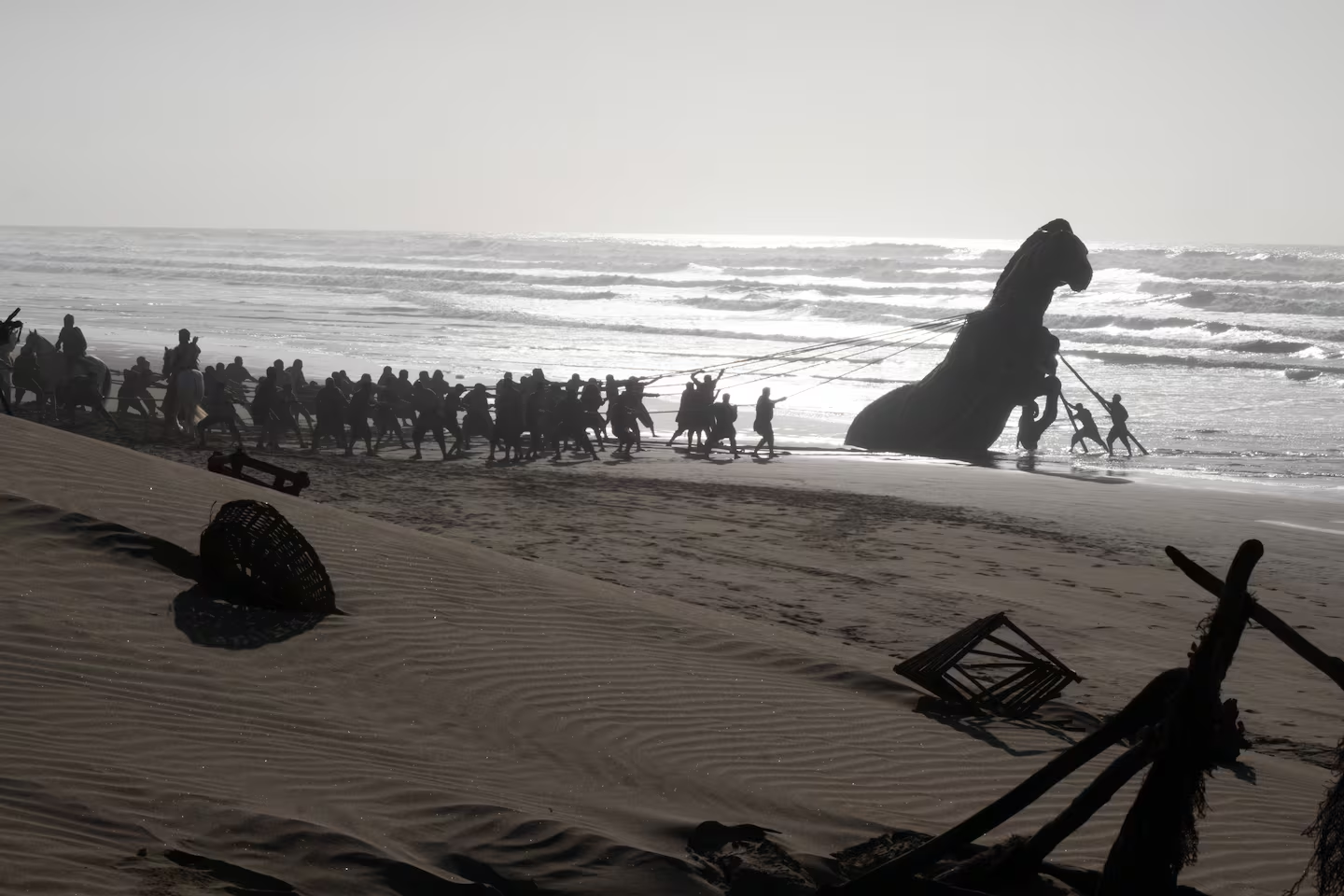
But Christopher Nolan’s new adaptation, which stars Matt Damon and came out last week, offers something different: a more traditional version of the legend, set in the era in which the poem takes place, with all the effects and pristine imagery offered by modern technology. His efforts to follow a 3,000-year-old story that has been passed down through oral and now written traditions over the centuries leads to a question for classics scholars: how successful was it as a retelling of the famous tale?
“When I heard that he was doing ‘The Odyssey,’ I thought, maybe there’s no one better to do it,” said Daniel Cashman, the department coordinator for the Art of Ancient Greece and Rome at the Museum of Fine Arts, Boston. “I was also kind of scared about these two things that I care so much about colliding.”
“The Odyssey” is an essential part of classics studies, and universities still offer courses devoted entirely to Homer’s epic. And as with any adaptation, arguments have arisenabout how faithfully the film follows its source material. But for classics scholars, “The Odyssey” is a work that has always been open to reinterpretation.
“There’s been a tradition since the telling of these epics of changing them and altering them,” said Thomas Sapsford, a classics professor at Boston College who specializes in gender, sexuality, and performance in the ancient Greek and Roman worlds. “Greek mythology is wonderfully malleable. It’s plastic, in a way.”
That’s why some of them emphasize that Nolan’s “The Odyssey”is ultimately his own artistic interpretation, with no obligation to reproduce Homer’s text exactly.
“When people complain about so-called unfaithful adaptations, I always wonder: What is the point of making a movie that tries to replicate the original exactly?” said Brian Walsh, a Boston University professor who teaches a course on “The Odyssey” every fall.
“Why adapt a work at all if you aren’t going to bring something new to the table? Otherwise, it is artistically redundant and stagnant,” he added.
Read more Ariana Grande defies gravity at TD Garden on her ‘eternal sunshine’ tour
For Sapsford, the film offered standout interpretations of scenes from the original poem. He called the scene where Samantha Morton, as Circe, turns Odysseus’s men into pigs “really striking,” saying it “was quite different from typical portrayals of Circe as this beautiful, alluring temptress/witch figure.”
“For me, that really worked.”
Sapsford also enjoyed Nolan’s vision of Odysseus, who emerges as a more solemn and introspective character.
“To have Odysseus become this very sensitive man who’s gone through trauma and carries this guilt, I think, is really relevant,” he said. “I think it will resonate with audiences.”
Still, Nolan had a couple of missteps the experts caught.
“At the end of the film, characters go from Pylos to Ithaca on foot, and Ithaca is an island,” Cashman said. “You can’t walk to an island. You can’t go over land to an island, so that was a big one.”
But Cashman pushed back against criticism that the film lacks historical accuracy.
“I’ve seen discussions online about people complaining about how historically accurate the costumes are,” he said. “We have to step back and say it’s not a historical story; it’s a mythological story. I don’t think Nolan’s trying to be historically accurate.”
Regardless of the film’s relative faithfulness, for scholars, it has another benefit: encouraging audiences to engage with classic texts and mythology.
“Hopefully what this movie will do is get a lot of people to be interested in ancient Greece, its literature, its ideas, and their afterlives,” Sapsford said.
Read more Ms. Lauryn Hill, Hot Tuna, Hayley Williams, and more kick off the 2026 Newport Folk Festival




Post Comment