The DNC may snub the N.H. primary once again — and make the same mistakes once again
An elite group of Democratic National Committee members are set to meet — and likely vote — Friday on a plan for first state presidential primaries in the 2028 presidential election.
Read more ‘He’s on a death march for the economy.’ Trump’s recent actions on Iran and tariffs could hurt GOP.
But instead of designing a process that is most likely to identify the party’s strongest general election nominee, the debate has become consumed with which constituency deserves to go first, repeating the same mistakes from 2024 and the 1980s when Democrats lost three presidential elections in a row.
But first, let’s step way back. States run elections. And while there is a national general Election Day, there isn’t a national presidential primary day. That leaves it up to states to decide when their presidential primaries will be held.
Because those dates are flexible, the national political parties have long tried to shape the calendar. Their leverage is straightforward: The purpose of presidential primaries is to select delegates to the party’s national convention, and the party can determine who is eligible to serve as a delegate. States that don’t comply with party rules can have their delegates ruled ineligible.
Traditionally, the national parties have allowed states to hold primaries within roughly a three-month window, usually March through June, followed by the national convention.
But some states receive waivers to go earlier. That began in 1976 when Iowa and New Hampshire received waivers. In 1980, South Carolina was added by Republicans, and Democrats eventually followed suit. After the 2004 election, Democrats added Nevada as an early state, and Republicans later did the same.
For 2028, Republicans have essentially decided to keep the same four early “carve-out” states. Democrats, meanwhile, want to reexamine the calendar and may even add a fifth early state.
For months, the DNC’s Rules and Bylaws Committee has debated the issue and heard presentations from about a dozen states explaining why they should be included in the early window.
One of them was New Hampshire, which has held the nation’s first presidential primary for more than a century. That includes 2024, when the Biden White House broke with precedent by trying to move the first primary to South Carolina. New Hampshire held the first primary anyway, as required by state law. Even though it violated DNC rules, the state’s delegates ultimately faced no punishment.
The DNC may now be poised to snub New Hampshire again, this time without pressure from a sitting Democratic president. The real fight appears to be between South Carolina and Nevada.
The competition between those two states has intensified in recent days and has largely centered on race. In South Carolina, Black voters play a disproportionately large role in Democratic primaries. In Nevada, Latino voters play a similarly outsize role. (New Hampshire, meanwhile, is disproportionately white, but independent voters play an unusually large role in its partisan primaries.)
This 1980s-style identity politics masks the bigger questions Democrats need to answer before 2028. Namely: How do they find a candidate who can actually win?
South Carolina’s political culture gives an outsized role to well-connected local political consultants. Hire them early and pay top dollar, and you have a serious chance. If you don’t, you probably don’t. As a proving ground for a general election strategy, however, South Carolina isn’t the ideal laboratory. It isn’t a swing state. In fact, the last time it voted for a Democratic presidential nominee was 1976.
Nevada is a swing state in the general election, but its Democratic primary is heavily influenced by a single union: the Culinary Workers Union. Consider this: Only about 104,000 people voted in the 2020 Democratic primary, while the local culinary union has roughly 60,000 members, not including their families.
Of course, every state has flaws in this process, or the choice would be obvious.
But if Democrats want to know how they ended up with a campaign like 2024, there are really tworelated answers. First, Joe Biden decided to run again. Second, his team effectively sidelined the New Hampshire primary, which might have exposed his inability to wage a competitive campaign much earlier and given another candidate time to build legitimacy — and certainly more than 107 days to try to win a presidential election.
New Hampshire has a proven, plug-and-play system that demands fairness and openness. Just ask almost any also-ran from a presidential primary over the past half-century and they will likely agree. Unknown governors, senators, and longshot candidates have all had a legitimate opportunity to compete there on something approaching equal footing.
The singular focus on race also fails to acknowledge that modern presidential primaries no longer exist in a vacuum. Every constituency matters. Candidates today aren’t simply trying to win Nashua or Columbia or Las Vegas. They are raising money in California, speaking before major interest groups in Texas, campaigning in swing states months before voting begins, building nationwide networks of small-dollar donors online and appearing on podcasts that reach millions of listeners. The opening months of a presidential campaign increasingly resemble a national election, not a state-by-state one.
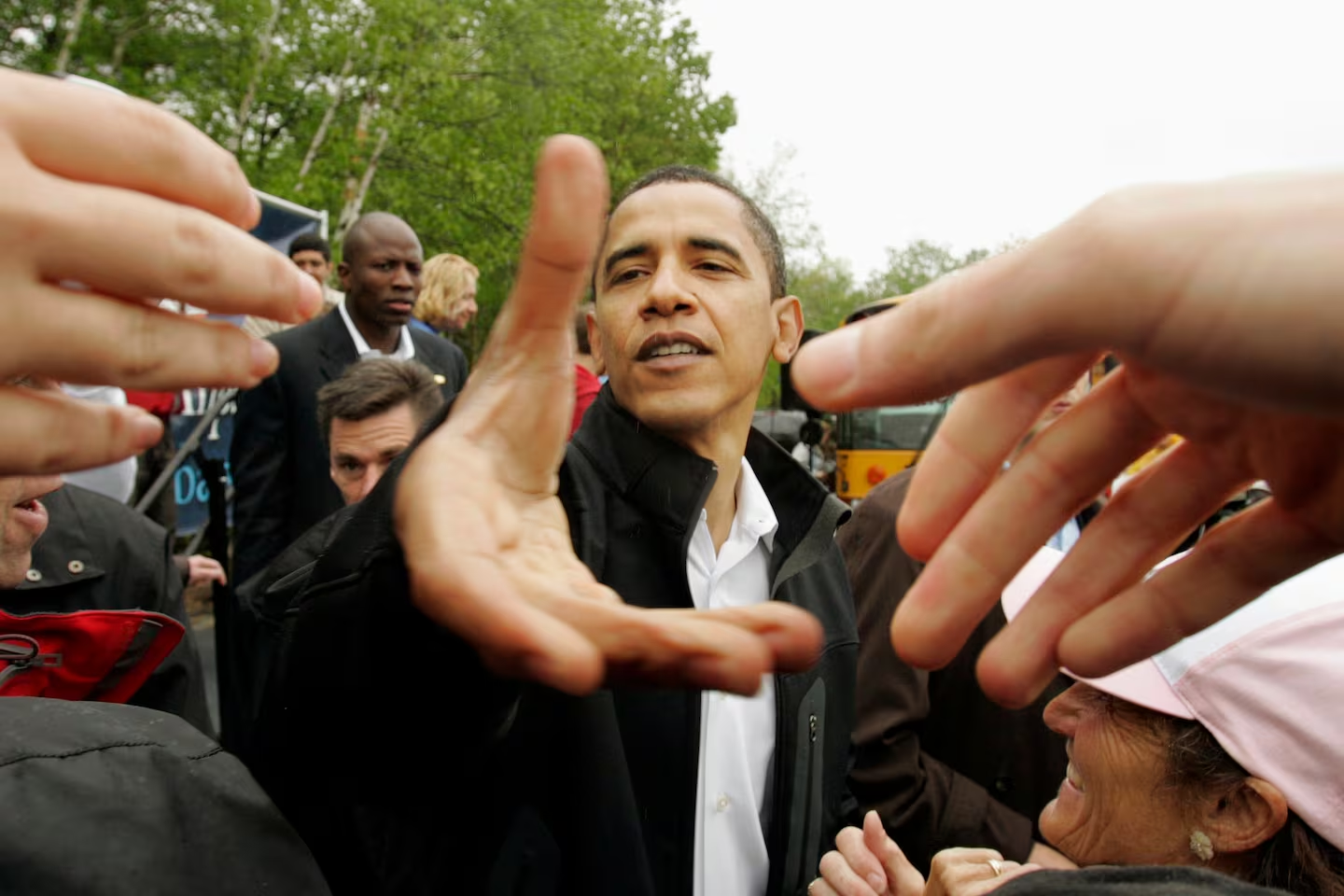
That trend is only accelerating. Four years from now, candidates will communicate with voters more through podcasts, YouTube videos, livestreams, and social media than through living room meet-and-greets or county party dinners. Retail politics will still matter, but it will matter less than it did in Jimmy Carter’s day or even Barack Obama’s.
In that context, the first primary will never again be as insular or uniquely focused on the concerns of one state’s voters as DNC members may hope. The party should stop pretending otherwise.
What the process should do is identify and reward candidates whose message catches fire across the country. After all, that’s the only formula Democrats have consistently found for winning with candidates who emerged from relative obscurity, such as Jimmy Carter, Bill Clinton, and Barack Obama.
The DNC may decide to postpone this vote until after the midterm elections, just as it did last time. If it does, members should spend less time debating which state deserves to go first and more time asking what the early states are actually supposed to accomplish.
The purpose of the first presidential contest shouldn’t be to reward a demographic group, a labor union, a consultant class, or a state. It should be to identify the candidate best equipped to build a national coalition and win the presidency. If Democrats lose sight of that objective, it won’t matter which state goes first.
Read more Ben Kohles shoots 62 to take first-round lead at 3M Open, while Scottie Scheffler lurks three back


Post Comment