‘We got a C-minus’: With Springfield courthouse bid mired in controversy, some worry about trust in process
SPRINGFIELD — For the second time in as many years, Governor Maura Healey’s administration is being taken to court after alarge state contract became mired in controversy, finger-pointing, and allegations of conflicts of interest.
Read more If you pay attention to only one primary election this midterm, make it this one on Tuesday
The latest round of high drama and accusations of potential mismanagement involves a $2 billion award for a new courthouse in downtown Springfield to a team stuffed with well-connected Boston figures.
One of them, the interim head of the Massachusetts Convention Center Authority, has since stepped away from the project. Aiming to blunt criticism, state officials released a variety of bid documents while facing a lawsuit.
The Healey administration had already weathered one controversial procurement, afterits award of a contract to redevelop 18 highway service plazas drew a lawsuit and led the winning bidder to pull out.
While it isn’t unusual for losing bidders to sue over a procurement bid, former attorney general Scott Harshbarger said the back-to-back controversies send a message that “money and power matter more than competence and integrity.”
“If you’re the governor and the attorney general, you can’t just stand back and say, ‘That’s our process,’” said Harshbarger, who also ran for governor on the Democratic ticketin 1998. “It reflects negatively on public interest and leadership.”
The Springfield courthouse at issue was built in 1971, is infested with mold, and is making people sick.
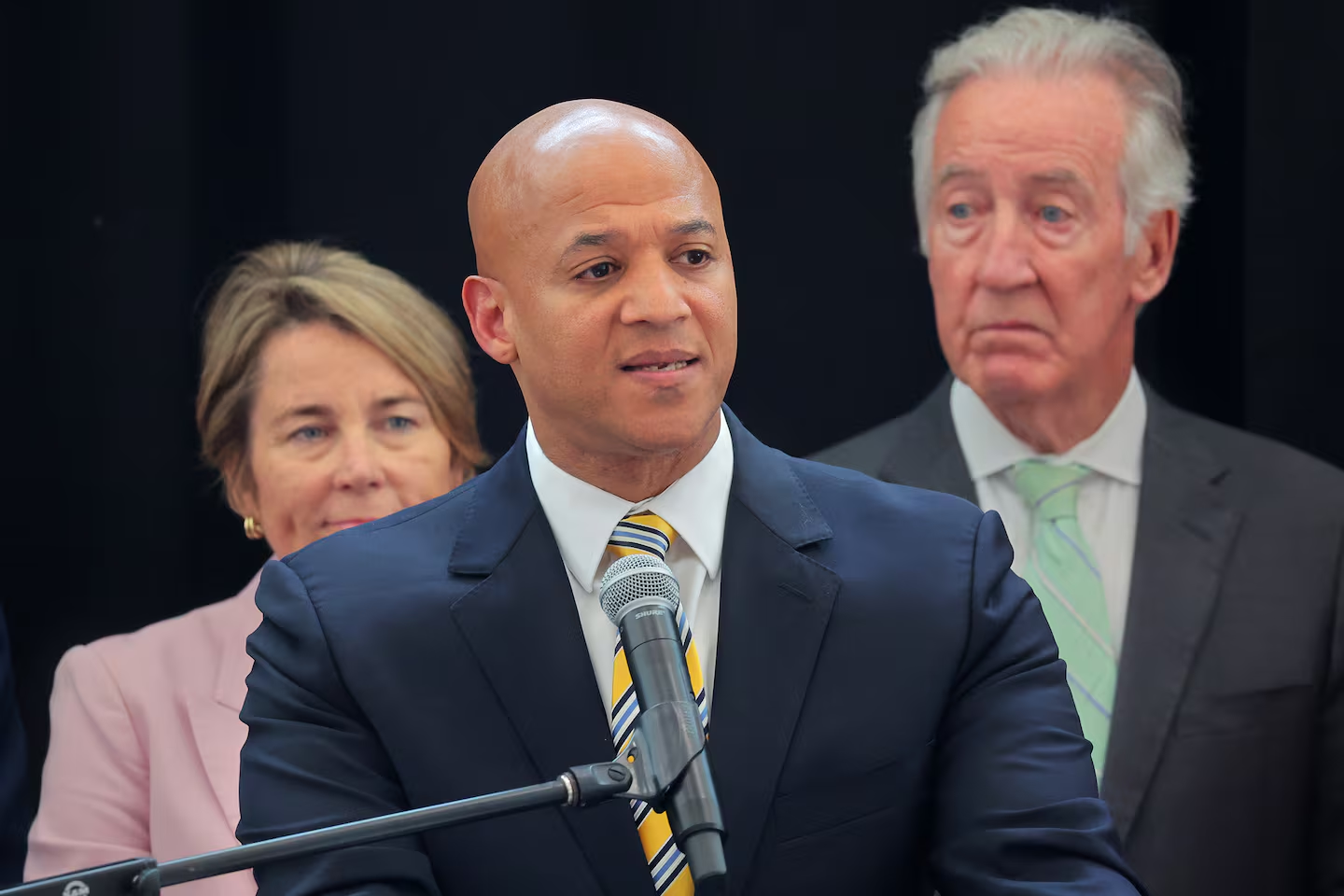
The state solicited proposals for a new building in2025, and ultimately awarded a $2 billion contract to a group called Liberty Junction, which is made up of a real estate firm from Virginia, FD Stonewater, and CoJo Real Estate, owned by John Barros, now interim executive director of the convention center authority, and Conan Harris, husband of US Representative Ayanna Pressley.The team listed Boston’s Suffolk Construction as its general contractor.
On Thursday, Healey spoke at an unrelated event in Springfield with Barros at her side. She defended the courthouse bid, saying it “followed the standard procurement process,” and that litigation can be common in these types of bids.
She also called the Liberty Junction bid “high quality,” and argued it was $300 million below the next-lowest bid.
“I don’t know about you,” she said, “but I think that makes a lot of sense,” she said.
Barros was unanimously appointed to his position in January. One of the members of the convention board who voted for his appointment is Healey’s budget secretary, whose office also oversees the agency that awarded the Springfield courthouse contract, the Division of Capital Asset Management and Maintenance.
Two of the losing bidders — Springfield auto magnate Jeb Balise and real estate developer Dinesh Patel — teamed up to sue Liberty Junction and DCAMM, asking the court to rule DCAMM violated the conflict of interest law and to also declare Liberty Junction ineligible for the contract. The parties are set to appear in court Aug. 11.
Barros on Wednesday announced he was “divesting” from CoJo Real Estate and the project at large, saying through his attorney that its “significant public benefits . . . outweigh his personal interests.”
In Springfield, many local elected officials have said they are frustrated with the results, despite the state’s reasoning that it was the lowest-cost option.
Hampden County Sheriff Nick Cocchi, whose son works as a court officer in Springfield, said the illnesses suffered by those who work in the courthouse feel personal.
The state, he said, put “a tremendous emphasis on the cost” instead of a locally-based bid.
“We had an opportunity for an A-plus,” Cocchi said of the bid process. “In my opinion, we got a C-minus.”
Last June, the administration came under intense scrutiny for a different procurement, when the Massachusetts Department of Transportation had selected a team led by Irish retailer Applegreen and Boston’s Suffolk Construction for the rest-area revamp of the state’s service plazas.
Global Partners, which already runs four of the plazas outright, was the losing bidder for the contract and waged a campaign against the decision in the press and in court. Applegreen ultimately withdrew from the negotiations altogether, and state investigators later said the process was riddled with flaws. The project is now being rebid.
MassDOT’s procurement process had been shrouded in secrecy, and a complaint in the lawsuit argued that friendly text messages between a MassDOT official and Suffolk Construction executives should disqualify Applegreen and Suffolk from winning the bid.
The controversy around the Springfield courthouse has a different flavor, ethics experts said.
“Whenever you see that a government official also receives a lucrative personal benefit from the government, it’s going to raise questions,” said Kedric Payne, senior director of ethics at the Campaign Legal Center, a Washington, D.C.-based watchdog.
Eric Petry, an attorney at the Brennan Center for Justice, said even in instances where there is no proven conflict of interest, just the appearance of one can still harm faith in government.
“When the public sees insiders benefiting and their concerns going unaddressed, it fuels the sense that government only works for the select few,” said Petry.
Petry said he witnessed a “troubling backsliding” of trust in government in the last several years. That’s particularly true at the federal level. But, he warned, it can trickle down to state and local government, too.
“When scandals emerge and when abuses are uncovered, it draws attention to the fact that there was an issue,” he said. “When people see this, they think, ‘This is how it is,’ that all politicians are in it for themselves?”
Those in Springfield who’ve said they already feel disenchanted with the process questioned whether the cost savings Healey boasts will be worth it in the long term.
When a group of court employees ranked the submitted bids, the Liberty Junction proposal was near the bottom of their list, said Hampden County Clerk of Courts Laura Gentile, adding that the procurement Hampden County Clerk of Courts Laura Gentile said the procurement for the project “sure looks like” a political failure.
Speaking from her office in the aging Springfield courthouse, where she said raw sewage had been leaking onto the carpet, Gentile said she felt like choosing the lowest bid felt like a “consolation prize.”
“We’re not stupid out here,” she said. “Seeing what’s going on is a slap in our face.”
Jon Chesto of the Globe staff contributed to this report.




Post Comment