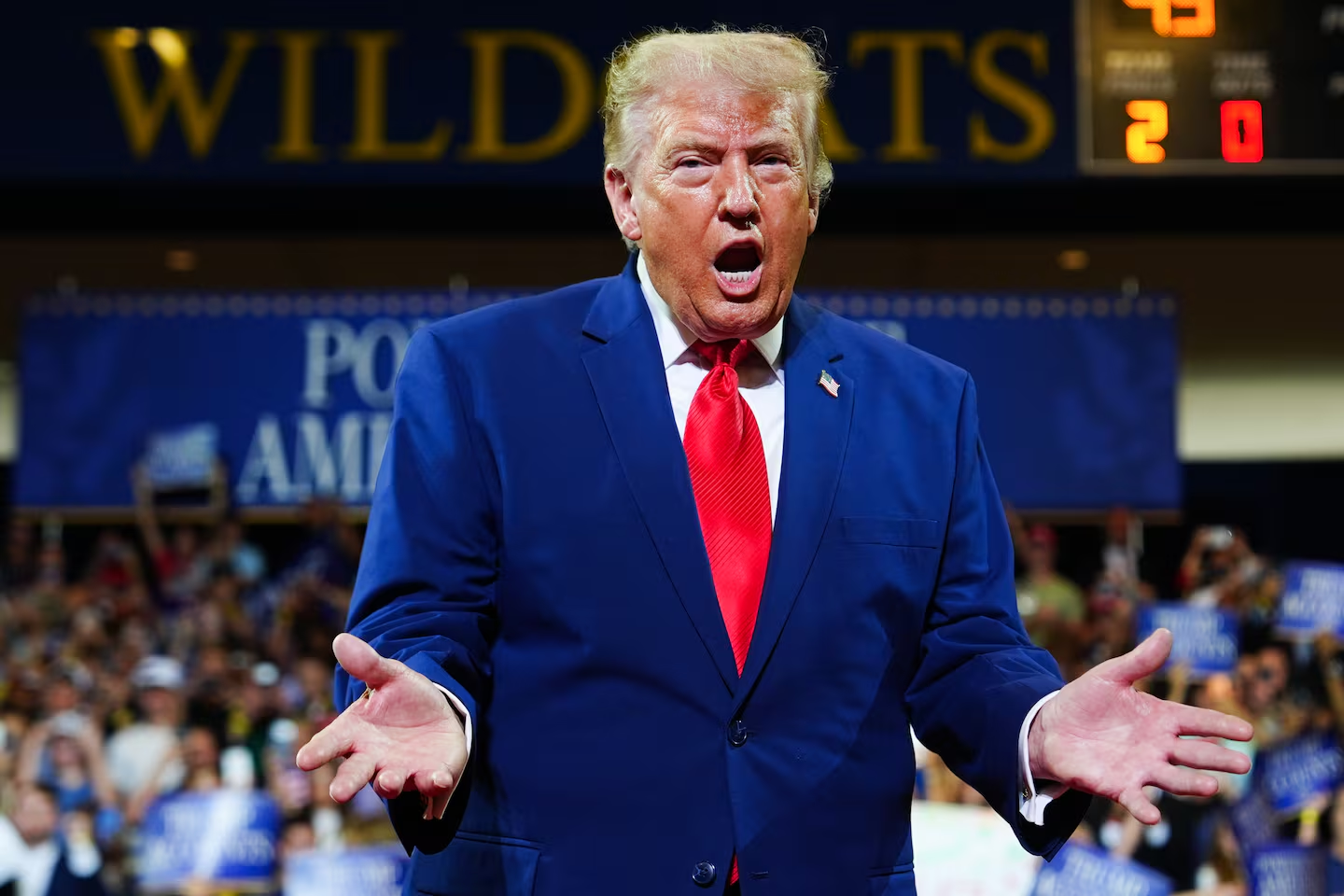
‘He’s on a death march for the economy.’ Trump’s recent actions on Iran and tariffs could hurt GOP.
WASHINGTON — As July began, things were finally looking up for President Trump and his fellow Republicans as the high cost of living slowly began to ease heading toward the midterm elections.
Gasoline had dropped below $4 a gallon as a cease-fire took hold in the Iran war. With the help of a Supreme Court ruling that overturned a swath of Trump’s tariffs, the global trade war had eased. And Congress had overwhelmingly approved a bipartisan bill to address the high cost of housing.
Then, in typical Trump fashion, he abruptly upended it all — and, in the process, added new peril for Republicans in November.
First, he resumed major US military attacks against Iran after it struck oil tankers in the Persian Gulf, sending gas prices surging above $4 a gallon again and threatening to reignite still-high inflation. Then on Monday he imposed 50 percent tariffs on most Canadian imports, followed by new levies announced Thursday on dozens of countries to replace expiring ones — moves that could drive up costs for Americans and trigger retaliatory tariffs that add to upward price pressures.
Trump even failed to capitalize on the one significant action Washington has taken to address the affordability crisis since he took office.
Upset Congress hadn’t passed a separate measure on voting restrictions, Trump refused to sign a bipartisan housing construction bill passed by Congress, allowing it to become law by default on July 11. That deprived Republicans of a signing ceremony where Trump could have trumpeted an accomplishment his party hopes to highlight in their midterm campaigns.
“He’s on a death march for the economy and seems not to care,” said Senator Peter Welch, a Democrat from Vermont, a state that will be hit hard by new Canadian tariffs. “These connections that you build up over time, like with the United States and Canada, he’s totally unraveling that … He’s shown a complete contempt in this regard — not just for Congress, but for his Republican supporters in Congress.”
Some Republicans are getting worried as the inflamed Iran war threatens to spread in the Middle East, which caused oil prices to hit $100 a barrel on Thursday.
“We should all be concerned any time you’re seeing basic commodity prices going up,” said Senator Mike Rounds, a South Dakota Republican facing reelection this fall. “Those are of concern to all of us, or at least they should be.”
High inflation — and Trump’s promises to bring down prices “on day one” if he were reelected — were a major factor in his 2024 victory. But fueled by the tariffs he began levying last year and then the Iran war he launched this spring, prices for many products have continued to rise, and annual inflation, most recently at a 3.5 percent annual rate, remains above the Federal Reserve’s preferred level.
The renewed fighting in the Iran war has led to the closure of the crucial Strait of Hormuz, which has sent oil and gas prices skyrocketing in recent days. And a Politico poll released on Wednesday showed even his own supporters are questioning Trump’s decision to start the war.
Only about 37 percent of self-identified MAGA Trump voters said the Iran war is worth the economic cost, down from 50 percent in early May.
Overall, 63 percent of adults blame the war for the high gas prices, and 42 percent said those prices are higher under Trump than they would have been under a Democratic president. Just 18 percent of respondents said gas prices would be higher if a Democrat were in the Oval Office.
Asked on Tuesday if Iran was trying to influence the midterms, Trump said “probably” but that he would not be deterred in a war he has argued was necessary to prevent the country from building a nuclear weapon.
“They won’t have any impact on me,” he told reporters. “I’m just going to do the right thing.”
The White House did not respond to a request for comment.
Representative Troy Nehls, a Texas Republican and strong Trump supporter, said he isn’t concerned about high gas prices because he believes they will be temporary. But Nehls acknowledged that those higher prices might stick intonext year, and that could be a political liability for Republicans.
Read more Ben Kohles shoots 62 to take first-round lead at 3M Open, while Scottie Scheffler lurks three back
“It could because everybody wants to talk about it, specifically the left,” he said.
Gas prices typically decline in the fall as the summer driving season ends and stations return to cheaper winter blends, said Patrick De Haan, head of petroleum analysis for price-tracking firm GasBuddy. But the uncertain situation in the Middle East, along with recent Ukrainian attacks on Russian refineries in that war, make projections extremely difficult, he said.
“It’s akin to hitting a dartboard through the woods 5,000 miles away,” De Haan said. “It will remain volatile depending how these situations evolve.”
Senator Lisa Murkowski, an Alaska Republican who is not on the ballot this year, said she’s worried about the impact of the high cost of living because that’s what her constituents are talking about at the dinner table.
“I think there’s going to be blowback on all incumbents, actually, but I think particularly on Republicans,” she told the Globe. “It’s Republican control of the Congress and the White House. We’re setting the agenda, and people expect that the issues that they care about are dealt with. And so, when they’re not, there’s that consequence.”
As for the housing legislation, the most significant passed by Congress since 1990, Murkowski said she was disappointed Trump didn’t sign it.
“It’s law; that’s the good thing,“ said Murkowski, a Trump critic. ”But I do think the president missed an opportunity to promote it.”
The new tariffs on Canada also add to the inflationary pressures caused by high gas prices. A report in February by Democrats on the congressional Joint Economic Committee found the average family paid about from February 2025 to January 2026.
“I believe that tariffs can be used strategically quite valuably, but what the Trump administration is doing is picking the pockets of American consumers,” Senator Elizabeth Warren, a Massachusetts Democrat, told Trump’s top trade official at a hearing Wednesday. “And after Donald Trump promised he would lower costs on day one, he put in place tariffs that have done nothing but raise prices for consumers.”
The official, US Trade Representative Jamieson Greer, defended the tariffs during his appearance before the Senate Finance Committee and sought to ease concerns about another trade war. But he said Trump was committed to tariffs despite the Supreme Court ruling the president exceeded his authority in using emergency powers last year to enact high tariffs on dozens of nations.
“The specific authorities this administration is using have changed, but the trade strategy has not,” Greer said. “We are committed to continuing to use tariffs and to negotiate deals to support the reindustrialization of our economy, protect American workers and increase their wages and shrink our trade deficit.”
Retaliatory tariffs from other countries have been felt deeply by US farmers, as have higher prices for fuel and fertilizer caused by stalled shipments through the Strait of Hormuz. In response, Republicans included $12 billion in aid to farmers in a partisan budget bill that passed the House on Tuesday.
Representative Thomas Massie, a Kentucky Republican who lost his primary this year because of his opposition to Trump, said the president still is widely popular with the GOP base. But Massie doesn’t think that will last.
“Eventually, I think people’s pocketbooks are going to impose reality on them, and they’re going to quit watching Fox and pay more attention to the gas prices,” Massie said. “We’re already seeing that with farmers, and that’s why you’ve got this $12 billion bailout … Here’s $12 billion. Please don’t punish us in the midterms.”
Read more Lauren Coughlin, Jenny Shin share first-round lead with 66s at LPGA Scottish Open


Post Comment