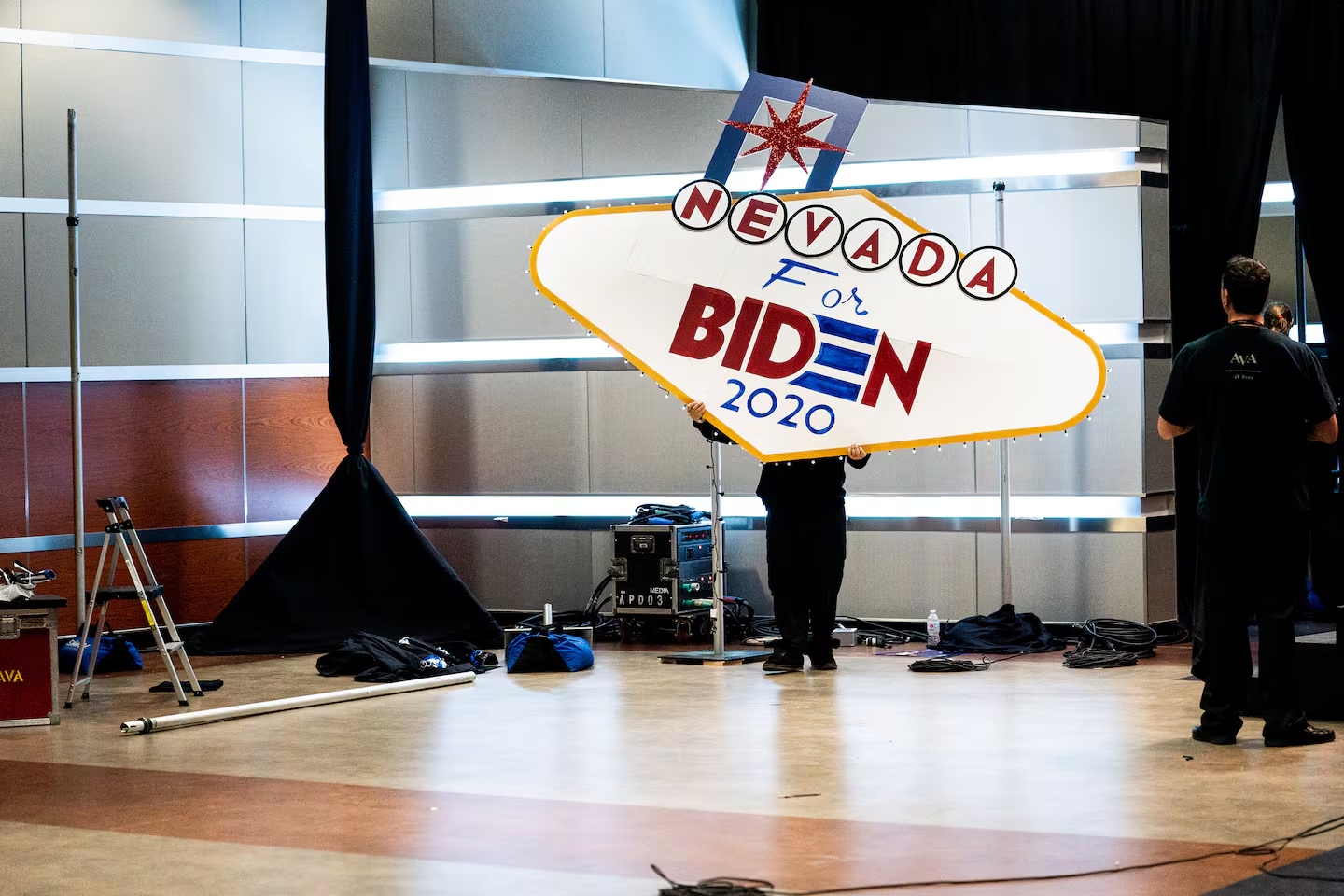
South Carolina and Nevada fight to kick off Democrats’ 2028 presidential calendar
South Carolina and Nevada have emerged as the two front-runners to begin the 2028 Democratic presidential nominating calendar, but their jockeying has grown acrimonious and pitted Black and Latino party leaders against each other, according to interviews with more than a dozen party officials involved in the discussions.
Read more Trump expands a voluntary pledge to protect consumers from high utility bills from AI data centers
A powerful panel of 49 insiders of the Democratic National Committee is set to meet this week in Washington to sketch out the order of the early-state calendar. The full party body would then vote next month to finalize the choices.
The order of primary states is deeply consequential. Different states have different upsides and downsides for the party’s potential 2028 contenders — and require the constructing of different political coalitions. The calendar is likely to play a significant role in deciding who ultimately emerges as the next Democratic presidential nominee. And months of private lobbying, backroom discussions and brass-knuckle racial politics are bursting into the open on the eve of the gathering.
“It’s almost like we’re running against Nevada,” Christale Spain, the chair of the South Carolina Democratic Party, said in an interview. “That’s what it feels like.”
“If Nevada gets elevated over South Carolina, it would be because of their Latino vote,” added Spain, who is Black. “So you would then be telling Black voters that you matter less than brown voters. And I refuse to believe that our party wants to send any type of message like that.”
Other new states are jockeying to jump into the influential early window, including Virginia, which also has a sizable Black population.
“If you have the right calendar, you can have the right nominee to prepare you for the general election,” said Terry McAuliffe, a former Virginia governor and DNC chair.
Worries about influence for Black Democrats
For decades, the nominating calendar for both Democrats and Republicans had begun in Iowa and New Hampshire, two overwhelmingly white states. But former President Joe Biden put South Carolina — whose many Black voters helped make him the nominee in 2020 — first in 2024.
Now South Carolina is fighting to kept its premier slot. At the same time, Nevada argues that its status as a diverse and growing battleground state — with a large Latino population and a strong tradition of organized labor — would better position Democrats to win the general election. Nevada is a swing state that Democrats have won in recent years — they currently hold both of its Senate seats — while South Carolina is reliably Republican both in presidential years and at the state level.
Prominent Latino leaders and groups have been instrumental in Nevada’s lobbying charge, including the campaign arm of the Congressional Hispanic Caucus and recently Xavier Becerra, the Democratic nominee to be the first Latino governor of California in modern times.
Gov. Michelle Lujan Grisham of New Mexico sent handwritten notes to every DNC rules committee member lobbying for her state. In an interview, she argued that putting New Mexico in the early window would push Democrats to hone their message to Latino voters who drifted away in 2024.
“It’s pretty critical because we don’t talk to Hispanic voters until the end no matter what we commit to do,” she said of past races.
At the same time, the Supreme Court’s recent decision in Louisiana v. Callais, which further hollowed out the Voting Rights Act, has heightened anxiety among many Black leaders. The ruling allows the erasure of majority-Black seats in the U.S. House that were once protected across the South.
Daniele Monroe-Moreno, the chair of the Nevada Democratic Party, framed the choice of her state as essential because it would elevate a presidential battleground.
“The bottom line is the best way to beat back the Trump administration’s assault on Black voters is to elect a Democrat to the White House in 2028, period,” she said, adding: “And choosing Nevada to go first is a strategic decision.”
Behind-the-scenes maneuvering
The DNC has laid out some loose rules to guide the calendar selection.
The party will choose at least four states to vote in February 2028 before Super Tuesday, which usually falls in early March, with the likely addition of a bonus fifth state. One state will be chosen from each of four regions: the West, the South, the Midwest and the Northeast. A dozen states applied and are still eligible, though some have Republicans in power who are unlikely to shift primary dates for Democrats.
There are other complications. New Hampshire, for instance, has a state law that says the state must hold the first nominating primary — and it did so in 2024 even though the party had formally changed the order. Democrats stripped delegates from the state, but they were ultimately restored before the convention.
Iowa, whose 2020 caucuses had a counting meltdown, has applied to move back among the early states, but Michigan is seen as a bigger presidential battleground in the Midwest. Before the 2024 election, legislators there moved the state’s primary to February.
The 49 members of the DNC Rules and Bylaws Committee have approved stiff penalties for states that try to jump ahead of the official calendar — and on candidates who campaign in such places. Access to party debates and delegates will serve as cudgels.
Multiple officials said that support on the rules committee for allowing New Hampshire to go first had sagged, but that the state was still heavily favored to land an early slot and could still form alliances with others.
“New Hampshire serves as a critical testing ground for whether candidates can attract independent voters,” Raymond Buckley, the state’s longtime party chair, said in a statement.
On Tuesday, the chair of the DNC’s Black Caucus, Virgie Rollins of Michigan, urged the rules committee members in an email to put South Carolina first, noting its “larger African American population than any other state currently under consideration” to be first. She called for her own state to also stay near the start of the calendar.
Choose us, not them
Then there are the whisper campaigns about drawbacks for various entrants.
Nevada, for instance, allows the counting of mail votes that arrive after Election Day, meaning the winner of an especially tight contest might not be immediately clear. South Carolina, some say, is so solidly red that it would be a waste of grassroots energy. Both New Hampshire and Iowa have been criticized as too white. And a presidential primary in Michigan, some worry, would shine a light on the party’s divisions over Israel, which are currently on display in the Senate contest there.
Hoping for a speedy resolution
It is also possible that the DNC rules committee could delay a final decision.
The full party committee is set to meet next month in Austin, Texas, but at least some party officials prefer to wait until after the midterm elections to choose the early-state order, lest they disappoint anyone in the middle of elections.
Others believe that waiting could cause a mangled mess, because it would probably mean that candidates would announce their bids before a final calendar had been set.
Ken Martin, the party chair, has not yet taken a heavy hand in pushing for a particular outcome, officials said, though he is involved and party aides have been regularly monitoring developments.
Martin has spoken openly in the past about how important it is for the Democratic Party to expand its competitiveness in the South. Outside South Carolina, Virginia is seen as the likeliest entrant to the early-state window, though some complain that its size and the high cost of campaigning there could be prohibitive.
Many in the party are hoping that a resolution comes soon and with relatively little rancor.
“It is terribly unfortunate this process has been allowed to come down to Black voters versus brown voters,” said Jay Parmley, executive director at South Carolina Democratic Party, who is white. “And I think that is very dangerous for our party, and I would hope the Rules and Bylaws Committee is adept enough at not letting it go there.”
Read more House again passes resolution seeking to halt military action in Iran as some Republicans defect
This article originally appeared in The New York Times.


Post Comment