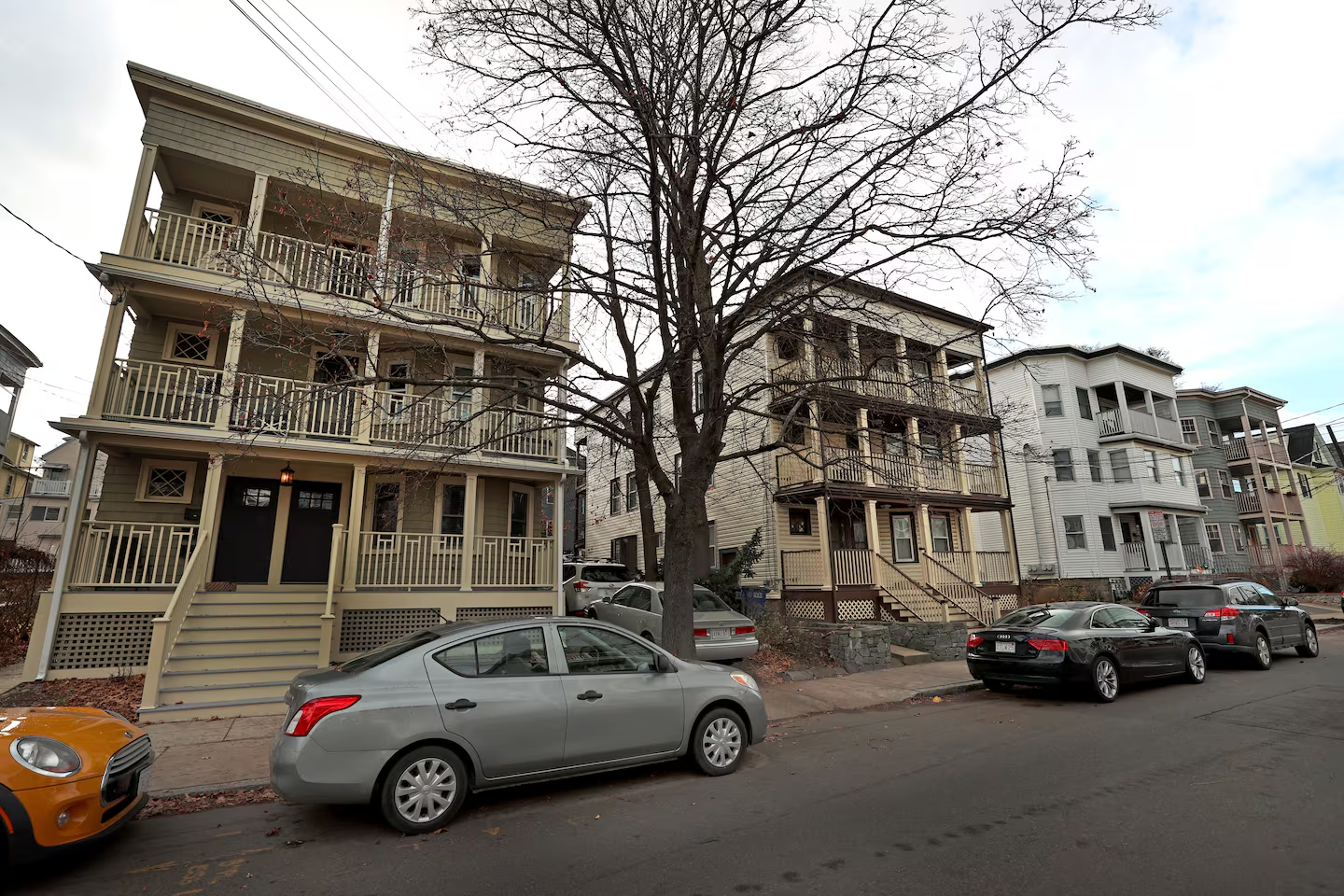
Will Beacon Hill do anything to help the Massachusetts housing crisis? With clock ticking, two ideas are on the table.
State-level housing reform in Massachusetts is always a hard sell. But lawmakers are feeling the pressure of this state’s ever-rising housing costs — especially after the near-miss earlier this year with a ballot question that would have brought the nation’s strictest rent control policy to Massachusetts.
Read more House again passes resolution seeking to halt military action in Iran as some Republicans defect
Now, with next week’s close of the two-year formal legislative session fast approaching, the House and Senate are trading proposals for substantial reforms that would make it easier to build multifamily homes in this state that is desperate for more of them.
Two significant policies have emerged in negotiations over a major economic development bill. One would allow moderately-dense apartment buildings by-right, or without special local approval, on land owned by religious institutions. The other would allow duplexes by-right on all residentially-owned land in Massachusetts.
Neither effort would be a panacea to the state’s housing woes, and it’s not clear what might emerge in final legislation that will be hashed out over the next week. But either could offer a significant boost, perhaps facilitating the construction of thousands of new homes.
“This housing problem we have is so pervasive that it is not going to be solved one piecemeal solution at a time,” said Jesse Kanson-Benanav, executive director of the pro-housing group Abundant Housing Massachusetts. “We need a whole slate of ambitious reforms aimed at immediately making it easier to build the homes we need. Anything short of that is not enough.”
The religious-land provision in the House’s version of the economic development bill closely follows similar “Yes in God’s Backyard” — or YIGBY — efforts in other states. It would allow multifamily housing development without discretionary approval from local governments on parcels up to four acres owned by churches, synagogues, temples, and other places of worship. Those developments could be 30 units per acre, and even denser — 50 units per acre — if 25 percent of units are set aside at affordable rents. So the policy could in theory pave the wave for projects as large as 200 units.
The provision would tap into what has already been a growing trend: Many churches and other religious institutions have fallen on hard times recently as the number of people attending services has dwindled. That has left many places of worship searching for a second life, and many have settled on housing.
It’s a natural transition: Many churches own substantial real estate — acquired when congregations needed space for services, schools, and dormitories — often in premium locations on main streets near town centers where housing development makes good sense. It often fits their mission, too, said Rev. Adam Isbitsky, the legacy pastor of the soon-to-be-closed Second Congregational Church in Beverly.
“Religious institutions are always trying to ask, in this time when the role of the church in society is shifting, how can we continue to serve our wider community?” he said. ”When the cost of housing is a huge challenge facing many people, this is a natural way for us to further our mission.”
Isbitsky’s Second Congregational Church will eventually turn their sprawling Conant Street building over to LifeBridge North Shore, a homeless services nonprofit, to be operated as a new resource center. But the process to reach that agreement was at times contentious, with residents concerned it would bring homeless people to their neighborhood.
Many other churches making similar transitions or that have opted to build housing on their land have encountered similar opposition. The YIGBY provision could smooth the path.
Read more Democrats seize on AI data center backlash that’s dividing rural Republicans in places like Texas
“Churches and religious institutions are deeply rooted in the community,” said Isbitsky. “You’re not putting this power to develop land into housing in the hands of an out-of-state developer. You’re giving it to groups who have a place’s best interests in mind.”
Amy Dain, a local zoning and land-use expert and senior fellow at Boston Indicators, the research arm of the Boston Foundation, said the YIGBY proposal could spur the construction of thousands of new homes.
An analysis by the Lincoln Land Institute and the Boston-based Lynch Foundation identified some 4,800 developable parcelstotaling over 20,000 acres owned by religious institutionsacross Massachusetts. If even a quarter of that land was developed at a reasonable density, it could translate into 250,000 new homes, according to the Citizens’ Housing and Planning Association.
Of course, that level of build out would take time and resources.
“But the potential is there,” Dain said.
The impact of the duplex provision, which was included in the Senate’s version of the economic development bill, is harder to measure.
The idea is simple: there are millions of residentially zoned parcels in Massachusetts, and in a state that needs to build 222,000 homes by 2035 to moderate price growth, allowing two units on those lots instead of one could go a long way.
And, importantly, the provision would tackle the state’s thorny history with single-family zoning. Apartments were broadly allowed in many Massachusetts cities and towns as the state grew rapidly in the late 1800 and early 1900s. But many municipalities gradually banned them starting in the 1920s, in part over concerns about immigration and a desire to keep neighborhoods exclusive.
Today, 96 percent of the residential land in Massachusetts allows single-family homes by right, according to a report from the National Zoning Atlas, which analyzed the zoning codes of all 351 Massachusetts cities and towns. By contrast, duplexes are allowed by-right on 38 percent of the state’s land, and three-unit buildings are permissible on just 7 percent.
And beyond efforts to build more housing, advocates say even something as simple as allowing duplexes on all of that land could help undo that legacy. Other states have done the same, and have been celebrated for “ending single-family zoning.”
Either proposal, said Eric Shupin, the chief executive of CHAPA, would also represent a further step to reign in the power of municipalities to restrict the rate of construction in this state. Strict municipal zoning rules are in part responsible for the state’s housing shortage to begin with.
“The fact that the House and Senate have taken up these meaningful reforms is both sides acknowledging that we have to do something urgently about our housing shortage,” said Eric Shupin, CHAPA’s chief executive. “And the best way for them to do that, frankly, would be to pass both of these reforms immediately.”
Read more WNBA commissioner and union leaders discuss steps to protect players from online harassment


Post Comment