‘Great people make a great city.’ Finding a measure of hope in a Boston neighborhood
Would you like a little pick-me-up in this monumentally messed up moment?
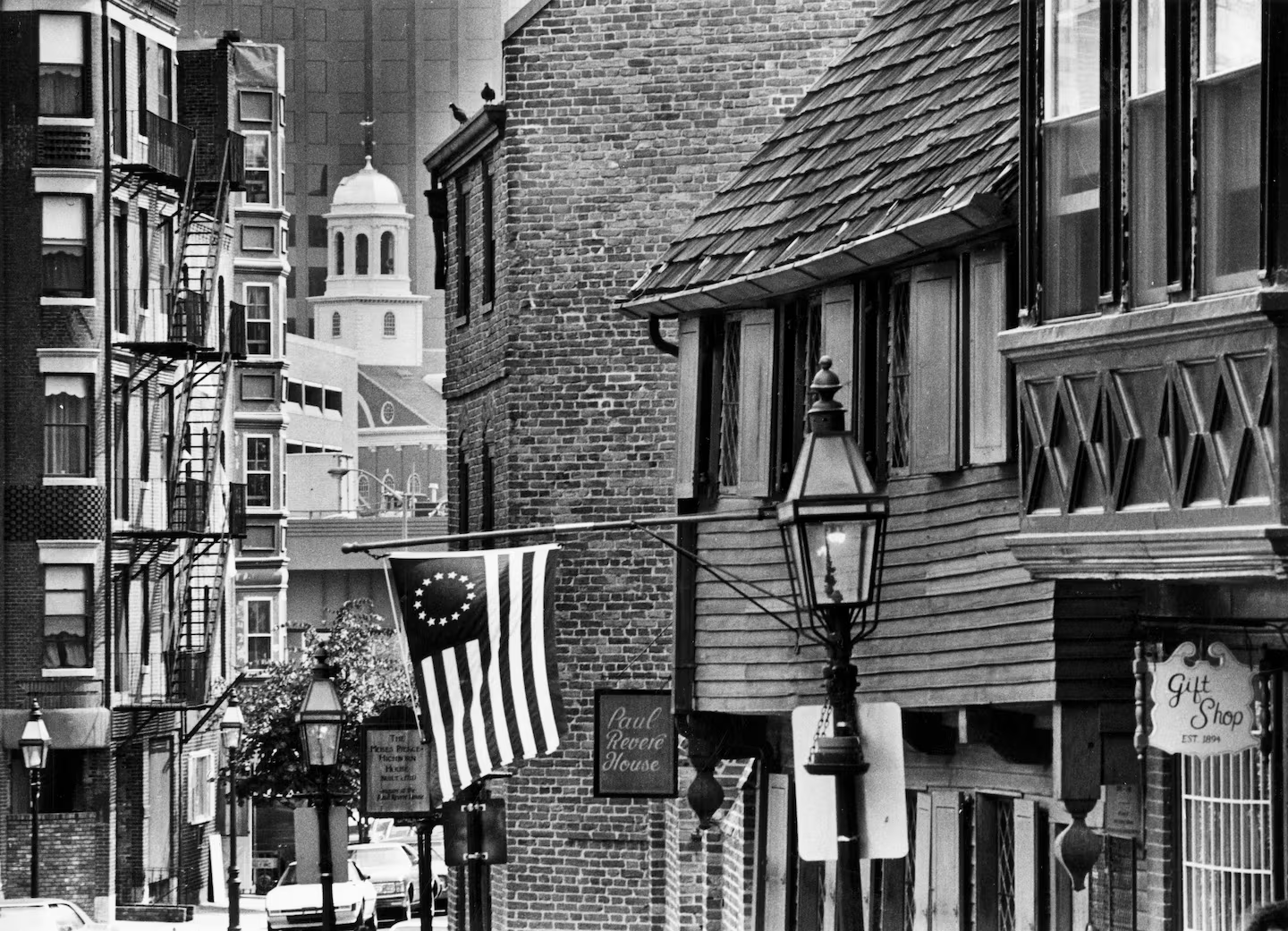
Take Feargal O’Toole’s North End walking tour.
O’Toole is a guide for Boston By Foot, the outfit that offers loads of fascinating walking tours for locals and visitors alike, in the hopes of better connecting them with our history, and each other. It’s a nonprofit, celebrating its 50th anniversary this year. Like the other guides — they currently have about 200 volunteers — O’Toole researches, writes, and leads the walks just for the love of it.
Read more Trump stands to profit off US policy announcements by selling fast access to his social media posts
The tour I went on views the neighborhood through its role as an immigration hub in the 19th and early 20th century, when it was the first stop for Irish, Italian, and Jewish people who crowded onto boats and came ashore here, desperate to make lives.
“It’s amazing how these guys persevered,” said O’Toole, 55, who immigrated here from Ireland for school in 1992. “It’s a testament to their grit, and that’s what Boston is, a gritty city. Great people make a great city.”
I’d walked through these streets hundreds of times over the decades. But it was shocking how little I’d actually seen.
The whole 90-minute walk reminded me what humans are capable of in the face of unrelenting obstacles. Between 1845 and 1855, 50,000 Irish immigrants fleeing famine and poverty got off those boats, swelling Boston’s population by 50 percent.
It was a wild place in those days, jammed full of strivers and strugglers and dreamers. And seedier types.
O’Toole made a stop on North Street, near the Madonna del Soccorso Social Club, an area that catered to sailors and others interested in indulging various vices. In 1851, he said, there were 227 brothels, 26 gambling dens, and 1,500 places to buy liquor right here. It’s hard to imagine, standing among the condos and polished facades.
The immigrants kept coming — Italians from Genoa and Sicily, and Jews fleeing Russian pogroms. They were often hated and exploited, but many of them overcame: Luigi Pastene ran a pushcart selling fresh fruit, and his son started an import business on Fulton Street that his family has run for generations. (Pastene crushed tomatoes are the best, I will fight you on this.) A building on Prince Street that hosts 42 loft-style condos was once the Prince Macaroni factory.
Salem Street, where the legendary Bova’s bakery now sits, was once the center of the neighborhood’s Jewish community. This corner was the site of around 1892, before eventually going on to found Stop & Shop. By 1895, the Jewish population of the North End was 6,200, enough to sustain at least three synagogues. Look above a third-floor window atop a former Hebrew School on Baldwin Place and you can see a faded Star of David.
The new arrivals gained footholds, and power. On Fulton Street, at the site of a former kosher slaughterhouse, O’Toole talked about the meat strikes of the early 20th century, when Jewish women boycotted butchers to protest their high prices, and tried to set up co-ops to get around them.
Read more UEFA says it has lost confidence in FIFA’s Infantino after failed private equity plan for World Cup
“They went from being desperate immigrants to fighting big business,” O’Toole said.
The neighborhood’s most meteoric rise began in the mid-1800s, when members of the Fitzgerald family arrived here from the village of Bruff, in County Limerick. They quickly embedded themselves in Boston politics. One of those new arrivals had a great-grandson named John F. Kennedy.
In North Square, O’Toole told the story of George Scigliano, a son of Italian immigrants from Calabria who became a legislator and reformer around the turn of the 20th century. He introduced legislation to protect immigrants from predatory lenders and labor bosses, and formed organizations to build their power. O’Toole said that when Scigliano died in 1906, his funeral procession was the biggest the North End would see until the one held for Sacco and Vanzetti in 1927.
By 1930, the North End was one of the densest places on the planet, home to 44,000 people (there are 10,000 residents there now), who lived tightly packed in tenements, many of which were demolished long ago. Even a decade later, 90 percent of homes had no baths, so people gathered at what is now the Nazzaro Community Center on North Bennet Street to wash.
There was suffering and misery, but also ambition and joy. The stories are awful and gorgeous. And they’ve added up to something spectacular.
“It’s a cracking city, Boston,” O’Toole said. “It’s a stunning city, and maybe it’s an affinity people have with their adopted cities, but I like to show it off.”
Standing in the places where those people lived — seeing what those places have become — makes their stories more real, and affecting, than just reading about them could. Look at what they endured, and the city they made for us.
These are ugly times in this country, especially for immigrants. And sometimes, it’s hard to imagine how new arrivals, and those of us who care about them, will come through this. But spending 90 minutes in the North End with Feargal O’Toole reminded me what is possible — what we can make possible, if we refuse to stop fighting for it.
Read more Kalshi wants prediction markets to be seen like polling. Senators aren’t ready to make that bet.


Post Comment