Most Americans loathe data centers. Construction workers love them.
For many residents of Western Massachusetts, the proposal to build a massive data center complex in Westfield seems like a nightmare.
Read more ‘Great people make a great city.’ Finding a measure of hope in a Boston neighborhood
For Jeremy Dunn, it sounds like a dream come true.
“It means an absolute astounding number of jobs,” said Dunn, business manager at Local 7 of the International Brotherhood of Electrical Workers, the union local serving Westfield.
Michael Langone, business manager of Plumbers and Pipefitters Local 104 in Holyoke, is just as effusive. “It would be an absolute game-changer,” said Langone. “This goes above and beyond any construction project we’ve ever seen in Western Massachusetts. This would be hundreds and hundreds, thousands of construction jobs.”
Where data center critics fear that the huge facilities will drain local water supplies and cause surging electric bills, construction union leaders see a bonanza of high-paying jobs and a major opportunity to train the next generation of skilled tradespeople.
That’s why Dunn was on hand last month at the Westfield City Council to speak on behalf of the proposed $4 billion data center planned by developer Servistar Realties. More broadly, it’s why IBEW and the United Association, a major plumbers union, have launched letter-writing campaigns urging federal, state, and local politicians to support data center development. And it’s why North America’s Building Trades Unions, an alliance of 14 major construction unions, has teamed with AI giants Microsoft and OpenAI to train crews to work on AI data center construction.
Politicians across the spectrum, from leftist Vermont Independent Senator Bernie Sanders to GOP Representative Nancy Mace of South Carolina, have called for moratoriums on data center construction. They’re reflecting public opinion polls, which show bipartisan opposition to the building of these massive complexes.
That leaves the unions as Big Tech’s strongest ally.
Unions don’t always embrace new technologies. Consider the Teamsters Union’s campaign against self-driving trucks or how entertainment union SAG-AFTRA has forced movie and TV studios to limit the use of artificial intelligence.
But construction of a data center? That could mean hundreds of high-paying jobs. And, if AI eventually makes many jobs obsolete, skilled tradespeople don’t think it will come for theirs anytime soon.
Robert Wilson, a Local 7 electrician with 39 years on the job and nearing retirement, wants to ensure good jobs for newly licensed journeymen and apprentices.
“This is a generational project,” Wilson said of the Westfield data center, “an opportunity to work on a long-term overtime project, [to] be able to save money for a down payment on their first home.”
Wilson is thinking about people like Thomas Dagenais, another Local 7 member who got his journeyman’s license in April. Dagenais is 28, a US Marine reservist who’d held jobs in landscaping and roofing after high school.
“I couldn’t seem to crack my way into like the stable-living blue-collar life,“ said Dagenais. ”Someone on my softball team said, why don’t you join the union?”
He managed to score a slot in the IBEW’s apprenticeship program and spent the next five years learning the trade. These days Dagenais is helping to rewire an elementary school in Holyoke.
Such assignments come and go. Lou Antonellis, business manager of Boston’s IBEW Local 103, puts it pithily: “Anybody that works in construction basically is working themselves out of a job.”
But on major projects, the jobs can last a long time. Dagenais knew tradespeople who worked on the construction of the MGM casino in Springfield, a project that took three years to build. “That was life-changing money for dozens if not hundreds of local tradesmen,” he said. Dagenais knew unlicensed apprentices who earned enough on the MGM job to buy homes while still in their early 20s.
A data center could represent the same kind of opportunity. The developer of the Westfield data center, Servistar Realties, expects to take a decade to complete its vision of a project that would include 10 separate buildings.
It projects 1,800 construction jobs, including licensed electricians, pipefitters, and heating and cooling technicians — many of whom will earn six-figure wages.
Read more Trump stands to profit off US policy announcements by selling fast access to his social media posts
But the sheer size of the Westfield project is one reason for the intense opposition to it; at full build, it would be the largest in New England. One critic of the project, Westfield City Councilor Kristen Mello, said she’s all for providing good jobs, but not if it means ravaging Westfield’s quality of life.
“I think it is possible to invest in infrastructure, buildings, scientific laboratories, all kinds of things, including housing, without threatening our natural resources and our ability to live comfortably in our communities,” said Mello. “I would love for them to have all of those apprenticeships and opportunities for high-tech jobs in areas that do not threaten whether or not we can drink water or breathe air.”
But union electrician Robert Wilson said the same people who hate data centers also oppose alternatives. Westfield residents have fought off plans to build a gas-fired power plant, a distribution center for the giant retailer Target, and a large-scale battery complex to store renewable energy for the local power grid.
“Nobody wants anything built in their town,” Wilson said. “Everything is a fight.”
Even so, the controversy prompted the Westfield City Council to adopt a one-year moratorium on any new data center proposals beyond the one from Servistar Realties.
Indeed, in what is perhaps the biggest public backlash against Big Tech in the United States, critics have been remarkably effective at stopping data centers. According to Data Center Watch, at least 75 such projects worth $130 billion were canceled in the first quarter of 2026 alone, largely due to public pressure. Lowell and Holyoke have also enacted moratoriums, while Everett and Mansfield have set strict limits on their size.
But unions say the projects provide another important benefit: They are the ideal training grounds for the next generation of skilled workers.
Becoming an electrician, pipefitter, or HVAC (heating, ventilation, air conditioning) worker requires classroom training and an apprenticeship, with hands-on work guided by an experienced journeyman. The process that usually takes five years.
It’s a process that attracts some surprising candidates, such as Christopher Howsen, a Stoughton resident with a degree in culinary science from Johnson & Wales University.
Howsen was once an executive chef at Boston’s Federal Reserve Bank. He also worked at a nursing home to spend more time with his wife and four children but found the work so depressing that at age 40, he took a job at electrical contractor Sullivan & McLaughlin.
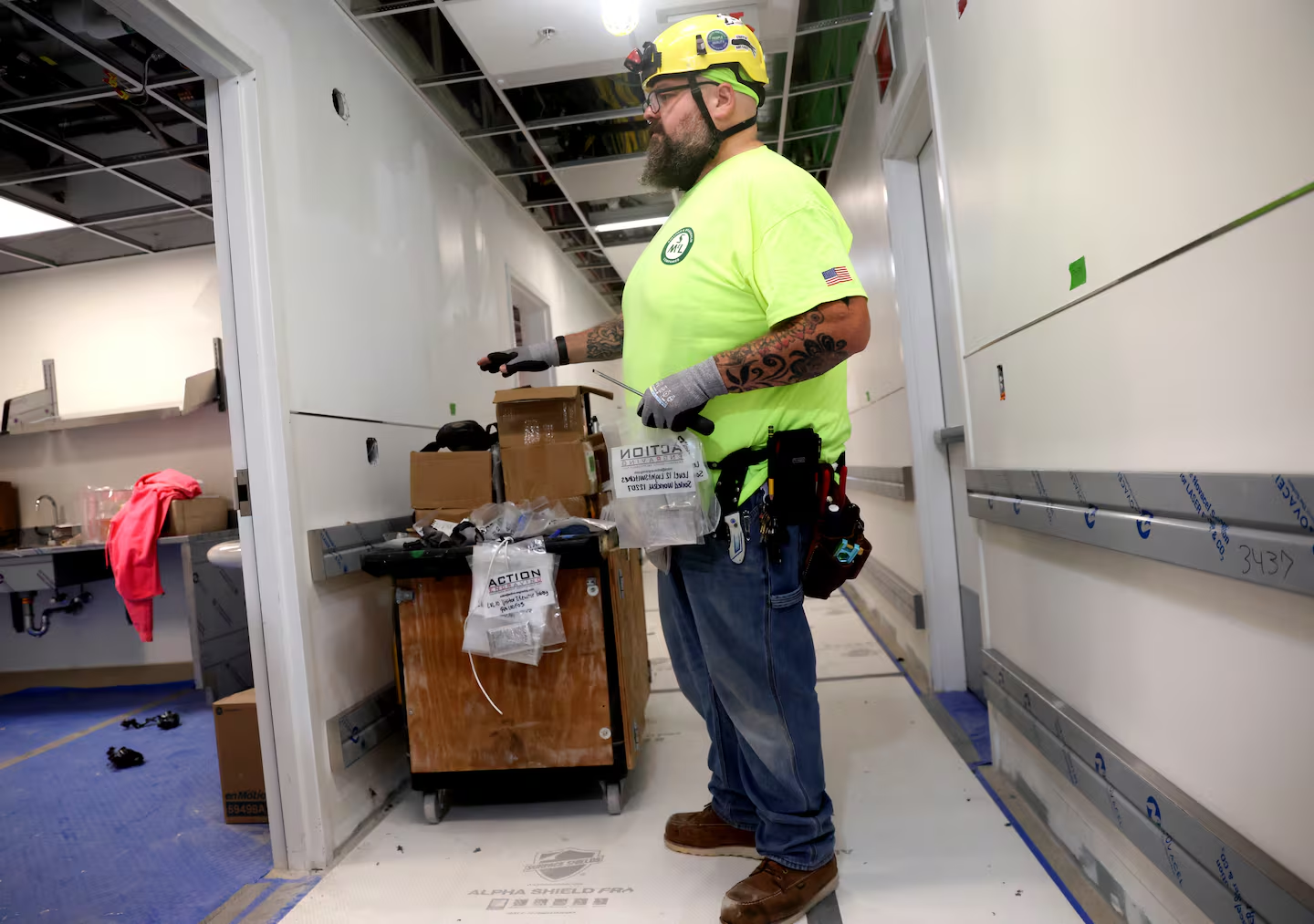
Now at 45, he’s on his last year of apprenticeship, and installing electrical wiring in a large new inpatient building being erected by Mass General Brigham in Boston.
It’s the kind of long-term project tradespeople dream of: hundreds of jobs, a $2 billion budget, and an expected completion date of 2031. Howsen might even get to work alongside his daughter. “My eldest is 19, going to be 20,” he said, ” and she’s going to be starting the program in the fall.”
The Howsens are moving into a job market that needs them badly. The US Bureau of Labor Statistics estimates the US economy needs an additional 81,000 electricians per year to keep up with growing demand and an aging labor force. Other skilled construction workers are also in short supply.
But since new workers must be trained on the job, it takes a constant flow of new projects to fill the labor pipeline. A single data center project can provide apprenticeship opportunities for hundreds of new workers.
Of course, the same is true of a new hospital or hotel. But with US developers still spending more on data centers than on office buildings, it’s easy to see why trade unions want to keep the gravy train rolling.
Read more UEFA says it has lost confidence in FIFA’s Infantino after failed private equity plan for World Cup





Post Comment