The House and Senate have had strong bipartisan votes on housing affordability legislation. So why can’t they get a bill over the finish line?
WASHINGTON — Just about everybody in Congress agrees housing has become unaffordable and that there are numerous things the federal government can do to help solve the problem.
They just can’t agree on exactly what those are.
In the latest sign of the dysfunction in Washington, two largely similar, bipartisan housing affordability bills have been bouncing back and forth in Congress for months as prices for homes and rentals keep rising.
The Senate’s version received unanimous approval in that chamber last year and then 89 votes in March. Across the Capitol, the House version got 390 votes in February and, in the latest development in this back-and-forth legislative drama, earned 396 votes on Wednesday.
The White House officially endorsed the Senate bill this spring and then the House bill on Wednesday. But because neither chamber is willing to accept the other’s legislation without making changes, there is no end in sight as negotiations continue.
“Well, obviously, we’re waiting on the Senate now,” Representative Maxine Waters, a California Democrat who helped shepherd the House bill, told the Globe after Wednesday’s overwhelming 396-13 vote.
Although there were last-minute changes to the House bill to more closely align it withthe Senate’s, there still are some differences that need to be worked out, said Senator Elizabeth Warren, a Massachusetts Democrat and key player on the legislation.
“The Senate passed a bipartisan bill with strong support because we’re in a housing crisis,” she said. “We will continue to work to get a bill passed that can make it through the Senate and to the president’s desk for a signature.”
The differences between the two liberal lawmakers show that this dispute is more between the two sides of Congress than the two political parties. Warren and Waters each are the top Democrat on the two committees handling the bills, and worked closely with the Republican chairs of those panels in crafting the competing legislation.
“This is not a partisan scrum, it is a bicameral one,” said Dennis C. Shea, chair of the J. Ronald Terwilliger Center for Housing Policy at the Bipartisan Policy Center think tank. The organization released a poll this month showing strong bipartisan support on the issue, with 79 percent of respondents saying the cost of housing was an extremely or very important issue.
The bills have the same name — the 21st Century ROAD to Housing Act — and take the same approach to expanding housing supply, incorporating proposals from many lawmakers. The goal is to boost construction of new houses and apartments through reduced or streamlined regulations, and encourage creative approaches, such as more prefabricated housing.
One of those approaches is a $1 billion innovation fund championed by Warren would provide grants for infrastructure, such as new schools and other public projects, to communities that are constructing more housing or changing their land-use rules to make it easier to build.
There’s strong motivation to do something to address housing affordability in a midterm election year.
“I think there’s a desire to get a bill done quickly and have something to show what everyone’s doing on housing ahead of the election,” said Ken Wingert, chief advocacy officer at the National Association of Homebuilders trade organization. “There’s an opportunity for everyone to get a win here with some sort of compromise.”
The provision most in need of compromise revolves around Wall Street hedge funds, private equity firms and other large institutional investors buying homes with cash in a practice that critics, including President Trump, argue has been driving up prices.
Read more If NCAA’s proposed eligibility rule passes, college hockey could be among the sports hardest hit
“I called for Congress to save the American Dream of Homeownership, and ban these purchases, PERMANENTLY!,” Trump wrote on Truth Social on May 11 in endorsing the Senate bill. But in an executive order in January, Trump also called for “narrowly tailored exceptions” for properties built as rentals.
The Senate bill bans large institutional investors from purchasing single family homes but also includes other restrictions on the industry, including one that requires them to sell any single-family homes being used as rentals after seven years. Warren said the sale requirement on so-called build-to-rent homes was needed to prevent private equity firms from funneling all their money into rentals.
“Most members of the Senate right now are pretty clear that letting private equity buy up more and more residential housing and own more and more housing going forward is a bad idea,” Warren told the Globe.
Senator Bernie Moreno, an Ohio Republican, is a strong supporter of the sale requirement.
“We don’t want to create a generation of renters,” he said.
But there was strong pushback from the housing industry, which argued that the Senate bill would choke off money needed to fund the building of new homes.
“There are some people who sincerely believe that institutional investors should not have any role in housing at all, and reasonable people can disagree with that,” said David Dworkin, president of the National Housing Conference, a coalition of organizations including banks, homebuilders, realtors and housing advocacy groups. “I think anybody who wants to invest in making more housing, I want them to make more housing.”
On Tuesday, Waters and Representative French Hill, an Arkansas Republican who chairs the House Financial Services Committee, added provisions on institutional investors to their bill that more closely resemble the Senate’s — although they did not include the seven-year divestiture requirement on build-to-rent homes.
Still, that was enough to earn the White House’s backing.
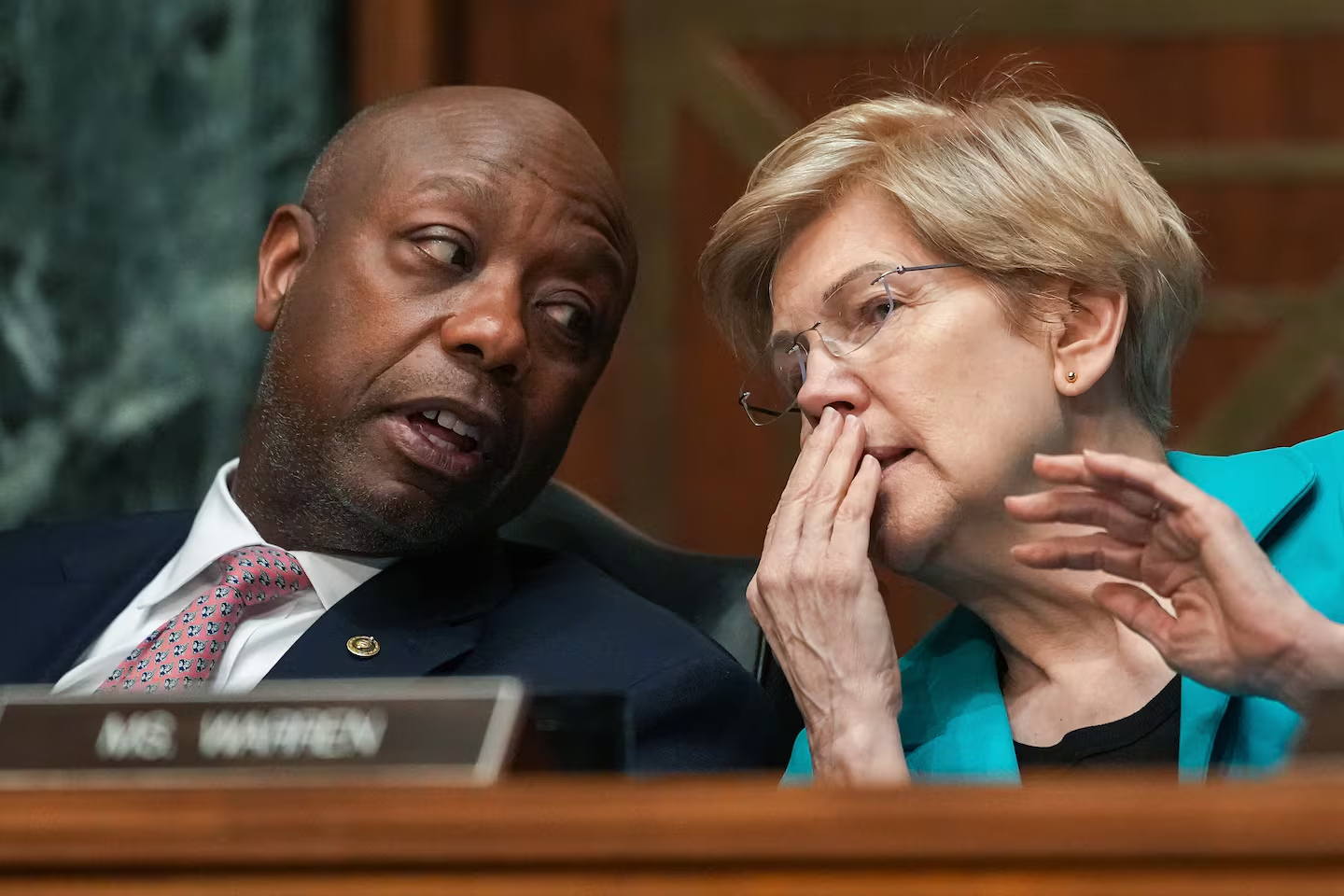
But it wasn’t enough for Warren and Senator Tim Scott,a Republican from South Carolina and chair of the Senate Banking, Housing and Urban Affairs Committee. After Wednesday’s House vote, they issued a joint statement saying that “there’s still work to be done.”
Normally, when the House and Senate pass different versions of legislation they would appoint a formal conference committee to meet and work out a compromise. But there doesn’t appear to be much appetite for that as each chamber tries to push its own bill.
Senate Majority Leader John Thune, a South Dakota Republican, told reporters this week, “I wish they would just pick up the Senate bill.”
House Speaker Mike Johnson countered that after Wednesday’s vote.
“We are grateful that a strong, bipartisan majority of the House voted to pass this legislation today, and we urge the Senate to swiftly do the same,” said Johnson, a Louisiana Republican.
Shea said he supports a formal or informal conference committee — essentially Warren, Scott, Waters and Hill getting together to hash out their differences. He backs anything that would help get legislation enacted to start addressing the housing affordability problem.
“I think it would be a shame if both houses have passed serious bills twice and were unable to move a bicameral package over the legislative finish line to send to the president,” he said.



Post Comment