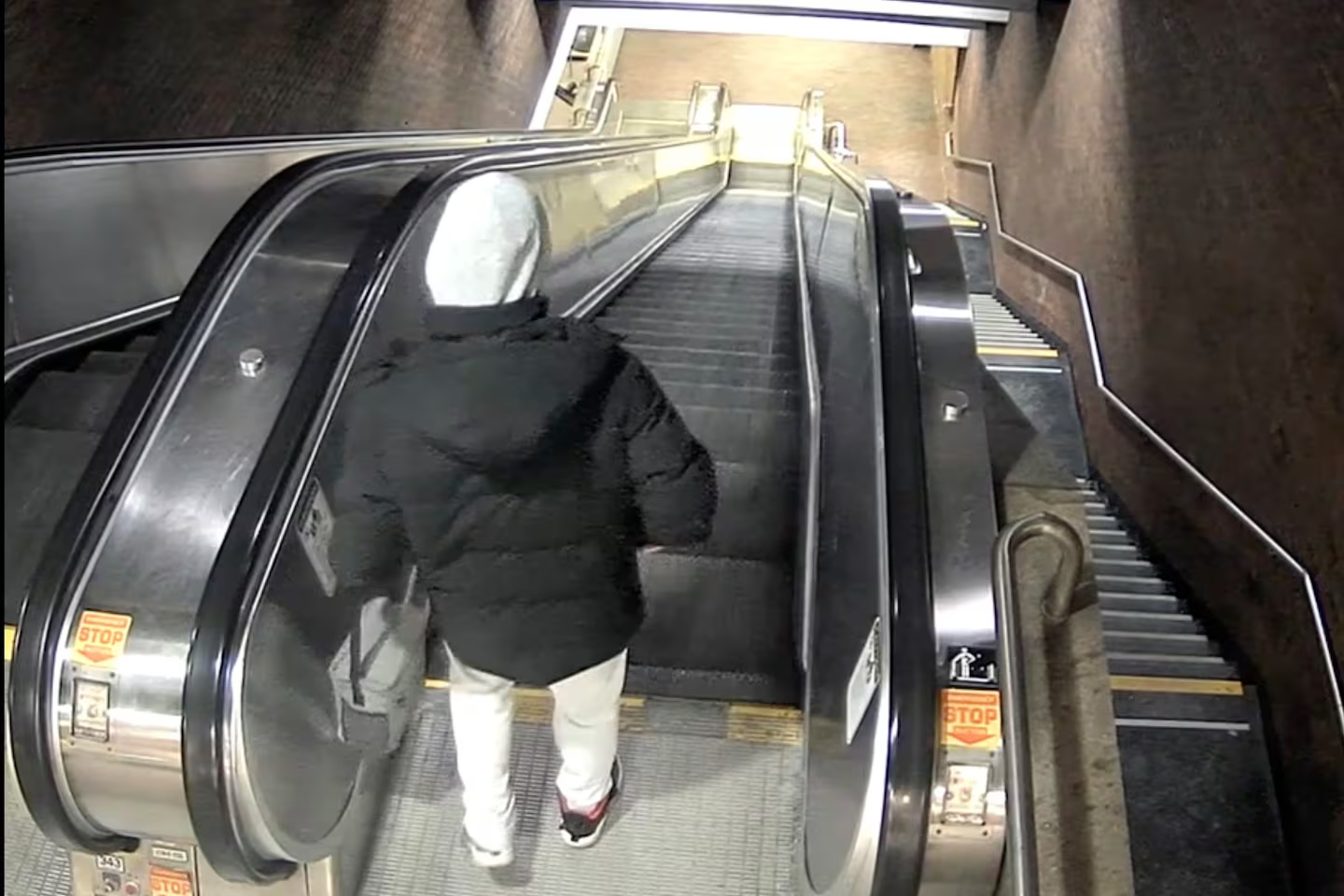
A man lay at the bottom of a moving escalator for 23 minutes. Would you have helped?
You want to think you’d do more.
You watch as much as you can stand of the video of Steven McCluskey falling then getting trapped at the bottom of the escalator at the Davis Square station on a frigid Friday morning, his clothes getting pulled into the machinery and choking him. A couple of minutes later, other commuters start arriving. Some see him, some don’t. Some stop, and some don’t. A couple try to help, but appear to give up. Nobody pushes the button that stops the stairs moving.
Read more Platner earns backing of influential, big-spending Democratic veterans group in Maine Senate race
You hope you would have made better decisions. It’s easy to see now what so many people didn’t see before sunrise on Feb. 27. You’d like to think you would have done the thing that could have saved him.
Would you?
It starts in the most mundane way. McCluskey steps onto the escalator, black jacket, gray hoodie up, at 4:58 a.m., according to the timestamp on the video. He holds the railing and a gray lunch bag in his left hand, then lets go briefly near the bottom. Forty seconds after he steps onto the escalator, he loses his footing on the last step and falls backward. He tries to get up but his clothing is caught in the moving stairs. Still seated at first, he struggles to free himself.
Would you do better than the man in the gray hat?
He arrives at the top of the escalator at 4:59 a.m., 30 seconds after McCluskey’s fall. At that moment, McCluskey is being pulled back into a lying position, his clothes drawn deeper into the stairs. Does the man recognize what he is seeing? He watches from above for 21 seconds before taking the stairs. At the bottom, the man seems like he’s going to keep walking, but he turns back and takes the trapped man’s right arm, briefly. He seems to say something to McCluskey — does McCluskey say something to him? — then walks on.
Why doesn’t he do more? Does he understand how much danger McCluskey is in? Does he try to tell somebody? Is he a bad person? Is he afraid? Is he late for work? Is he sure somebody else will come along?
As the man leaves, McCluskey kicks his legs frantically, trying to free himself. Within two minutes, he stops kicking. By 5:03 he is a man lying motionless at the bottom of a moving escalator.
If you don’t look closely enough to see his clothes are caught in the escalator, he could be any person passed out in an MBTA station, a sight so common as to be unremarkable.
He is alone there for eight eternal minutes. The metal stairs keep coming.
Would you be more aware than the man who walks down the stairs beside the escalator at 5:11, and appears not to see McCluskey at all? A minute later, a person in a blue tie-dyed hoodie stops short at the top of the escalator after seeing McCluskey. He then hurries down the stairs, glancing back as he walks by. The woman who takes the stairs at 5:13 doesn’t seem to see McCluskey either.
Would you do better than the three men who step onto the escalator at 5:14, before seeing him? They reverse direction, struggling to get off the moving stairs, bumping into two other men who are waiting. As they all head for the stairs, one of the five men, in a brown tartan cap, looks down at McCluskey for a few seconds. When he gets to the bottom of the stairs, he and one of the other men stop to look at McCluskey. Another man approaches from inside the station, and at 5:15 he pulls on McCluskey’s legs to try to free him, but can’t. They all head into the station. The man in the brown cap is the last to turn away. Another man — perhaps alerted by the others — comes to look at McCluskey briefly at 5:17.
You hope you would have pressed the button to stop the escalator long before now. You hope that you would know that such a thing is even possible. But that alone will not free him. He is pinned too tightly. Later, somebody from the escalator company will have to be called to extricate his coat.
Read more ‘A tough New Englander.’ Meet the South Natick carpenter’s son frustrating Trump as a federal judge.
At 5:18, a young woman in a gray puffer stops at the top of the stairs then pulls out her phone, presumably to call 911. An older woman in a coat with a fur-lined hood stops, too. They wait there for help to arrive.
At 5:19 a.m., an MBTA police officer is dispatched to the station for a report of somebody stuck underneath an escalator. Somerville police are also called to the station.
A Red Line employee arrives at 5:21, and finally stops the escalator. By then, McCluskey has been trapped for 23 minutes.
Would help have come sooner if you were there?
When EMTs arrive, they find the man bare-chested and unresponsive. They cut away the shirt that is choking him. They give him Narcan and CPR, and eventually he regains a pulse. At 5:54 a.m., they load him onto a stretcher and take him to MGH.
Steven Michael McCluskey died 10 days later, on March 9.
The man at the bottom of the escalator was a 40-year-old father from South Boston, a carpenter who was devoted to his two children, Shayne and Steven. His obit said he loved Eminem and long conversations. He was from a big, loving family, one of seven kids. He had battled substance use disorder, his mother has said, but he always tried to show up for the people he loved.
Earlier this month, NBC10 Boston obtained the surveillance video from the station and showed it to McCluskey’s mother and sister for the first time. That is when they learned he did not struggle alone that morning, but in the presence of at least a dozen commuters. Outrage piled onto their grief.
“I’ll be honest, I have never had such a lack of faith in humanity ever,” McCluskey’s sister Shannon Flaherty told the Globe last week. “It is, for lack of a better word, despicable. I just can’t believe that so many people had the same inclination to just walk by.”
You would hate to be the person whose inaction that February morning worsened this family’s pain. You would see Steven McCluskey as a whole person, and not another unlucky guy passed out in the subway. You would look closely enough to see the situation was potentially fatal. You would put aside your fear, your own needs. Even at 5 a.m., you would have been alert enough to save him, or to call somebody who could.
Read more Jaylen Brown often rubs people the wrong way, but that doesn’t mean he’s not making some good points
You would do better. Of course you would.



Post Comment