As Masters Academy International gears up for its first year, here’s what we can expect, now and in the future
STOW — When Masters Academy International teams take the field this fall, they will wear navy and orange uniforms and be called the Mavericks. The school’s founders like the bold, untamed connotations of that nickname.
Read more A man lay at the bottom of a moving escalator for 23 minutes. Would you have helped?
Another one they could have considered: Tornadoes.
A real-life twister, with winds peaking at more than 100 miles per hour, touched down in Stow last Sept. 6 and stomped its boots all over MAI’s $83 million, 82-acre construction site. It sent trees and debris across the lot. Porta potties became projectiles.
Had that storm hit on a weekday, it would have threatened more than 100 workers. This visitor relocated a few dozen trees at 3:45 p.m. on a Saturday.
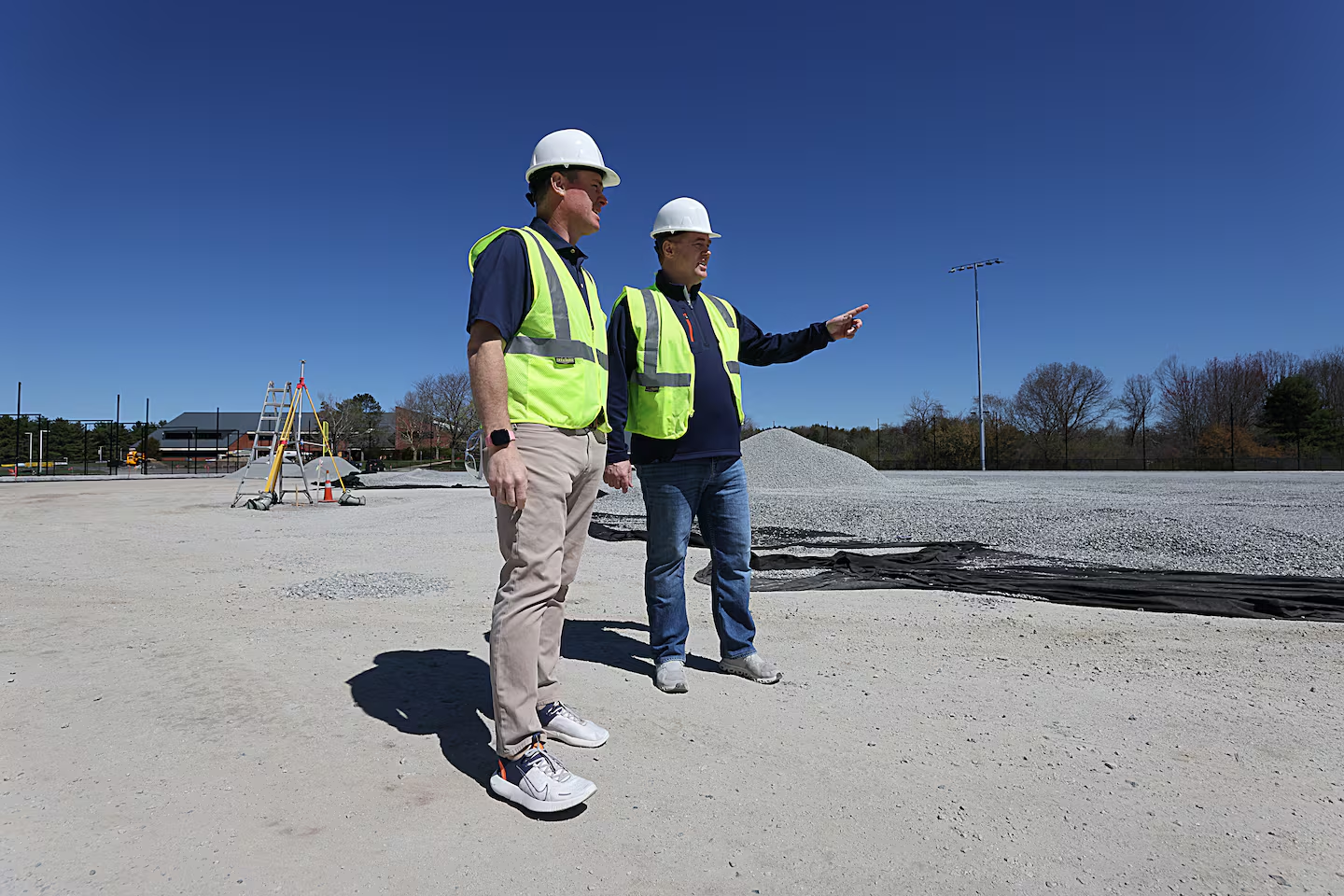
“We got lucky,” said Peter Masters, the school’s cofounder, standing near a pockmarked field in late April. “Who knows who would have been walking out there, who might have been in the bathroom, you know, any of that stuff.”
Masters, 53, and his brother, Chris, 51, now know their buildings can handle a tornado.
And they believe their project will stir up the New England school sports scene.
‘Selling a construction site and a dream’
Masters Academy is entering a crowded market. In New England, leafy, lofty schools with famous and successful graduates are not difficult to find. Alumni networks and family ties are strong.
Its mission is to become the “IMG of the North” by offering a better education than sport-focused academies, more comprehensive training than the preps, and a driven-to-succeed student body.
For the cost of a nice new car — annual tuition is $79,500 for boarding students in grades 9 through 12, $65,500 for day students, and $55,500 for middle-schoolers — MAI had about 200 enrolled in mid-May, and expects nearly 300 students on campus this fall. Eventually, it hopes to double that number.
As of late April, gravel fill was being leveled and concrete dugouts were curing at a $12 million multi-sport turf field. Sheet plastic and dust covered clusters of workout machines in a 10,000-square-foot training center.
To the first class, Peter Masters said, they are “selling a construction site and a dream.”
Abbey Capobianco was a skeptic.
A former three-sport athlete from Framingham who became a youth, college, and pro lacrosse coach, Capobianco had a tough time believing that going all-in, all-year on a single sport would create more well-rounded students. She also wasn’t sure the Masters’ plan was better than the elite schools already established.
“We’re in the backyard of the best preps and publics in the country,” she said.
Eventually, MAI convinced Capobianco to become girls’ lacrosse director, in addition to her duties with the Laxachusetts travel program. She and her colleagues believe the school will create loads of Division 1 athletes across the nine initial sports (baseball, basketball, eSports, golf, fencing, figure skating, lacrosse, hockey, and soccer).
“They’ve put the right combination of time, energy, and resources into this, and left no stone unturned,” Capobianco said. “I’ve had 20 families on campus, and 18 are coming.”
Each of the coaching hires interviewed for this story said they were drawn by increased freedom. NEPSAC (and MIAA) rules limit coaches from working with players out-of-season, or too late in the school day.
Boys’ soccer director James Proctor, formerly of Worcester Academy, said the Masters’ plan mirrors South American and European soccer academies: Athletes will train for four hours daily, with all the extra work they desire (the academic portion is five hours). Instead of 3½ months, each sport goes nine.
“From the first day of school, we can work with players,” girls’ hockey director Jeff Pellegrini said. “We’re not held to any limitations.”
They’re hoping to play the best of the best.
As part of an independent, tournament-heavy schedule, both boys’ and girls’ hockey programs believe they can compete for a spot at USA Hockey nationals. They’ll both visit Minnesota’s Shattuck-St. Mary’s, the first premier hockey academy in the United States, in January.
Though he declined to name her, Pellegrini said he has at least one committed player who starred at the most recent Under-18 World Championship. Boys’ coach Mike Anderson said he had four teams of players committed (U-14, 15-only, prep, and U-18 national-bound).
Read more Platner earns backing of influential, big-spending Democratic veterans group in Maine Senate race
Baseball aims to play IMG — the original — at a September tournament in Maine (an IMG spokesperson, declining to comment on MAI in general, said the school hadn’t committed to that). Masters will travel to Florida in the fall, and play a mix of prep schools, junior colleges, colleges, and high schools.
“It’s 20 to 25 games in the fall, 40 games in the spring, and 120 to 130 practices,” said coach Patrick Moriarty, who came from Deerfield Academy, “as opposed to 20 spring games and 35 to 40 practices.”
Boys’ basketball, which is building around top-50 recruit Antonio Pemberton, will play in the top-tier Nike EYBL travel league, and compete in the Springfield HoopHall Classic in January. A prep team will compete in the NEBL, against prep powers such as Newman, Putnam, and Cushing.
“You’re never telling a kid you can’t get extra help in calculus outside of class,” coach Jason Smith said. “That would be terrible. Why are we doing that for athletics?”
Retired Cushing Academy hockey coach Steve Jacobs pointed out that several preps, including Cushing, have started club teams that mimic a full-season academy schedule, and that many coaches often live on their school’s campus, spending plenty of time with kids.
“I wish them luck,” Jacobs said of MAI. “More power to them. It might not be prep school, but it might be a good fit for some kids.”
MAI has attracted USA Fencing, which will set up a satellite national training center at the school this fall, directed by MAI fencing director and women’s national team coach Ralf Bissdorf. The figure skating director is Stow’s Wendy Enzmann, an international judge and former skater.
The Masters brothers — Boston College hockey alums who have been running the Boston Junior Bruins program going on three decades — hope to add sports, including wrestling and volleyball. They said they wouldn’t rule out football, if there was a high demand for it.
They have plenty of space to expand.
Years in the making
Some 10 years ago, the brothers began working on their sports academy project.
After first considering a too-small, 10-acre plot next to the New England Sports Center (the home of the Junior Bruins and temporary home of Masters hockey), and looking into buying the then-bankrupt International Golf Club in Bolton, they found flat, cleared acres at the former Bose Corporation compound on Great Road in Stow. In May 2024, they bought it for $2.2 million.
The 312,000-square-foot main building was essentially turnkey as office space — it had a kitchen and servery for 1,200, some 6,600 leftover office chairs and 30 100-inch TVs — but MAI is renovating about two-thirds of it to add boarding, classrooms, food service, and athletic training and recovery areas.
On July 19, they’ll open 12 acres of turf, including two baseball diamonds and two FIFA-sized soccer fields, for summer tournaments. During the year, once school practice ends at 5 p.m., clubs and tournaments move in.
Adjacent to the ballfields is a 12,000-foot steel warehouse that used to hold Bose’s latest car audio projects. Plans call for an indoor turf field, about the size of a full baseball infield plus a short outfield, with Trackman technology for baseball and golf.
In July, they’ll break ground on a 40,000-square-foot basketball and volleyball pavilion, to open in the fall of 2027. That will exhaust MAI’s initial funding.
The next phase would be a hockey rink, bubble-covered indoor field, another outdoor turf field, and a fencing pavilion, plus 200 more dorm beds and classrooms.
The founders believe they’ll get there. Tornadoes are hard to slow down.
“I’ve had people [on tours] say, ‘I don’t know. You guys are new. Is this going to be ready? How’s it going to look?’ ” Chris Masters said.
“All the decision-makers, the people running programming, academics, athletics, residential life — no one’s new. What’s new is what families and student-athletes want to be new.”
Read more ‘A tough New Englander.’ Meet the South Natick carpenter’s son frustrating Trump as a federal judge.





Post Comment