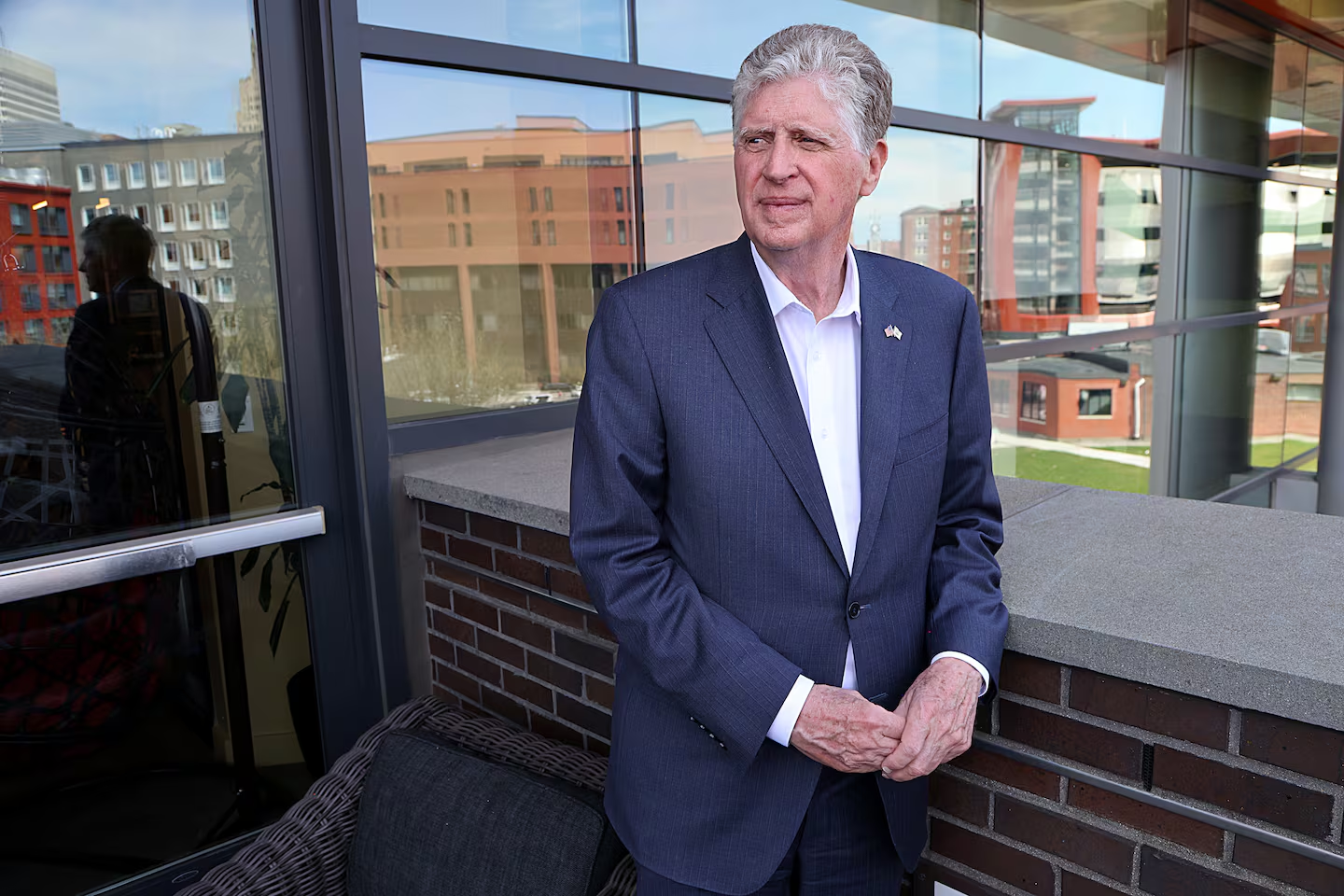
How Dan McKee became one of America’s most endangered governors
PROVIDENCE — Rhode Island Governor Daniel J. McKee is in danger of becoming just the second sitting governor in state history to lose his party’s primary, as weak poll numbers, sagging support within his Democratic base, and the political fallout from a high-profile bridge closure have left his campaign in a precarious position.
With less than 10 weeks until the Sept. 9 primary, multiple polls show McKee trailing by at least 20 percentage points behind Helena Buonanno Foulkes, the former CVS executive who finished a close second to McKee in the 2022 Democratic primary.
“Look, a lot can happen in two months,” Providence College political science Professor Adam S. Myers said. “But I think the dynamics have been pretty much the same for a long time now, and the trend over the past year has been Rhode Islanders moving away from Governor McKee and not toward him.”
Unlike many Democratic primaries across the country this year, Rhode Island’s race is not an ideological showdown between a progressive insurgent and an establishment moderate. Both McKee and Foulkes occupy the party’s pragmatic wing, with Foulkes drawing support from many of the same business leaders and establishment Democrats who once backed former governor Gina M. Raimondo.
Myers said McKee still has a base of support in the Blackstone Valley and among some union workers, having built his political career on the retail politics he honed as mayor of Cumberland for 12 years. In one campaign ad, he has embraced that image by describing himself as “not the most polished.”
Admirers say the approach makes him relatable and authentic. Critics argue it has reinforced a lingering perception that he lacks the leadership many Rhode Islanders expect from their governor.
Those doubts were magnified when state officials closed the westbound span of the Washington Bridge in December 2023 after inspectors discovered a structural failure that raised fears of collapse.
The bridge is a critical gateway linking Providence with Rhode Island’s eastern suburbs, southeastern Massachusetts, and Cape Cod, and its sudden closure upended daily life in a state where most commutes are measured in minutes rather than hours.
Few Rhode Islanders blame McKeefor the bridge’s structural failure, but the fallout has been less generous. The state’s response — from shifting timelines to unresolved questions about accountability — transformed the closure into a defining political issue for his administration.
The crisis created an opening for Foulkes. She has blasted McKee over his handling of the bridge and vowed to fire the state Department of Transportation director, who later resigned. While McKee faced criticism for declining to discipline any state employeesover the bridge, Foulkes argued the episode underscored Rhode Island’s need for more effective management in the governor’s office.
That message has resonated with Democratic voters. Foulkes has consistently outraised the incumbent, and in June she secured enough support at the state Democratic convention to deny McKee the party’s endorsement — an unusually public sign of an incumbent governor’s weakness.
Perhaps the most stunning sign of McKee’s political erosion came in his hometown of Cumberland, where the Democratic town committee endorsed Foulkes over the governor who had led the town for more than a decade before moving to statewide office.
During his inauguration, McKee stood in front of flags from Rhode Island’s 39 cities and towns, and he has highlighted his support from other mayors. But this year, the Democratic committees in 13 cities and towns endorsed Foulkes, including the state’s three largest cities — Providence, Cranston, and Warwick.
McKee secured the endorsements of Democratic committees in Pawtucket, East Providence, and North Providence. And the incumbent is counting on support from the Rhode Island AFL-CIO, which backed him in 2022 and is set to make endorsements July 15. But on July 1, Foulkes announced an endorsement by the Rhode Island Service Employees International Union State Council.
While the candidates vie for endorsements, political analysts say the biggest obstacle for McKee is the Washington Bridge.
An April 23 poll by the University of New Hampshire found 79 percent of voters disapprove of how McKee is handling roads and bridges — a reflection of anger and frustration over the Washington Bridge.
“The bridge plays a big role in the job approval numbers because people see it every day,” veteran Rhode Island pollster Joe Fleming said, “and it’s just a thing that has not gone away for the governor.”
McKee had originally called for having a new Washington Bridge built by September 2026 — just in time for the election. But now plans call for opening the new bridge by November 2028. “In that sense, McKee has overpromised and underdelivered,” Myers said.
McKee vowed “a day of reckoning“ as the state sued 13 contractors over the Washington Bridge’s failure. But McKee stood by former Department of Transportation director Peter Alviti Jr. for more than two years before he retired in February. And Myers said, “If there is one thing voters want when there is a fiasco, it’s they want the problem fixed, but they also want accountability.”
The McKee administration also has dealt with the botched rollout of a new $95 million payroll system — a lawsuit claims it resulted in missed paychecks, underpayments, and missed overtime for as many as 20,000 state employees — and pieces of an Interstate 95 ramp collapsing onto Amtrak railroad tracks, disrupting service between New York City and Boston for days. It all feeds “an image of incompetence,” Myers said.
Fleming noted that while McKee’s favorability rating was just 18 percent in a June 30 UNH poll, Foulkes didn’t fare much better at 26 percent.
Even so, political analysts say the dynamic is less about Foulkes’s popularity than McKee’s extraordinary vulnerability. Last year, Matthew Klein, then an analyst with the Cook Political Report, described McKee as “probably the most vulnerable Democratic governor in the country to a primary” and “among the two most vulnerable governors overall.”
For months, the McKee campaign has been hammering away at Foulkes’s role as a CVS executive in the opioid crisis.
In December 2024, the US Department of Justice sued CVS Pharmacy Inc., accusing the Woonsocket-based pharmacy giant of unlawfully prescribing controlled substances, and seeking reimbursement from federal health care programs for more than a decade.
“Not all drug deals look alike,” a McKee ad begins. “On Helena Foulkes’s watch as President of CVS, the company fueled the opioid crisis, prioritizing their own profits.”
Fleming said the UNH polls showed 32 percent of voters are “neutral” on Foulkes, so he expects the McKee campaign to continue such attacks to drive up her “unfavorable” numbers.
Robert Walsh, an influential Democratic strategist and former executive director of the state’s largest teachers’ union, is among those who believe McKee can still recover.
While acknowledging the political damage caused by the bridge, Walsh argued that Rhode Island voters have a history of judging governors harshly before ultimately sticking with them.
“Rhode Islanders are always tough graders on their incumbents, but often can look beyond the bridge when it comes to voting in the Democratic primary,” he said.
McKee’s predecessor, Raimondo, who elevated him to the governor’s office when she resigned in 2021 to become US commerce secretary in the Biden administration, also endured chronically poor approval ratings before winning reelection in 2018.
Walsh said McKee still has time to turn his campaign around.
“When they remember the governor’s considerable accomplishments on jobs, education, housing, and so many other areas, when they fully reflect on his overall record, voters will resort back to where they usually resort and support the incumbent,” he said.
Myers said polls show McKee still enjoys support in the more working-class areas of the state. But he said McKee is in danger of becoming the first Rhode Island governor to lose a primarysince 1994, when Bruce Sundlun lost to Myrth York amid fallout from the state’s credit union crisis.
One big factor, Myers said, is that McKee is essentially facing Foulkes one-on-one in this year’s Democratic primary, which includes some lesser known candidates.
In 2022, by contrast, McKee received 32.8 percent of the vote, edging Foulkes at 29.9 percent, then-secretary of state Nellie M. Gorbea at 26.2 percent, Rhode Island Political Cooperative co-chair Matt Brown at 7.9 percent, and Dr. Luis Daniel Muñoz at 3.1 percent.
Fleming said televised debates will provide McKee with a chance to turn the race around.
“He has to come across as forceful, strong, and knowledgeable,” he said. “We know she is a good debater — we saw that four years ago. He has to be a good debater this year.”
But Fleming also noted that early voting begins Aug. 20. “Time is getting short,” he said.
Read more Dodgers star Shohei Ohtani to have left knee drained and miss All-Star Game


Post Comment