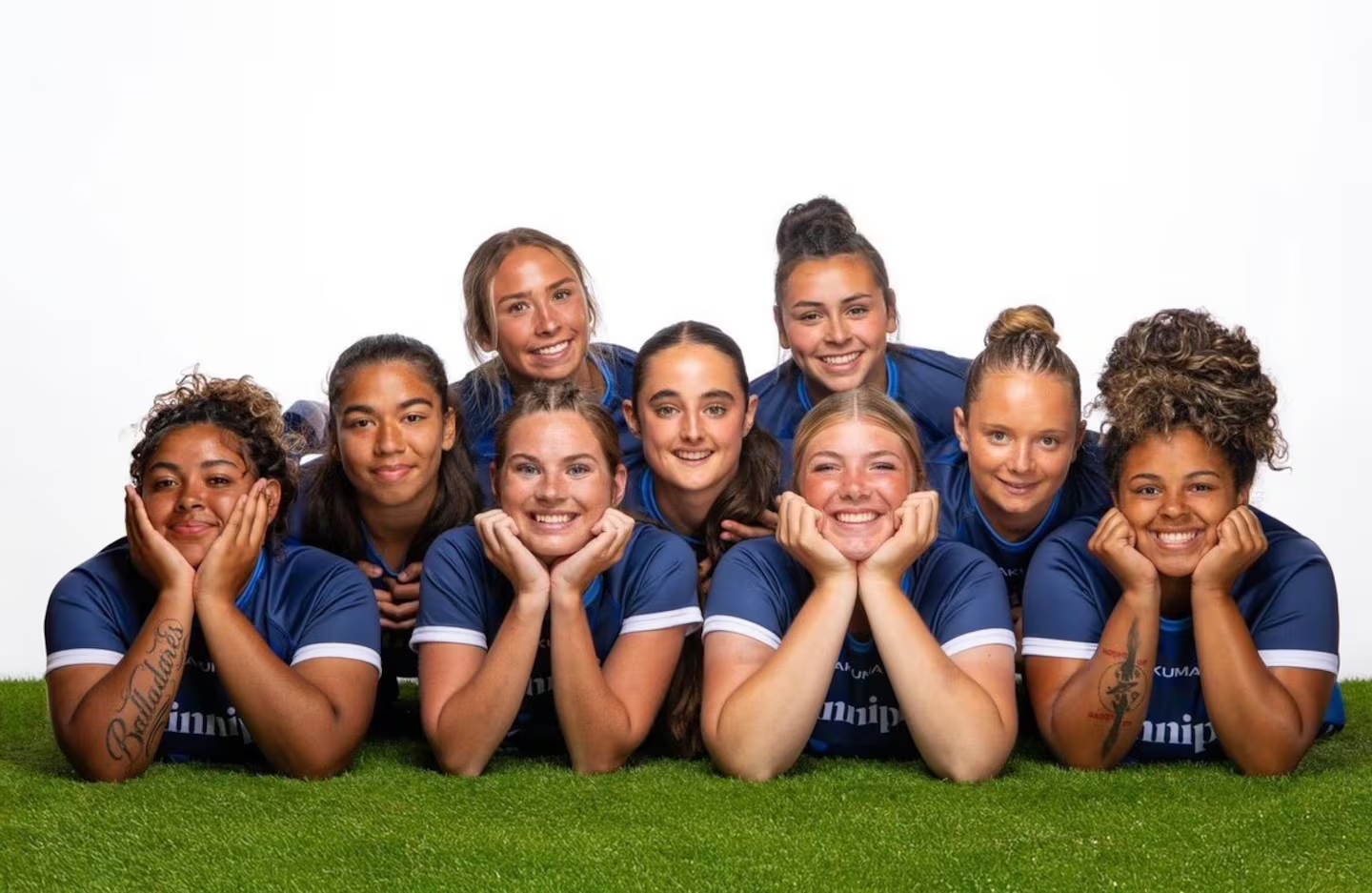
Women’s rugby vs. Quinnipiac anything but a game in Title IX fight against diminishing sport to club status
Tuesday morning, April 14, in Hamden, Conn. Fresh off hosting a weekend tournament on campus, filled with the energy of a successful spring season, the Quinnipiac women’s rugby team is riding high. Players gather in their locker room, preparing for practice. Excited chatter hums in the air, infectious, spreading as players talk of goals for the upcoming fall season. As one of the university’s most storied sports programs, they dream of adding a fourth national championship to the trophy case.
The world is good.
For Carolyn Melody, a rising sophomore, the future beckons with such joy. She can’t wait for the fall. As a freshman with an impressive rugby résumé dating to middle school, Melody started the first four games of her debut season, when the team played 15s and competed for conference and national titles. When a thumb injury ended her season early, she rehabbed intensely enough to return for the spring 7s season.
With practice about to begin that April day, Melody heads toward the training room to get her hand taped.
She has no idea what is coming.
Teammate Reagan Perez walks into the room, reading from a notification on her phone. The team is being summoned to a meeting with athletic director Greg Amodio and deputy director Sarah Fraser. They have 15 minutes to get there. Kids in class? Out of luck. Coaches are not included. Phones are left behind, stored in lockers for practice, as they file upstairs.
There, Fraser reads from a prepared statement about an organizational restructuring of the athletic department. Women’s rugby would no longer be a varsity sport, reclassified to club status. The room falls silent. In shock.
“In that moment, as somebody who naturally tries to take charge, it was really hard to feel hopeless,” Melody recalled. “There were girls sobbing on my shoulder. I didn’t know what to do. I was trying to control myself, to go into that mode of, ‘What comes next.’ I was thinking, ‘What now?’ ”
The “now” has led Melody and Perez to join 23 current and prospective players at the front of a class-action complaint against the school, its board of trustees, the president, and AD. In a June 5 filing, in the US District Court in Bridgeport, the plaintiffs alleged that the demotion of the rugby team constitutes a violation of Title IX of the Education Amendments of 1972, as both gender discrimination and illegal retaliation for Title IX complaints made by the team’s head coach, Becky Carlson.
While an email asking for comment went unanswered by Quinnipiac’s athletic communications, Amodio’s comment in an official news release April 14 said: “These decisions are never easy, but they are essential to ensuring that Quinnipiac Athletics remains equitable, competitive, and sustainable for the long term.”
The players fight for themselves and for their program, and they fight for a larger cause. Like the proverbial canary in the coal mine, this is the fear for women’s sports in the face of the recent House vs. NCAA settlement regarding name, image, and likeness payments to college athletes. As the bigger men’s revenue sports get bigger, the more recent, growing segment of women’s sports gets smaller.
“I just think, as a broader community, it really is going to shine a light about if this happened to us, who’s going to be next?” Melody said. “Because I think as things continue to develop, it’s really going to be a warning sign. We’re seeing it kind of across the country with other sports, and I think that it really should, especially for incoming recruits and the younger players that are looking to commit to these schools, make us take a deep look and look at the history of the school, and also kind of learn about the future, because they too could be in this position that a year ago when I was an incoming freshman, looking forward to the next four years, never believed that I’d see myself in.”
Read more Dodgers star Shohei Ohtani to have left knee drained and miss All-Star Game
Despite a recent setback when Judge Kari A. Dooley on June 30 denied the request for a temporary restraining order/preliminary injunction to stop the change, Dooley did commit to issuing a condensed case management schedule to bring the full case, and all the discovery within, to trial as quickly as possible.
“To me, it’s most important that people understand that even though this motion was denied, it isn’t determinative of whether or not there is a viable cause of action here,” said plaintiffs’ attorney Christine Brown. “We continue to believe the record shows clearly that a successful women’s varsity program with real institutional value has been targeted, while other responsibilities under Title IX and basic fairness have been ignored. We believe that Quinnipiac is still choosing to downgrade a women’s varsity program it once relied on as part of its Title IX posture, even after athletes, alumni, and experts have raised serious questions about the rationale.”
Among those voices is Ilona Maher, the program’s most famous alum and bronze medalist at the 2024 Paris Olympics. Maher lambasted her alma mater on her popular podcast “House of Maher,” calling the decision, and the way it was handled, “shameful.” She feels for people like Melody, who chose Quinnipiac for its perfect combination of academics (the sports communication major earned a 4.0 GPA in the fall) and a legacy and tradition of big-time rugby, knowing that this late spring decision leaves them with little to no time to transfer.
Classes were selected, game plans were being learned, recruiting was ongoing. What do they do now?
“To this day, right now, I’m still in that limbo,” Melody said. “I have a really good opportunity here for academics and rugby, but I want to be in an environment where I feel wanted. I committed to the school and they failed to commit to me. It’s hard to think about.
“I want to let people know I’m OK, but I’m not OK.”
Of course she’s not OK. But she is determined. She’s thinking about law school, so that somebody, someday might be able to navigate the current morass of college sports, to understand how Quinnipiac can cite Title IX compliance among its rationale, and then demote women’s rugby while adding men’s indoor and outdoor long distance track teams as a way to do it.
“This decision looks like a confirmation that our lives and our work can be treated as numbers on a spreadsheet, and it is deeply disappointing,” she said. “We are a nationally recognized championship caliber of women’s rugby that Quinnipiac once pointed to with pride, and yet we are being downgraded.
“If a program like ours can be pushed aside despite its success and institutional value, then every other emerging women’s sport has a reason to worry about what comes next when budgets tighten or models shift. This is bigger than our team. It is a warning sign about how easily women’s and Olympic pathway sports can be sacrificed in this new college sports economy.”
Read more Victor Wembanyama, Spurs agree on five-year, $250 million deal





Post Comment