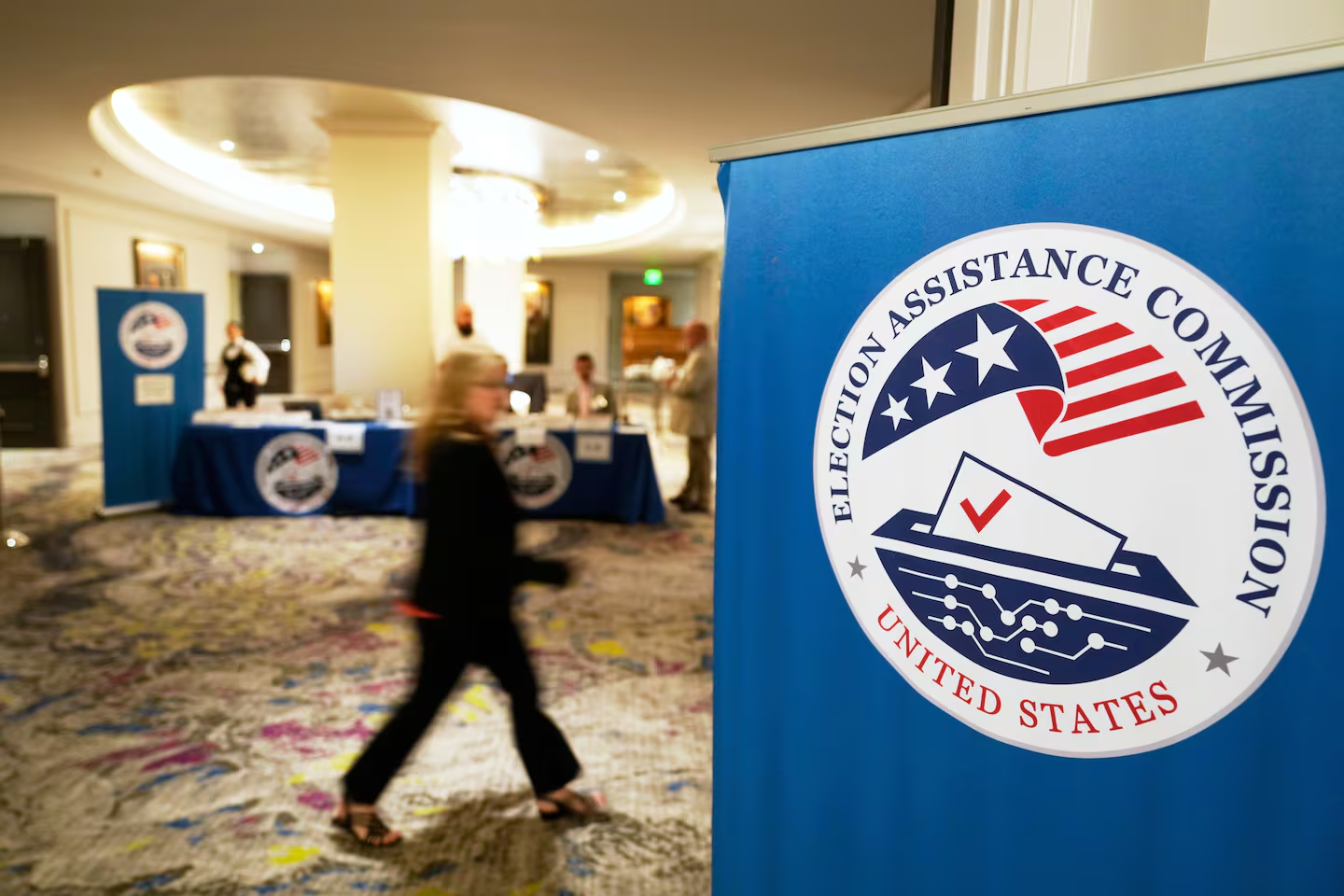
Trump administration fires members of independent election group
WASHINGTON — The Trump administration has forced out the three remaining members of an independent, bipartisan commission that supports states in administering their elections, the White House confirmed Thursday. The move comes as President Trump seeks to cast doubt on the outcome of the upcoming midterms and impose control over how ballots are counted. Trump terminated, effective immediately, Thomas Hicks and Benjamin Hovland, two members selected by congressional Democrats to serve on the Election Assistance Commission, and accepted the resignation of a Republican member, Christy McCormick.
Read more Graham Platner withdraws from Maine Senate race, kicking off Democrats’ quest for nominee
The board has no other remaining members, as its fourth commissioner resigned this spring.
An unidentified White House official said in a statement that Trump reserved the right to remove individuals who “may not be totally aligned with the important task of securing America’s elections and ensuring every legal vote is counted.” The White House official cast the dismissals as part of the federal government’s strategy to work across agencies to safeguard elections from fraud and abuse.
The official pointed to the recent decision in which the Supreme Court ruled that Trump had the authority to fire most independent regulators for any reason, ushering in a vast expansion of presidential power. Trump had hailed the decision as “the Greatest Increase in Presidential Power in the last 100 years,” and said it came down “at such an important time!”
The two Democratic members who were fired received their termination letters via an email from Morgan Dewitt Snow, whose signature identified her as the deputy director of presidential personnel.
“On behalf of President Donald J. Trump,” read the email, which was obtained by The New York Times, “I’m writing to inform you that your position as commissioner of the Election Assistance Commission is terminated effective immediately. Thank you for your service.”
Trump has been laying the groundwork for months to assert that Republicans would face a tough midterm election, not because of the broadly unpopular war in Iran and plummeting approval ratings on the economy, but because of a baseless claim that the country’s election system is fraudulent.
On Friday, Trump refused to sign significant housing legislation, a decision he framed as a protest against Senate Republicans for failing to pass a voting restriction bill. The president has ramped up his efforts to pressure Republicans to pass the voting bill, called the SAVE America Act, after he faced pushback from his party this year when he issued an alarming call for Republicans to “nationalize” voting and take over election administration from states.
Trump, who has falsely claimed that the election he lost in 2020 was “rigged,” has been pushing legislation that would impose stringent voter identification requirements. He has called for significantly curtailing the use of mail-in ballots, which he has claimed without evidence that Democrats have used to cheat. (Trump voted by mail in a special election in Florida in March.)
The Election Assistance Commission was established by Congress in 2002 after the Florida recount episode that marred the 2000 presidential election. It is generally viewed by election administrators as an important federal ally and a guardrail for ensuring smooth elections across the country, though for years it has drawn criticism from some Republicans, who viewed it as an unnecessary federal entity.
Read more DHS was granted $20M for body cameras. ICE agents in fatal Houston shooting had none.
According to its website, the commission guides states in ensuring they meet voting requirements, oversees testing and certification of voting systems and disperses funding to help states meet requirements. It serves as a national clearinghouse for information on election administration and maintains the national mail voter registration form established by the National Voter Registration Act of 1993.
After Russia’s election interference efforts during the 2016 presidential campaign, the commission sharpened its focus on cybersecurity issues, supporting states alongside the Cybersecurity and Infrastructure Security Agency as they reviewed and improved safeguards on their voting machines. Trump in his second term has overseen major cuts at the cybersecurity agency, which has not had a Senate-confirmed director since he returned to the White House. Now, after the ousters at the election commission, the two primary points of contact for state and local elections officials are leaderless.
In an interview, Hovland said he had been traveling for his job and preparing for a semiannual gathering of top state election officials next week in Rapid City, S.D., when he learned Thursday afternoon that he had been fired. He said the decision “was not unexpected” after the Supreme Court last week gave the president broad power to fire independent government regulators.
Hovland said the staff at the commission, which currently hovers around 60 people, was expected to continue its work supporting election officials. The small agency, which was given an annual budget this year of about $24 million by Congress, focuses on the unglamorous but important work of elections administration, he said.
“It is harder than it has ever been to run elections. Resources are stretched incredibly thin,” Hovland said. “We were out there to try to help those folks and be a source of best practices.”
Last year, Trump issued an executive order that calls on the Election Assistance Commission to require people to show government-issued proof of US citizenship to register to vote in federal elections and directs state or local officials to record and verify the information. It also seeks to require states to count ballots by Election Day. A judge permanently blocked the order, saying the president exceeded his authority.
Michael Waldman, president and chief executive of the Brennan Center for Justice at the New York University School of Law, in a statement called the terminations “deeply concerning in light of President Trump’s relentless efforts to try to interfere in elections.”
The removals also drew fierce condemnation from Democrats.
In a joint statement, Senator Alex Padilla, Democrat of California, a top member of the Senate Rules Committee, which has jurisdiction over federal elections, and Representative Joe Morelle, Democrat of New York, called the firings “illegal” and politically motivated.
“Trump continues to double down on his efforts to erode trust in our elections, undermine independent oversight and further his administration’s attempt to ‘take over’ elections,” the statement said. “Americans deserve elections that are safe, secure and run free from political interference — not overseen by partisan loyalists and election deniers beholden to Trump.”
Read more In replacing Platner, Democrats are haunted by Biden-Harris switch
This article originally appeared in The New York Times.


Post Comment