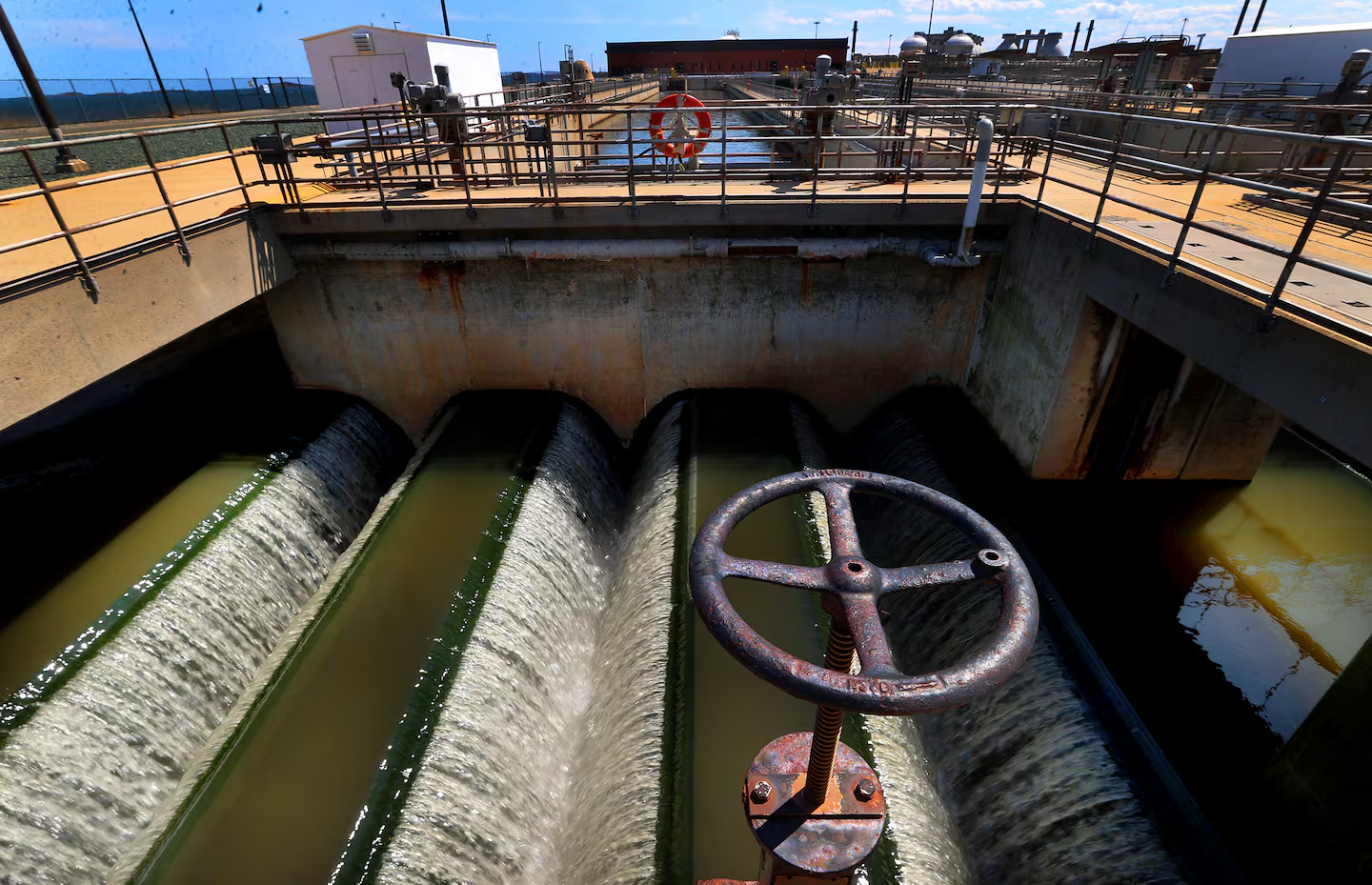
Waste water wars: Massachusetts company loses state contract as public health evolves
Not long after COVID-19 began spreading in the spring of 2020, a Cambridge startup helped launch a new era of disease surveillance.
Read more ‘Almost a legal scam’: Nearly a million investors lost $3.8 billion on Trump crypto coin
Biobot Analytics, founded by two MIT students, transformed the dirty business of sewage into an important new public health tool. By analyzing waste water from treatment plants, the company detected traces of the coronavirus days before infections showed up in hospitals and testing sites, providing a harbinger of where the disease was spreading — or not — at a time when the nation was in lockdown and on edge.
News organizations began tracking waste water movement much like they would the weather, and Biobot quickly became a reliable indicator for the US Centers for Disease Control and Prevention, the State of Massachusetts, and dozens of municipalities and other customers.
But Biobot no longer has the field to itself, and in the years since the pandemic, waste water surveillance has evolved from an emergency response into a routine public health tool.
For example, the CDC had terminated its contract with Biobot in 2023, selecting a Google-affiliated company as a replacement. More recently, Massachusetts’ partnership with Biobot ends on July 31, and with it a contract worth $400,000 a month. The state will instead do its own testing, which officials say will cost about one-quarter as much.
“I aspire for Biobot to be an independent source of truth,” said its chief executive, Mariana Matus. “I’m very sad about the state’s contract, because it’s a huge hit for my company, but I also think it’s a mistake.”
Biobot still has a large number of government customers, but the young company is now distinguishing itself by concentrating on much broader surveillance programs for diseases and other indicators that are beyond the focus of most state-run monitoring programs.
The company was founded in 2017 by Matus, a computational biologist, and Newsha Ghaeli, an architect and urban planner, while they were graduate students at the Massachusetts Institute of Technology. It has raised over $40 million since 2017.
“I fell in love with science because of ‘Jurassic Park,’” Matus said with a laugh. “I wanted to use science to change the world.”
People infected with viruses and other pathogens shed genetic material in their waste, allowing scientists to measure what diseases are circulating across communities by testing waste water. The company deploys a technology called metagenomic sequencing to read the genetic material in a waste water sample and identify thousands of viruses and other microbes at once.
As a doctoral student, Matus said she became convinced that waste water surveillance could reveal the hidden health of communities, from infectious disease to drug use, in near real time. Waste water surveillance has long been used in parts of Europe and Australia to monitor illicit drug use and in some countries to track polio. But at the time, she said, no company in the United States was offering waste water monitoring as a commercial service.
“Our mission is to transform waste water infrastructure into public health observatories,” Matus said. “Our vision is to continue to build that into a data platform.”
Partners quickly jumped on board, and competitors followed suit.
In 2014, Biobot’s sequencing work helped identify signals of avian flu in waste water before officials fully understood how widely the virus had spread among cattle. The same approach helped detect measles signals months ahead of outbreaks in a dozen cities, said Anthony Maresso, a Baylor College of Medicine researcher whose lab works with Biobot.
In Nantucket, the Department of Public Health expanded its partnership with Biobot in 2023 to monitor illicit drugs. Waste water testing revealed persistently elevated cocaine levels, which led to six people being charged with cocaine trafficking or distribution, in what authorities described as the largest seizure in the department’s history: nearly 6 pounds of cocaine seized in February 2025.
Nantucket police Chief Jody Kasper said information from Biobot provided valuable insight into the types of drugs present in the community. While the data is not tied to specific criminal investigations, “It has helped us better understand overall trends. The levels of cocaine detected were particularly concerning,” Kasper said.
“Our Detective Division has been proactively targeting narcotics offenses over the past two years, and those efforts have resulted in multiple drug trafficking arrests,“ Kasper said.
Marc Johnson, a University of Missouri virologist, said waste water testing has shed light on a shocking amount of cocaine use nationally, along with glimpses into diseases that otherwise spread unnoticed through communities.
In July 2023, after Biobot’s contract with the CDC ended, the agency awarded a new contract to Verily, a Google-affiliated health technology company, in partnership with Emory and Stanford universities, for a program they call WastewaterSCAN.
Read more Game 87: Red Sox at Angels lineups and preview
Combined waste water testing at federal, state, and local levels and private sites captures 41 percent of the American population, according to Margaret Honein, director of the CDC’s Division of Infectious Disease Readiness and Innovation.
Massachusetts did extend Biobot’s contract for one month to cover the influx of travelers for the World Cup. In June, the company used the World Cup as an opportunity to launch a public dashboard tracking waste water in 11 cities, including Boston, showcasing genomic sequencing technology capable of detecting more than1,500 human and animal viruses from a single sample.
Catherine Brown, Massachusetts’ state epidemiologist, noted federal funding helped kick-start waste water testing. “At the time, because we were not using waste water testing already, most jurisdictions contracted with companies that provided those services.”
But as the emergency phase of the pandemic faded, federal funding priorities shifted. Rather than continuing to pay vendors, states were encouraged to build their own capacity.
Brown said Massachusetts researched waste water testing methods at the State Public Health Laboratory and expects to launch the in-house program in the fall. It will focus on diseases “people don’t test enough for anymore,” she said, including COVID-19, influenza, RSV, and mpox.
The state will monitor fewer locations than during the pandemic: 12 large municipal waste water treatment facilities, down from 60, that each serve about 95,000 people. Brown said those sites should provide a representative picture of disease trends while sharply reducing costs.
While Biobot is capable of detecting tick-borne diseases and other pathogens, Brown said she doesn’t think the state needs more extensive testing.
“You can test for almost everything,” she said. “But what do you want to test for, and how is it actionable when you find it?”
Massachusetts isn’t alone. States including Maine, Rhode Island, Ohio, Wisconsin, and Missouri have built or expanded in-house waste water surveillance programs as the federal government has encouraged states to develop their own laboratory capacity.
Matus said it’s “a good sign” the states believe waste water monitoring is important, but moving work in-house could also create redundancy.
“To some extent, it brings independence from a private sector partner; however, I think that it’s a mistake to only do work in-house because then your technology cannot advance as fast as what the industry is going through. It’s very hard to keep up with the pace of technology development,” she said. “For the same price point they may be doing five pathogens, they could be doing the whole thing.”
For now, Biobot’s new public dashboard displays viruses including respiratory and gastrointestinal pathogens, measles, mpox, rubella, dengue, and Zika. Biobot says it will reportother dangerous findings, such as Ebola or hantavirus, directly to public health authorities.
Biobot still works with dozens of communities and agencies, including Nantucket and Gloucester, in 40 states; federal agencies, such as the Office of National Drug Control Policy; and vaccine manufacturers, which use the company’s data to better understand how diseases are spreading.
“The company is doing very well despite the headwinds,” Matus said.
She argues government laboratories and private companies ultimately serve different roles. While many state labs focus on monitoring a handful of pathogens, Biobot is investing in technologies capable of detecting thousands.
“We’re optimistic about the long-term future because the opportunities are that big,” she said.
Matus likens waste water surveillance to another technology that initially struggled to find believers. “If you had asked people before the iPhone if they needed it, they would have said no. I think it’s the same with waste water epidemiology,” she said. “Even when we started the COVID-19 work, there were always people saying it was useless. And then, over time, it just became part of public health.”
Read more Exploring how the picks the Celtics received for Jaylen Brown could shake out, and other thoughts


Post Comment