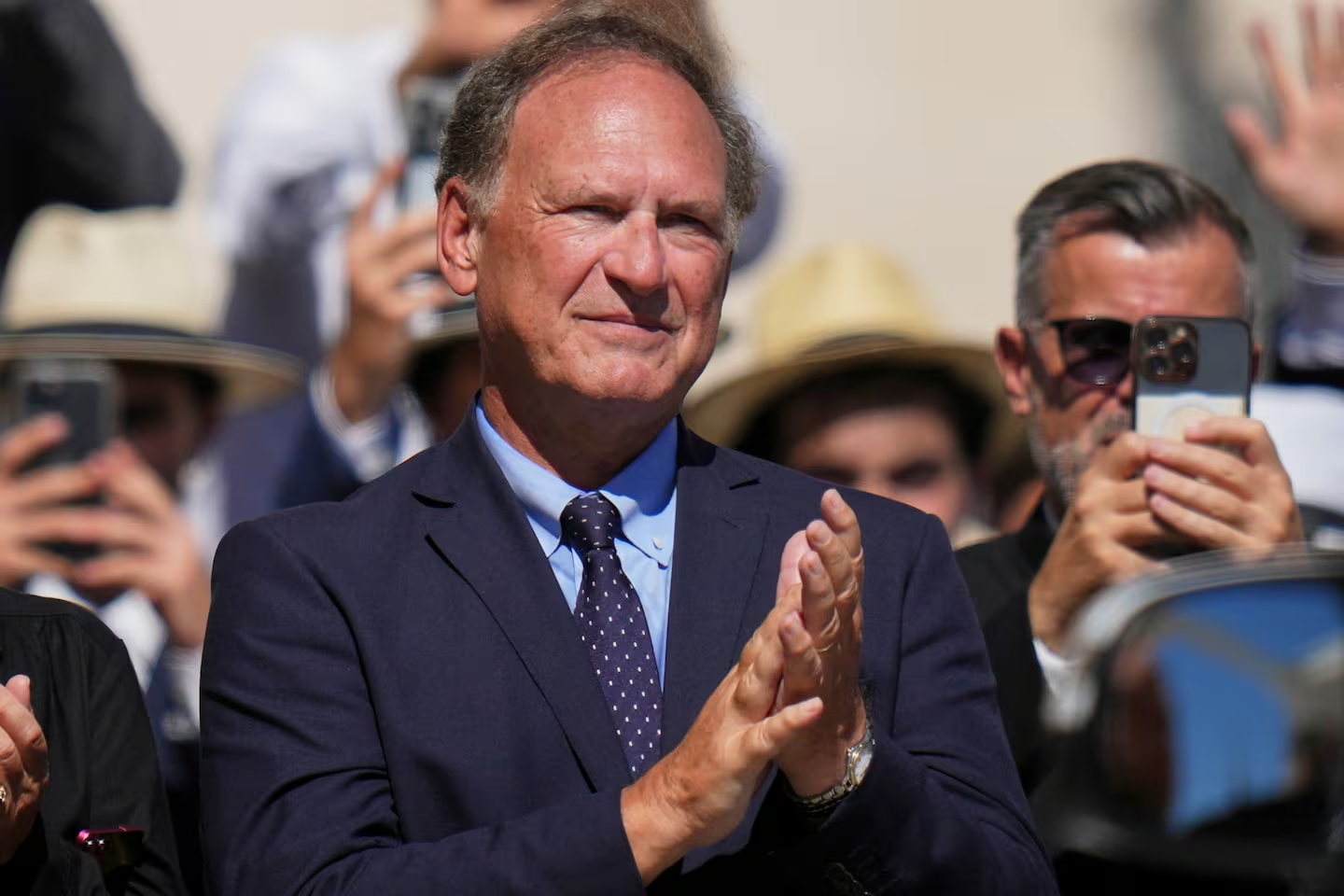
In backing President Trump’s policies, Justice Alito finds his moment
WASHINGTON — As a boy in suburban New Jersey, Justice Samuel Alito Jr. lay awake at night, listening to the click of a calculator as his father wrestled with how to redraw the state’s voting maps.
Read more Waste water wars: Massachusetts company loses state contract as public health evolves
The justice’s father, who worked for the state Legislature, had been tasked with drawing new maps after a series of decisions in the 1960s by the liberal, Earl Warren-led Supreme Court established a “one person, one vote” rule that districts should be of equal population.
Alito has said that his father’s redistricting efforts were an animating force for him, causing him to be skeptical of court oversight of redistricting. Those early experiences came to the surface in the Supreme Court term that ended on Tuesday, when he wrote a landmark decision weakening the Voting Rights Act, making it harder to bring race discrimination claims challenging election maps.
In his two decades on the court, Alito has emerged as one of the most reliable conservative votes, and has also gained the trust of Chief Justice John Roberts Jr., who has assigned him to write opinions in major cases.
At 76, Alito is the second-oldest justice on the court. And although some justices have served well into their 80s, Alito’s age and political alignment with President Donald Trump prompted feverish speculation in recent months that he would retire before the court’s next term begins in October.
Such a move would allow the president to choose his successor — Trump’s fourth pick for the court — and to do so while Republicans hold the Senate as their political fortunes appear to wane.
Alito did not respond to a request for comment, but several people close to him said that he expected to be on the bench in October. As a senior justice and part of the court’s conservative supermajority, they noted that Alito had wielded tremendous influence on long-sought conservative goals.
The speculation about Alito’s future burst into view this past week, when National Public Radio published a story reporting that the justice was stepping down. NPR quickly retracted the story, and veteran court reporter Nina Totenberg issued an on-air apology. But that did not calm the rampant speculation that a retirement was imminent.
But people close to him, who spoke on condition of anonymity to share private conversations, insisted that was not the case.
This term, Alito wrote decisions that restricted the path for asylum seekers, ended deportation protections for hundreds of thousands of immigrants from Haiti and Syria, and expanded gun rights. He demonstrated that he could get enough votes on these thorny issues, and was in the majority in divided decisions more often this term, even as he moved farther to the right.
“Justice Alito had a hand in many of the most influential decisions, held together majorities and continued to write in ways that advanced many of the conservative legal movement’s causes over the last 50 years,” said Derek T. Muller, a professor and election law expert at Notre Dame’s law school.
Alito and Justice Clarence Thomas were the only members of the court who sided with Trump in every case involving a major Trump administration policy. Though he was not always in the majority — he was on the losing side on a number of pressing issues, including the fate of the president’s tariffs — Roberts turned to him to write a number of consequential decisions.
“It’s a vote of confidence from the chief, and suggests a respect for his mind, his craft and his ability to keep a majority together in high-profile cases in which the justices might divide on how broadly they want to resolve something,” said Sherif Girgis, a law professor at Notre Dame who was a law clerk for the justice.
If Democrats gain control of the Senate in November’s midterm elections, Alito would be under renewed pressure to retire.
People who know him say that he may not want to jeopardize the chance to have a successor who aligns with his ideology, and that he is mindful of what unfolded when Justice Ruth Bader Ginsburg died in September 2020. Her death set off a confirmation scramble that allowed Trump to appoint her successor, conservative Justice Amy Coney Barrett, shifting the makeup of the court.
Alito’s conservatism runs deep. When he applied for a position in the Justice Department during the Reagan administration, he wrote: “I am and always have been a conservative.”
After years as a federal prosecutor and judge, he joined the Supreme Court in 2006, nominated by President George W. Bush to replace the more moderate Justice Sandra Day O’Connor.
He began his tenure just four months after Roberts. Both had served in the Reagan administration and as appeals court judges, and they started as nearly identical voters. But the chief justice drifted left in his first decade on the court, while Alito moved right, according to an analysis prepared for The New York Times by Lee Epstein and Andrew D. Martin at Washington University in St. Louis and Michael Nelson at Penn State. Alito is now more closely aligned with Thomas, the analysis reveals.
Over the years, Alito wrote high-profile rulings that carved out religious exemptions for contraception coverage and that chipped away at the Voting Rights Act.
Read more ‘Almost a legal scam’: Nearly a million investors lost $3.8 billion on Trump crypto coin
For conservatives, his most consequential decision was his 2022 opinion overturning Roe v. Wade, eliminating the constitutional right to abortion.
In the aftermath of that ruling, he faced criticism for failing to disclose a luxury fishing trip from a wealthy Republican donor, for flying flags at his homes linked to the “Stop the Steal” election-denying movement, and for his close ties to a right-wing German princess. (In response, Alito had said he was not required to report the fishing trip, and attributed the flags to his wife, Martha-Ann Alito.)
For a time, his power appeared to wane.
In 2024, Alito wrote the fewest number of majority opinions by any justice that term — just four.
That same year, the chief justice wrote a high-profile decision that he had initially assigned to Alito involving the people charged in the Jan. 6, 2021, attack on the Capitol.
But since Trump began his second term, Alito has reemerged as a forceful and influential voice, to the delight of conservatives and the anger and frustration of liberals.
“It’s hard to think of an area where Alito’s views do not align completely with the conservative legal movement,” said Pamela Karlan, a law professor at Stanford.
She added that Alito had been assigned the cases “where the court is going to hand it over to the Trump administration and the right wing.”
This term, he wrote six majority opinions, a similar number to most other justices. He had the lowest percent liberal voting record of any justice in any term since 1937, voting in the liberal direction in only 3% of nonunanimous cases, according to the analysis led by Epstein.
In cases on the so-called “democracy docket” — disputes involving voting, campaign finance, access to the ballot, and partisan and racial gerrymandering, Alito was the least likely of all the justices to vote in a way described by Epstein as “democracy protective,” or likely to expand access to voting and to the ballot and to curb partisan gerrymandering. That was true of all of the justices who had voted in 10 or more nonunanimous democracy cases.
His long-held skepticism of court interventions in redistricting came through in his April opinion narrowing the Voting Rights Act. Citing “vast social change” and improved race relations since the passage of the landmark civil rights law in 1965, Alito set a higher bar for challengers to bring claims that legislative districts discriminate on the basis of race.
Under his test, challengers will have to provide evidence of intentional race discrimination to prevail. The ruling prompted a Republican scramble to redistrict across the South, and likely handed the GOP an edge ahead of midterm elections.
Akhil Reed Amar, a constitutional law professor at Yale University and a close observer of the court who considers Alito a friend, said the voting rights decision ranked alongside the abortion case as one of the justice’s most important.
“It’s a seniority system, and you don’t get the plum assignments in your early years,” Amar said. “The longer you’re around, the more you get to write opinions in big cases.”
That is not to say that Alito always got his way in the most recent term. He was on the losing side, for instance, in one of the term’s most significant cases, a ruling that the Constitution guaranteed that nearly all babies born on U.S. soil should be considered citizens.
In his nearly 40-page dissent, the justice called the decision “a serious mistake,” adding that “before saddling the nation with a medieval rule, we had better be certain the Constitution requires it.”
Despite his frustration with some outcomes, several people close to the justice, a deeply private person, said he remained engaged with his colleagues and the work of the court.
So far, he has kept out of the public frenzy over his future. Even as the false retirement news briefly engulfed the court last week, Alito remained out of sight, not participating on the bench as the court’s final opinions were announced.
Read more Game 87: Red Sox at Angels lineups and preview
This article originally appeared in The New York Times.


Post Comment