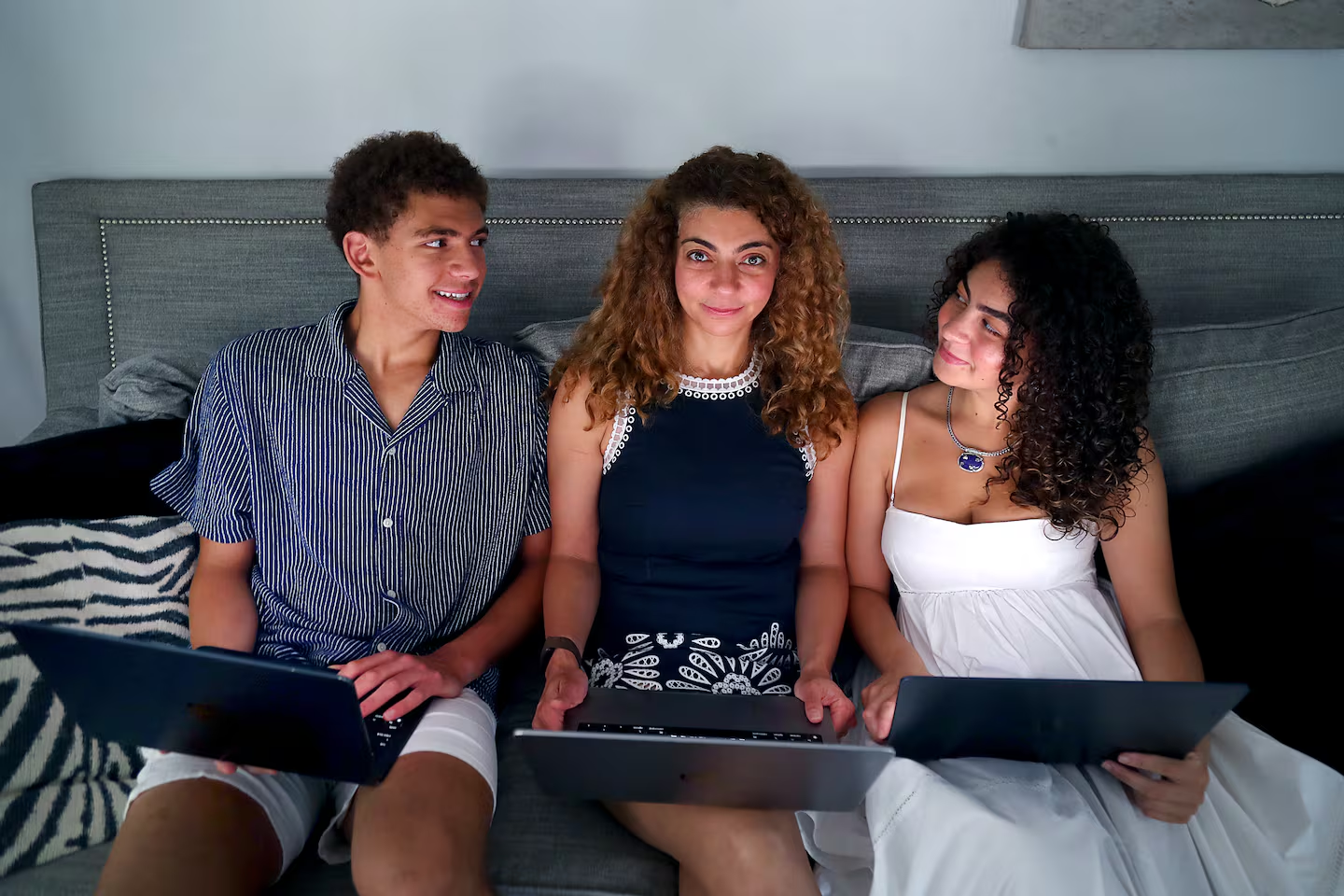
Gen Z isn’t happy about AI. Even when mom helped invent it.
Jana Amin, who graduated from Harvardlast year, calls herself a strong AI skeptic. After witnessing too many fellow students using the technology as a crutch, she rejected AI and helped found a cafe in Cambridge to encourage people to enjoy activities like music performances and plain old conversations, away from their digital devices.
Read more Bank of America CEO on how its FIFA sponsorship is going: ‘We feel good’
Many of her peers are wary of AI, worried about the technology’s impact on thinking and writing skills, job prospects, and the environment.
But in Amin’s case, it feels almost ironic. That’s because her mother, Rana el Kaliouby, is a pioneering scientist in AI who is well known in technology circles. Sheruns a venture capital fund called Blue Tulip Ventures, investing in AI startups, and previously cofounded Affectiva, an MIT Media Lab spinout now owned by Swedish firm Smart Eye.
Amin’s younger brother, Adam Amin, has followed more in his mom’s footsteps to become an AI power user. The Milton teenager founded an artificial intelligence club at his high school, built an app with AI to help translate Arabic documents, and used the technology to advise on his squash games and training.
The siblings reflect the opinions of Gen Z, which is split sharply over AI. About half of thoseage 14 to 29 use AI at least weekly and say they are curious about the technology, according to a recent Gallup poll. But almost one-third are angry about AI and 40 percent say they are anxious.
“I really worry about who gets to play in this AI world, either by building it or by using it or investing in it,” el Kaliouby, 47, said during a family sit-down with a Globe reporter. “And then I came home and I was like, oh my god, this is actually playing out in my own family.”
On a hot June day, the family gathered in their living room to talk about their different perspectives on AI.
“I’m probably the most AI-skeptical of our family,” Jana Amin, 23, said. “I’ve watched how people turn to AI to stop themselves from writing, and as a result, I think a lot of the critical thinking that comes through the process of writing, like the development of new ideas, or making new connections, is being lost,” she said.
Her brother saw it differently.
“A lot of the things we think about at the AI club and at school is how AI can benefit our learning instead of taking away from the learning experience,” the 17-year-old said. “I’d say I’m probably the biggest user of AI in our family.”
El Kaliouby’s kids grew up in the same house, where the single mom encouraged them to explore digital technologies along with analog pursuits like sports and music. They had plenty of tech gadgets, such as an Arduino computer, 3D printers, and a Jibo home robot that could recognize faces and conduct simple conversations. But Adam Amin also developed into an avid squash player, and his sister plays the harp and tutored writing.
“My philosophy as a parent has always been to expose the kids to technology, not just as consumers, but with a building/critical thinking perspective,” el Kaliouby said.
Adam Amin, a rising senior at Milton Academy, said he was always intrigued by the tech, using the 3D printer to make things around the house and getting sad when the localcompany that made Jibo went out of business and the robot’s servers shut down.
“When I was a little kid, my dream job was to move to an island and be a robotics engineer and build an island full of robots,” he said.
“That’s terrifying,” his sister responded.
While the kids were growing up, el Kaliouby would bring home her research endeavors onusing AI to analyze human emotions, first from MIT’s Media Lab and later from Affectiva,which developed AI systems to track people’s emotional reactions to ads and other content. Sometimes Jana Amin was a test subject, watching television while hooked up to instruments to monitor her brain waves and vital signs to gauge her responses.
She’s hardly a technophobe. An earlier wave of technology was perhaps most important to her growing up: social media.
The whole family moved from Egypt to the United States when Jana was in fourth grade so el Kaliouby could stop traveling back and forth to Boston and be closer to Affectiva full time.
Jana Amin was allowed to use Instagram at that young age so she could stay in touch with friends back in Egypt. “Technology has allowed me to bridge almost my world here in Boston [and] my community back home in Egypt,” she said. “That’s been really special.”
Read more A California farmer is giving away tons of nectarines that he’s not allowed to sell
When ChatGPT came out at the end of 2022, Adam Amin was in eighth grade and his sister was in college.
He was intrigued and got permission to use the app to assist with a science paper. Unfortunately, the early version of the app made up all its citations, giving mom an opportunity to discuss AI’s downsides (an “amazing learning moment,” el Kaliouby calls it now).
At Harvard, meanwhile, there was no clear, campus-wide policy about using AI at first, Jana Amin said. She witnessed how some kids used AI to write papers, seeming to avoid doing their own critical thinking.
Since graduation a year ago, she has been looking for a job in communications and event planning. Friends using AI have applied to dozens of openings at a time, while she has not used AI and only applied to a handful, writing all of her applications and cover letters herself.
El Kaliouby said she is “not putting any judgment on either approach.” While applying to far fewer jobs, Jana’s gotten interviews from all her applications, she added.
Lately, Adam Amin has been using AI to explore documents housed at the American University of Cairo about archeological excavations from the 19th and 20th centuries. Written in Arabic and including hieroglyphics, the documents are hard to parse for typical AI systems, so he created an app that adds context from researchers to help properly decode the writing.
“As we keep moving into a digital world, how are we going to bring our history into the future?” he asked. “AI is going to make it accessible.”
While he dabbles with the latest AI models, he mostly uses one app called Manas, which uses a variety of different underlying companies’ AI services, to advise him on daily life tasks, like his health and fitness routines.
“I just took all my Whoop data and downloaded it,” he said, referring to the Boston-based fitness tracker. “Then I gave it to my [app] and I asked it to find the most important trends.”
“I hope you know that’s all your health data, like, you just uploaded to an AI,” Jana Amin warned from across the living room.
Adam Amin is going to Egypt to visit his grandmother this summer. He plans to use his translation app on handwritten letters his grandmother has from her mother, containing family recipes. “I want to digitize those using the app I built and see what comes out of it, and what can I learn from that,” he said.
“And then you can actually make the recipes,” his mom suggested, as his sister laughed since cooking would pull her brother out of his AI world and into hers.
Jana Amin is getting ready to reopen her Cambridge cafe, Minara, which closed for renovations in March, for another season of in-person events. She has used social media and flyers to advertise but is counting on a more traditional methodto get the word out.
“It’s word of mouth and people feeling like, wow, there’s a place where I can go and feel held, that brought more people through the door,” she said.
Their mom sees a way to unify both sides of the family’s activities, as AI performing more and more tasks may make people want more in-person events. As AI spreads, “people are going to be doubling down on these human experiences and human connections,” el Kaliouby said.
Read more Questions about resume gaps are expected. Here’s how job seekers can address them.





Post Comment