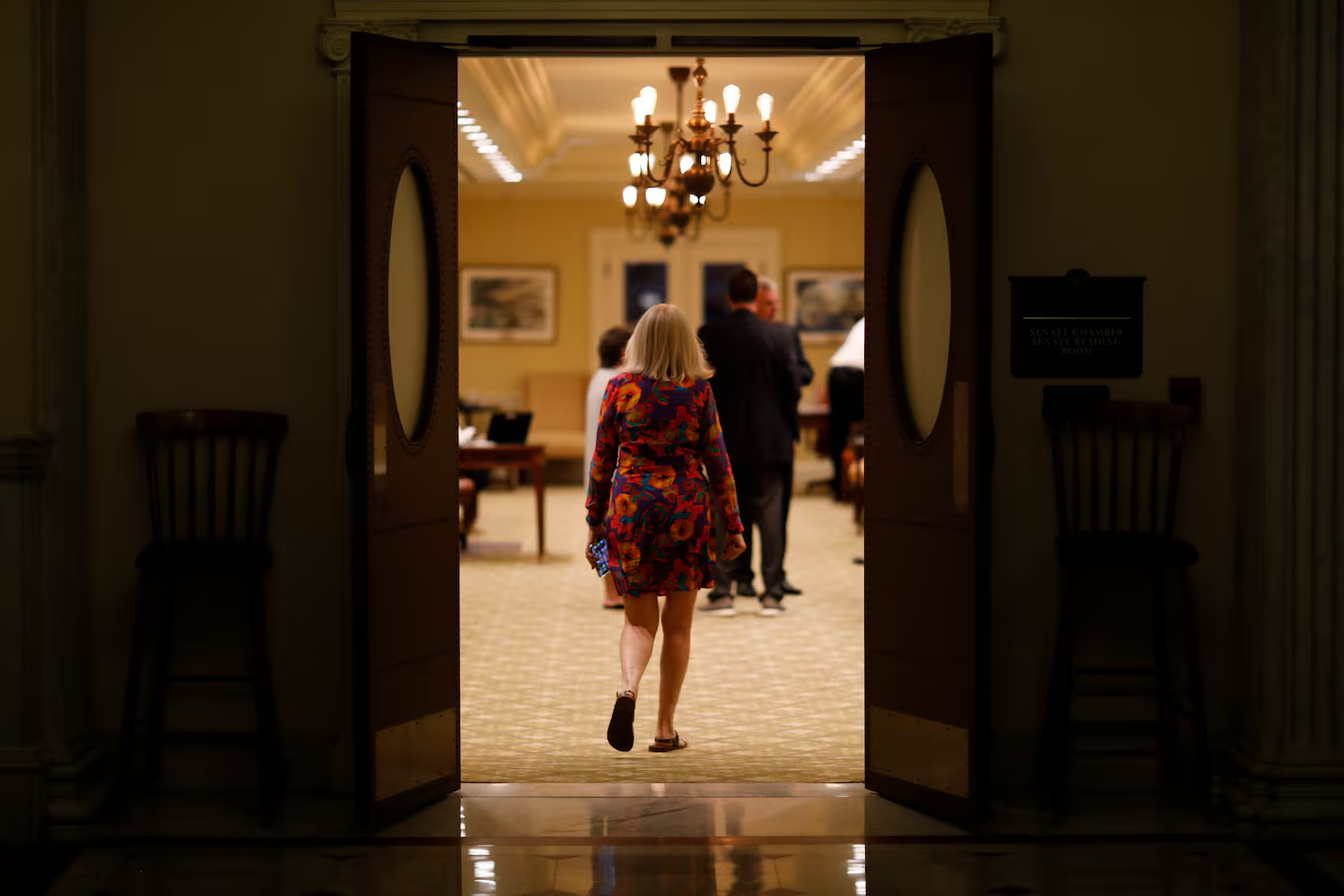
Massachusetts lawmakers, promising a tidier close to their session, still have a lot they want to get done
We’ve seen this film before. The Massachusetts Legislature is just promising a different ending.
State lawmakers are entering their final stretch of formal sessions this month with a lot left to do, including several bills Governor Maura Healey deemed policy priorities in an election year.
That lengthy list ranges from bills on energy affordability and university research funding to immigrant protections and school cell phone use. There are also questions of whether senators will embrace a House push to reshape the state’s public records law, or whether the House will back a Senate bill to ease primary care access.
State House leaders insist their rules changes, including installing new deadlines designed to help bills through the legislative process, would prevent the final-days-of-session pileup the Legislature has labored under.
And many organizations with interests before the Legislature said they are cautiously optimistic their policy priorities will, in fact, see movement in coming days and weeks — even if they also wish lawmakers would move faster on said issues.
To Dan Zackin, the legislative coordinator at 350 Massachusetts, a climate advocacy group, “we are very much still seeing an end-of-session pileup.”
“From a fundamental democracy perspective, voters should know what their legislators are fighting for and what bills they’ve passed by the time they go to the primary [elections] in September,” Zackin said. That said, he added, “I am very optimistic that they’re going to pass meaningful legislation on climate this session — it’s just a matter of how difficult it’ll be to get them to do it.”
Formal sessions for Massachusetts’ two-year legislative calendars have traditionally wrapped on July 31, ofteninvolving lawmakers scrambling during a chaotic final session that stretches until the early hours of August.
In 2024, formal sessions ended with a host of outstanding bills, which later passed through lame-duck lawmaking in the subsequent months and, in some cases, bled into the final days of the calendar year.
But last year, the House and Senate agreed to new rules that make July 31 a different deadline: Bills would need to be sent to a so-called conference committee by then, meaning the House and Senate each would pass a version of the legislation before a bicameral group of legislators works out differences behind closed doors.
Then lawmakers could pass a deal they cut later in the year, including up to or after Election Day. Lawmakers also gave themselves that option for passing spending bills or voting on gubernatorial veto overrides.
That, lawmakers argue, has extended their timeline toinclude the entire two-year session, which ends Jan. 5.
“We have already seen the positive impact the Legislature’s new joint rules have had this session by giving both chambers the opportunity to take up an ambitious agenda, while creating more time for conference committees to negotiate legislation beyond July 31,” said state Senator Cynthia Stone Creem, the chamber’s majority leader, who helped draft the new rules.
She pointed to several bills that have passed both chambers, such as data privacy and early literacy instruction — though the privacy legislation has yet to reach the governor’s desk.
House Speaker Ron Mariano, similarly, said in a statement bills this session have “moved through the committee process and onto the floor more quickly.”
“The whole point behind the July 31 extension for conferences was to take that pressure off the last couple of weeks,” Mariano told reporters this month. “We expect it to be a little smoother.”
Lawmakers this week said they reached a deal on one major piece of legislation before the session’s final month: the annual state budget.
Both chambers are rushing to move other bills forward that lawmakers want to continue working on: The House, for instance, unveiled legislation Tuesday that would immediately reshape when ballot question campaigns — pushing a record number of proposals before voters this year — would have to disclose who’s funding them.
Several other major bills remain in limbo.
Last year, Healey proposed the so-called DRIVE Act, a bill intended to backfill a major loss in federal funding to universities and colleges by paying for research and development projects at those institutions.
Read more Trump to visit newly built Theodore Roosevelt Presidential Library in North Dakota’s Badlands
Lawmakers in both chambers have backed a significantly reduced version of that, proposing $200 million instead of Healey’s requested $400 million, but it’s yet to emerge from the House budget committee.
“There’s broad support for wanting to do something,” said Rob McCarron, president of the Association of Independent Colleges and Universities in Massachusetts. “What that final thing looks like, I don’t know, but there is hope that something gets done.”
McCarron pointed to another still-outstanding bill, an economic development package Healey filed in April, as one potential vehicle for funding to support early-career researchers and maintain “our unique competitive advantage as a state.”
Similarly, the Massachusetts Senate is scheduled to vote on an energy affordability bill this week after the House took up its own version in February. A version that a House committee considered months earlier sparked outrage from climate advocacy groups.
Critics of the process say they haven’t seen enough tangible progress. Act on Mass, an advocacy group that’s long pushed for new transparency measures, said it found the Legislature passed justnine new statewide policies since January 2025.
“Despite promises of increased efficiency from state lawmakers, we are nearing the end of formal sessions with little new legislation to show for the last 1½ years,” said Scotia Hille, the group’s executive director.
Hille said lawmakers have also reported bills past their deadlines and effectively killed legislation without taking votes.
Other bills already in conference committees but not yet sent to Healey include measures to implement protections for immigrants in spaces like courthouses, restrict cell phone use in schools, and update infrastructure across state higher education campuses.
On some of those issues, advocates are applauding a more measured approach. The Massachusetts House, for instance, faced blowback from data privacy groups after tacking proposed youth social media restrictions onto a bill seeking to implement a bell-to-bell cell phone ban in K-12 schools.
It’s unclear whether the Senate will adopt similar social media regulations as the chambers negotiate.
“The House showed that when they want to do something, they can move really fast,” said Evan Greer, director of the digital rights advocacy group Fight for the Future, which has urged lawmakers to instead pass a bill aimed at improving data privacy. That bill is currently in a conference committee.
“I would love to see more reforms that lead to a more democratic process, so that there’s more transparency, and it’s easier to see why certain things are moving, and other ones are not,” Greer said.
On others — namely, immigration — advocates have for months encouraged state lawmakers to more forcefully fight the Trumpadministration’s mass immigration detention and deportation agenda.
“We, as advocates, would always like to see the State House act as quickly as possible, and yet, these are very complicated issues, and we realize that there are so many stakeholders involved,” said Elizabeth Sweet, head of the Massachusetts Immigrant and Refugee Advocacy Coalition, which is backing the so-called PROTECT Act.
Kade Crockford, director of the ACLU of Massachusetts’ Technology for Liberty program, held up the PROTECT Act and digital privacy bill as the Legislature “taking the federal government seriously.”
Those pieces of legislation are “really responsive to the moment in the sense that they defend and expand individual rights while simultaneously protecting our larger democracy,” Crockford said. “And that’s exactly what voters in Massachusetts want and expect of the Legislature.”
State Senator Adam Gómez, a Springfield Democrat who backed the PROTECT Act, said he anticipates seeing it pass before the end of July.That others may bleed much later into the year doesn’t mean “something still can’t be put into law.”
“We’ve got 30 days,” he said, “and we’re trying to do the most that we can so we can pass a just economy and just policy for all.”
Read more At 44 years old, Serena Williams returned not to win Wimbledon, but to do something she loves


Post Comment