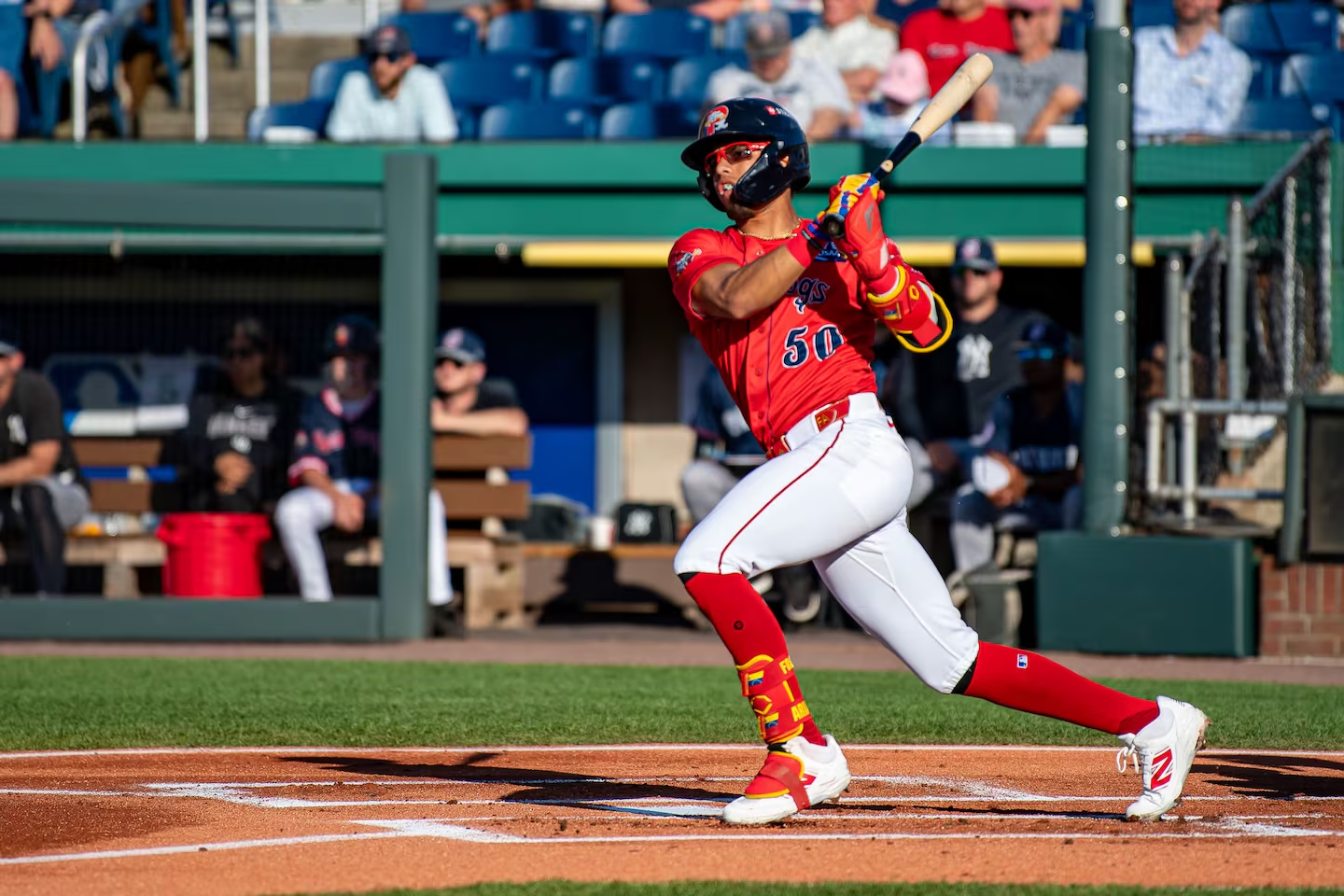
With Franklin Arias dominating Double-A, the obvious question is: When will he get promoted to the WooSox?
On Tuesday, Red Sox top prospect Franklin Arias put the finishing touches on a fantastic month of June with Double-A Portland.
Read more Trump to visit newly built Theodore Roosevelt Presidential Library in North Dakota’s Badlands
Nothing new there. He also was incredible in May and April.
In 63 games this year, Arias is hitting .328/.407/.594 while clubbing 16 home runs and 32 extra-base hits. He’s been a force for long enough that it raises an obvious question: When will he get to Triple-A?
Arias is trying not to concern himself with such matters. He recognizes that his job is to focus on sharpening his skill set, regardless of the level.
“Part of this game is to be patient,” Arias said through a translator. “Moving up to Triple-A, those type of decisions, I can’t control. The one thing I can control is what are my intentions daily, and it’s just to improve across all facets of the game.”
If history is a guide, a promotion to Worcester probably won’t happen until at least his almost-certain participation in the All-Star Futures Game in Philadelphia, and possibly not until after the early-August trade deadline.
That approach reflects largely on the value the Sox place on the development opportunity in Double-A. The team routinely has made Portland the longest stop for top prospects climbing the minor league ladder.
Ceddanne Rafaela and Marcelo Mayer spent more than a year in Double-A, while Roman Anthony spent a little less than a calendar year there. The Sox have treated the level as a critical developmental incubator, where prospects can be challenged to improve.
First, the talent level tends to be consistently high. In contrast to more uneven talent in the lower levels, nearly everyone in Double-A has the talent of a potential big leaguer.
“The tools that you see in Double-A may be the best at any level,” said Sea Dogs interim manager Kyle Sasala. “The pure stuff that you see from pitchers in Double-A and the tools that you see from the position players are pretty special here.”
Given this, Double-A is the stop where players are forced to start pairing tools with higher levels of execution.
“I think the jump from High-A to Double-A is probably the biggest jump, other than from Triple-A to the big leagues,” said Red Sox farm director Brian Abraham. “It tends to filter prospects [from] suspects, some of those guys that maybe performed because of just your skill, their ability to hit the ball hard, their ability to have nasty stuff.
“I think the next level, at Double-A, the challenge is for those skills to be more sustainable by making adjustments, being in the zone more [as pitchers], having better swing decisions [as hitters].”
Double-A also is the level where the emphasis shifts increasingly to situational play. Players are held to greater account based on their execution when it comes to situational hitting, base running, and defense. Whereas the primary purpose of Triple-A is to provide depth for the big league team, Double-A is more purely a teaching, developmental level.
“We want to work on certain metrics, but we’re now trying to blend those metrics with being able to play the game,” said Sasala. “Your job at that time, when you get called up, is to perform. You’re asked to get runners over, make the routine plays, make really good decisions on the bases.
Read more At 44 years old, Serena Williams returned not to win Wimbledon, but to do something she loves
“The guys that have been up there for five, six, seven years, who are getting paid the big bucks, those guys are expected to produce. We’re trying to get guys to be able to perform by respecting the game, respecting 90 feet, understanding what the game is requiring of them, and being able to execute those things at this level. So that when you go up to Triple-A and the big leagues, you’re not just ready physically, but you’re ready mentally and emotionally.”
It can be easier to focus on those finer developmental points in Double-A than Triple-A, because in Worcester it becomes almost impossible to avoid thinking about when that call to the big leagues might come.
“That noise definitely gets louder externally when someone’s in Triple-A,” said Abraham.
Given all of those factors, the Sox — like most teams — tend to give their top prospects more run in Double-A. Some players will skip Triple-A entirely; they almost never bypass Double-A.
That said, all players risk stagnating by staying at the same level for too long. The Sox don’t feel like they’ve arrived at such a point with Arias.
“I don’t think his development is stalling at all,” said Sasala. “Obviously, what he’s done this year has been pretty special, but he keeps his head down, and he continues to work, and he understands that where he eventually wants to be is not in Double-A, it’s not in Triple-A, it’s in the big leagues. The intentionality with how he goes about his work, day in and day out, it doesn’t look like to me that he’s frustrated with still being down here.”
Three up
▪ In June, Portland outfielder Miguel Bleis has posted his best monthly numbers (.272/.337/.543 with with 5 HRs in 22 games) since May 2024. The 22-year-old has improved in his chase rate and swing decisions, helping boost his production.
▪ Corner infielder Antonio Anderson, a 21-year-old picked in the third round of the 2023 draft, had his best stretch as a pro last week, with five straight multihit games and homering in three straight for High-A Greenville. In 12 games in June, Anderson is hitting .341/.408/.614.
▪ Catcher Franklin Primera, whose outrageous performance in the Florida Complex League (.427/.549/.718) has him flying up Red Sox prospect rankings, has been promoted from rookie ball to Single-A Salem. The 19-year-old has been able to dominate the strike zone (16 percent walk rate), rarely swing and miss (10 percent strikeout rate), and hit the ball extremely hard (eight homers and 14 extra-base hits in 32 games).
Three down
▪ Outfielder Kristian Campbell’s already difficult season in Worcester has gotten progressively worse, at least in terms of on-field production. He’s hitting .148/.270/.180 with a 33 percent strikeout rate in June.
▪ After he got off to an excellent start following his promotion to High-A Greenville, 19-year-old outfielder Enddy Azocar had slumped to a .104/.232/.125 line with a 30 percent strikeout rate over his last 13 games.
▪ While rehabbing from a hamstring injury, two-way player Conrad Cason experienced elbow stiffness. He’s now taking part in baseball activities with the hope of getting back into games. The Sox wanted to see him at shortstop this season while recovering from last year’s Tommy John surgery. But Cason, who wasn’t expected to pitch this year, is unlikely to do anything but DH this season.
Read more No sign of Celtics deals as NBA free agency tips off, and no resolution to the Jaylen Brown saga



Post Comment