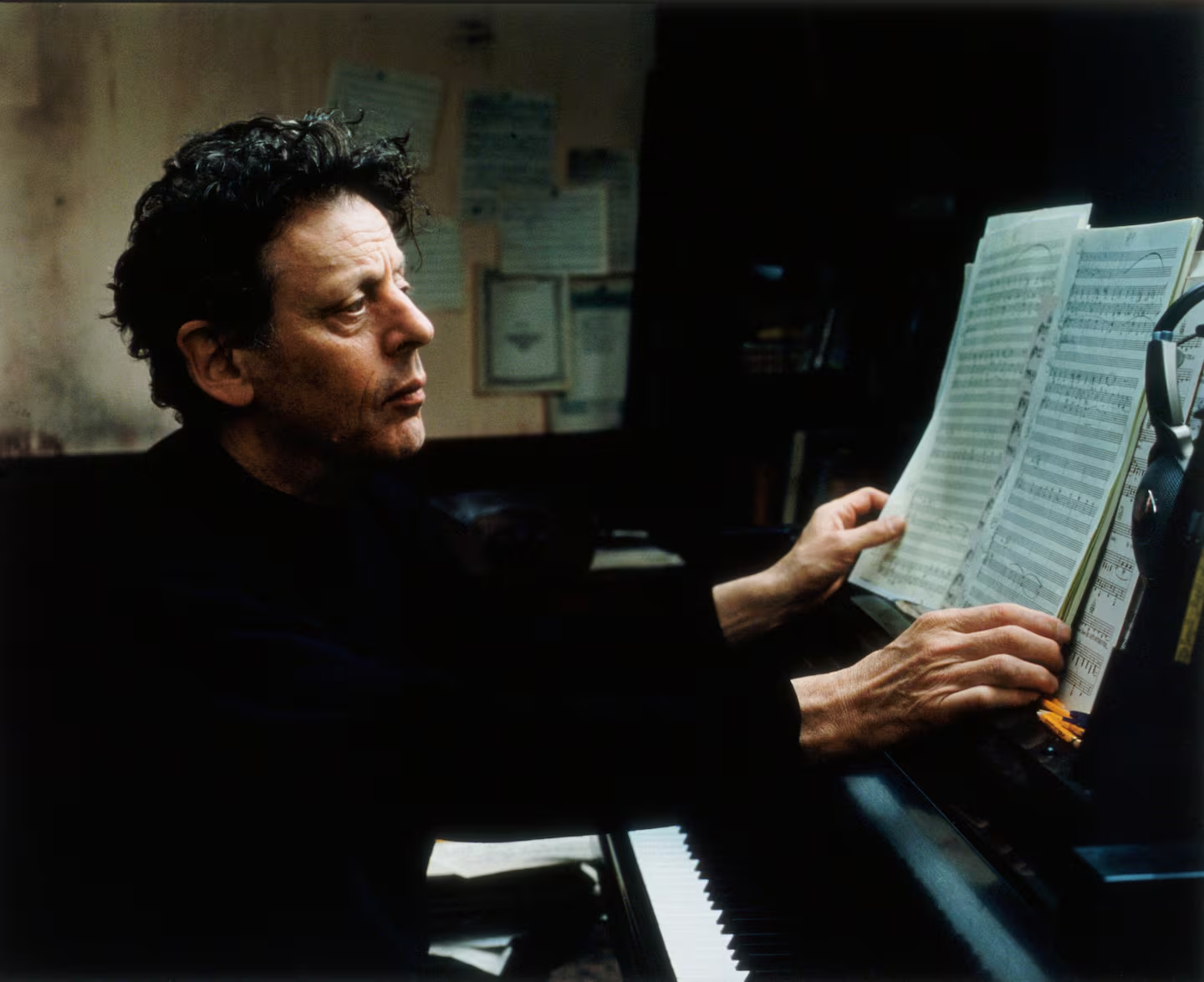
Inside the ‘Lincoln’ symphony that Philip Glass pulled from Trump’s Kennedy Center
Singer and actor Zachary James was expecting an audition much like any other — “at a studio, people behind a table” — when he agreed to try out for Philip Glass’s opera “The Perfect American” in the early 2010s. Instead, when James knocked on the door at the address he’d been given on the Lower East Side of Manhattan, the “Glassworks” and “Koyaanisqatsi” composer answered the door and welcomed James into his own apartment, where they talked for “over an hour” about theater, art, and “how we got into these crazy lives in showbiz.”
Eventually, Glass said “I guess you should sing for me, but I don’t feel like playing piano. Could you sing a cappella?” James recounted in a phone interview.
James sang his prepared excerpt, from Carlisle Floyd’s opera “Susannah,” unaccompanied. Glass’s reaction was something along the lines of “okay, that’s great. I’ll see you in Madrid!” James said. “And I thought, ‘did I just get hired on the spot by Philip Glass?!”
James was hired in “The Perfect American” for the cameo role of Abraham Lincoln; specifically an animatronic representation of Lincoln built by Walt Disney, the central character of that opera. Now, James is preparing to channel Lincoln vis-a-vis Glass again, but this time in a leading role as the vocal soloist in the world premiere of Glass’s new Symphony No. 15, “Lincoln,” with the Boston Symphony Orchestra and conductor Karen Kamensek July 5 at Tanglewood. Though the public hasn’t heard a note of the new symphony yet, it has already been in the headlines. At the beginning of this year, Glass withdrew his Symphony No. 15 from its scheduled June world premiere by the National Symphony Orchestra at Washington D.C.’s Kennedy Center: a venue that President Trump has been gradually reshaping in his own image, replacing previous leadership with loyalists who voted to add Trump’s name to the venue.
“Symphony No. 15 is a portrait of Abraham Lincoln, and the values of the Kennedy Center today are in direct conflict with the message of the Symphony,” Glass wrote in a public statement explaining his decision.
To James, the message of the eight-movement symphony is “a reflection on the fragility of democracy,” outlined through excerpts from Lincoln’s public speeches and writings such as the Lyceum Address, which warns of dire consequences should a tyrannical leader overtake the United States government.
“It’s interesting, because the heaviest moments — the words that, to me, have the greatest consequence — are spoken,” he said. “I come from musical theater, and the idea of speaking versus singing there is you speak and then when the emotions come to be too much, you sing. … What’s really fascinating about this is that it’s the opposite. He’s singing, and then when he gets to an emotional point, he speaks.”
One such moment draws from Lincoln’s personal reflections after signing the Emancipation Proclamation: “I never in my life, felt more certain that I was doing right than I do in signing this paper… If my name ever goes into history it will be for this act, and my whole soul is in it,” the speaker says, as the orchestra falls silent.
“He finishes the declaration with a vulnerable reflection and acknowledgment that this will be his legacy,” James said. “Because these words are not assigned rhythm and notes, I am given complete freedom in interpretation, which also is a vulnerable moment as a performer.” With that, it’s “as if Philip is saying ‘listen to this. Really pay attention. This is the message.’”
Drawing on American history as such concrete symphonic inspiration is somewhat new territory for Glass, whose previous titled symphonies have been inspired by subjects including Buddhist spirituality, the poetry of Allen Ginsberg, and three albums by David Bowie.
But for Kamensek, a longtime Glass collaborator, Lincoln is “conjured up in our presence” by the union of Glass’s music and Lincoln’s writing, she wrote in an email. “The Lincoln texts Philip selected are extremely powerful and thought provoking, very much human and biographical.”
For Kamensek and James, who were both involved in the Metropolitan Opera’s acclaimed production of Glass’s opera “Akhnaten,” working so closely with Glass on a world premiere is a dream come true. “He’s my very favorite composer on the planet, and my very favorite collaborator,” James said. “Our work together continues to be very easygoing, very respectful, very complimentary.”
To honestly channel “Honest Abe,” James said he needed to know what Lincoln might have been thinking privately, things he might not have dared to say out loud. The issues he faced during his presidency had “consequences in every direction,” he said. “We’re thinking of him not necessarily like the greatest president of all time, and every word he said was gold … but a man who grew up humbly and suddenly was thrust into positions of leadership over and over again without necessarily having those goals.”
In some respect, the symphony offers “a history lesson; look at these things we went through,” said James. “On the other hand, look at what we’re still going through.”
Read more The hantavirus outbreak is prompting COVID flashbacks — including the conspiracies


Post Comment