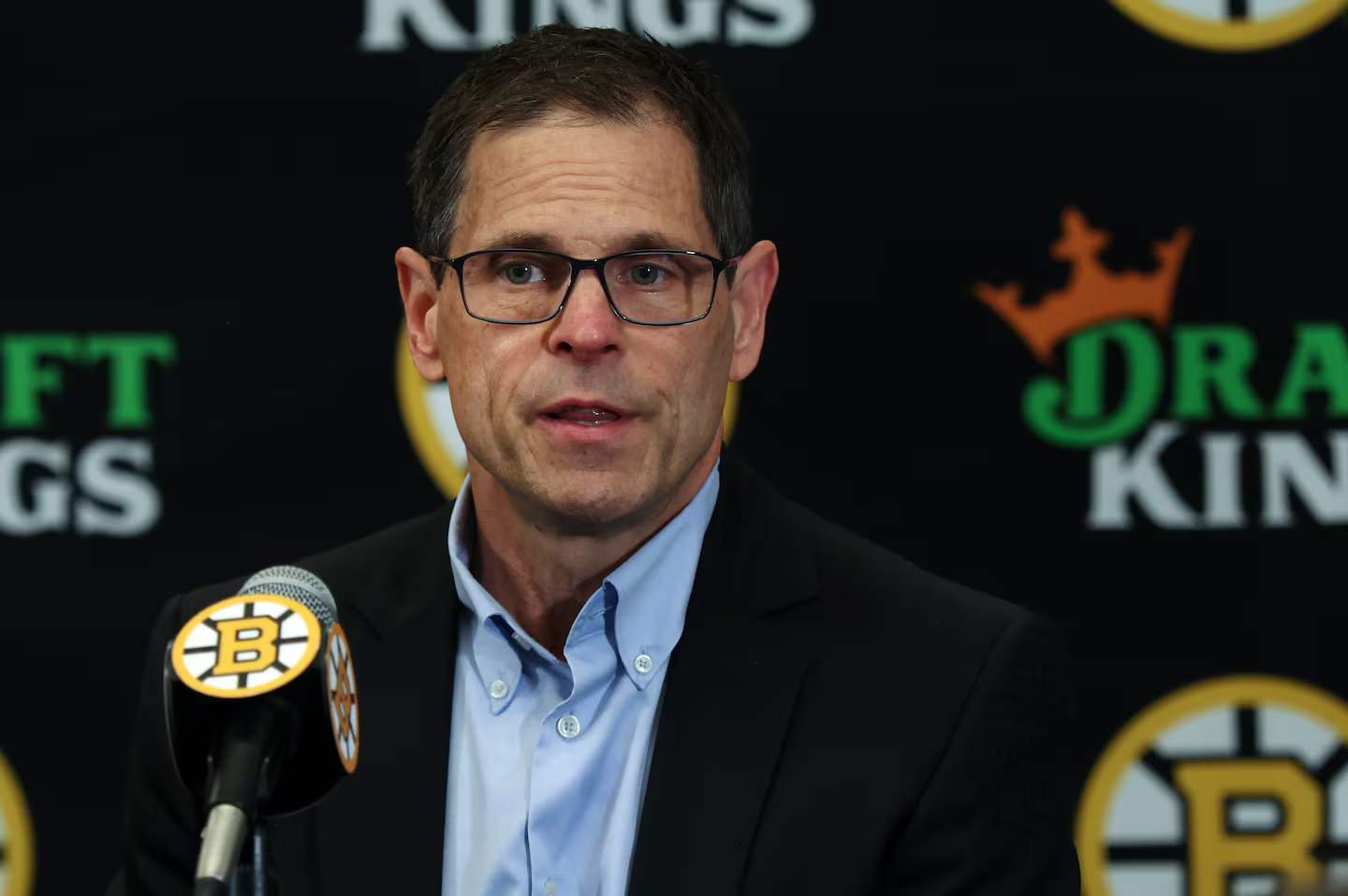
Evaluating the Bruins’ first-round draft picks since Don Sweeney took over as general manager in 2015
The road to a successful NHL Draft class comes with a lot of runway. That is particularly true when selecting first-rounders.
Unlike the NFL Draft, where most players taken in the first round are expected to make an almost immediate impact (quarterbacks can be the notable exception), the timetable in the NHL is longer — sometimes up to five years.
The most obvious reason for this is age. To be eligible for the NHL Draft, players must be 18 by Sept. 15 of their draft year. Many of the drafted players will be 17. Their body of work is often compiled while their bodies are still developing.
“When you’re drafting young kids and you’ve got to sort of project where they can be in 3-5 years versus can they play for us this upcoming season, right? So, it’s a lot different,” said Ryan Nadeau, the Bruins’ director of amateur scouting, explaining the difference between the leagues.
It’s rare when a player can make an NHL impact in their draft year, particularly those drafted outside the top 10.
Of last year’s top 10, Matthew Schaefer was the exception. The defenseman played all 82 games for the Islanders en route to winning Rookie of the Year honors. Five other top-10 first-rounders combined for 71 regular-season games: San Jose’s Michael Misa (No. 2, 45 games); Chicago’s Anton Frondell (No. 3, 12 games); Nashville’s Brady Martin (No. 5, three games); Philadelphia’s Porter Martone (No. 6, nine games); Boston’s James Hagens (No. 7, two games). Four of the top 10: Utah’s Caleb Desnoyers (No. 4); Seattle’s Jake O’Brien (No. 8); Buffalo’s Radim Mrtka (No. 9); and Anaheim’s Roger McQueen (No. 10) haven’t cracked the varsity roster.
Only two of the top 10 saw NHL postseason action: Martone (10 games) and Hagens (3).
“Most of these kids, there’s a few each year who are ready to make the jump, but the majority, you’ve got to think what needs to get better, what needs to improve for them to play and then, is it something that we think we can help them with? Is it something that’s just physical and maturity? Is it mental where sort of maturity is going to help, but also can we give them resources to help them get there?” said Nadeau. “So, there’s a lot of discussion on that and sort of looking at which kids do we project to be able to get to a spot and do they have attributes that fit their identity and then, where are their holes? Are there holes that we can live with or holes that we think we can help them fill in a little bit to help get them over that hump?”
The Bruins have had 10 first-round selections since Don Sweeney took over as general manager in 2015. Only Hagens was a top-10 pick. Of the other nine, only Jake DeBrusk (No. 14 in 2015), Charlie McAvoy (No. 14 in 2016), and Trent Frederic (No. 29 in 2016) have made a dent on the varsity roster.
Despite multiple chances, five of the remaining six haven’t been able to find footing in Boston.
In 2015, a little more than a month after being named GM, Sweeney traded veterans Dougie Hamilton (to Calgary) and Milan Lucic (to Los Angeles), resulting in the Bruins having the Nos. 13, 14, and 15 picks in that draft.
Read more Can the United States actually win the World Cup? It no longer seems like an impossible dream.
DeBrusk was sandwiched by Jakub Zboril (76 career games played, none since 2022-23) and Zach Senyshyn (16 career games, none since 2021-22). In 2017, defenseman Urho Vaakanainen was taken 18th overall. He’s played 221 NHL games, but just 31 with the Bruins. Two years later, Boston chose Johnny Beecher at No. 30. The center was waived last season after 11 goals and 22 points in 136 games. In 2021, Fabian Lysell was taken 21st overall. The winger played a dozen games in 2024-25 (1 goal, 3 points) but was sent back to Providence at the end of camp last September.
Dean Letourneau (No. 25) and Hagens were taken in 2024 and 2025, respectively. Letourneau is heading back to Boston College for a third season, while Hagens is poised to compete for a varsity job this summer.
The lack of success among first-rounders is certainly not limited to the Bruins but is among the chief complaints of the franchise’s fan base.
Sweeney has heard it.
“You have to respect the fans’ opinion, but you have to make your independent decision. These guys [scouts] are watching these players for really over the course of two and sometimes three years. Development is not linear,” Sweeney told the Globe. “[David] Pastrnak jumped in and played in the NHL. [Pittsburgh’s] Ben Kindel last year, it’s a hell of a pick [at No. 11]. He had a hell of a year as an 18-year-old player in the National Hockey League. Very few guys do it. Obviously, Schaefer’s unique. When you’re not picking in the upper echelon of the draft, the likelihood is those players do need time.”
Sweeney and his staff have hit on a number of picks in later rounds, most notably Brandon Carlo (2015), Ryan Lindgren (2016), Jeremy Swayman (2017), and Mason Lohrei (2020).
Sweeney said self-analysis is part of the process. When mistakes are made, steps are taken to not repeat them. By the same token, successes are recognized.
“There’s criticism, but you have to be reflective in that situation. In all honesty, we should have already done the work prior to a fan making a comment. We should have already said, ‘What can we do better? Where were our missteps?’ ” he said. “Even if it is a projection and we do that every year, year over year, and look at what opportunities were missed and in other situations that they’ll turn a blind eye to really good decisions, you reinforce that you made good decisions and what was your process when you made them? What was the process when you didn’t potentially make the best decision that you could have and continue to correct as you go forward?”
The future feels bright for Hagens, who was impressive in a small sample size last season, and Letourneau, who bounced back from a rough freshman season with a standout sophomore year.
“I mean, look at Dean’s year, year over year in terms of where he was at. And again, the player’s going to dictate how hard he’s going to work, the opportunity he’s going to have. You just have to be committed,” said Sweeney. “You have to understand the scouting, works in conjunction with the development, works in conjunction with your next layer of pro guys and projecting with your coaches, is he ready to play?”
Read more More than anything else, Susan Collins is testing whether old school politics still work



Post Comment