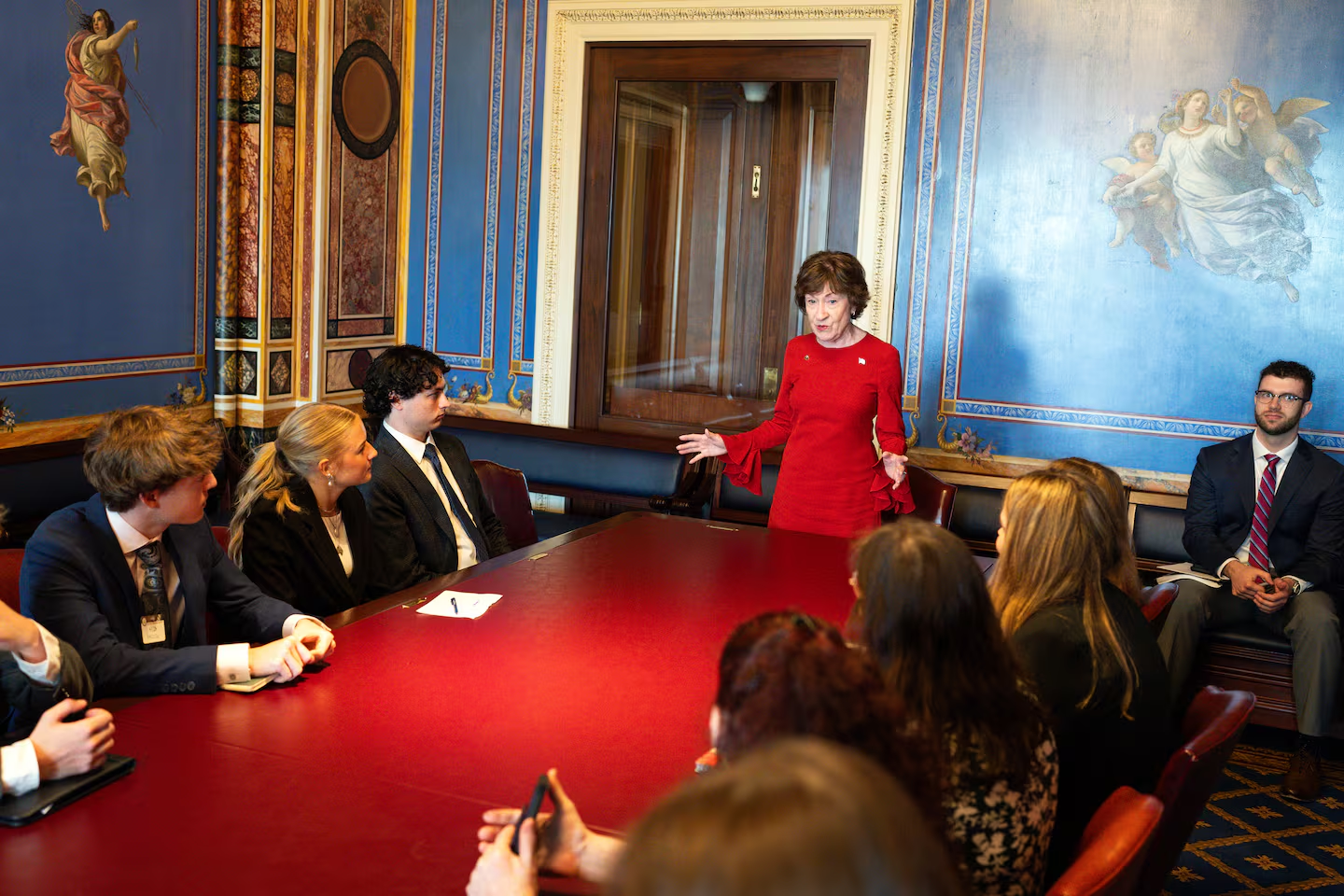
More than anything else, Susan Collins is testing whether old school politics still work
Maine Senator Susan Collins was first elected in 1996. It was a time when American politics was largely defined by Clinton-era triangulation — the art of appealing to the political middle — and when being an independent maverick was valued as a true sign of political courage. Back then, voters frequently rewarded lawmakers who crossed the aisle to forge bipartisan compromises.
Read more Game 78: Red Sox go for series win in matinee at Rockies
Some 30 years later, Collins, who enters the cycle as one of the most vulnerable Senate Republicans seeking reelection, is making a high-stakes bet that this style of politics still works. She is dug in on this strategy despite a mountain of available evidence showing that it no longer succeeds anywhere else in the country.
However, if there is one truism in the modern political age, it might be that Collins is the singular exception to the rule. At least, she has been so far.
With Democrats officially selecting her general election opponent — the controversial oyster farmer Democrat Graham Platner — Collins has begun to step into the spotlight to frame the upcoming campaign on her own terms. She hopes to steer the conversation away from national partisan warfare and back to her brand of localized independent leadership.
Last week, reporters asked her a defining question for this campaign: whether she regretted her 2018 vote to confirm Brett Kavanaugh to the Supreme Court. The question is a potent one, given that Collins claims to support abortion rights, while Kavanaugh ultimately voted to overturn Roe v. Wade in the landmark Dobbs decision. While the core ruling to strike down Roe was a 5-4 vote, a concurrent Mississippi case saw Chief Justice John Roberts join the conservative majority in a broader 6-3 decision.
“I do not regret that vote,” Collins told local reporters in Maine. She then noted that while she disagreed with Kavanaugh’s ultimate ruling, the state of Maine had since protected and expanded abortion rights through its own legislature. She also reminded voters that she later voted to confirm the three liberal justices who dissented in the Dobbs decision.
She went even further during a Fox News appearance, laying out what might be the entire rationale for her campaign over the remaining five and a half months of the cycle.
“I think I need to make sure that the people of Maine understand my record of independence and delivering results,” Collins said on “The Story with Martha MacCallum.”
“Independence and delivering results” was certainly a winning mantra in the bygone age of Republicans John McCain, Jim Jeffords, Lincoln Chafee, and Democrats, Russ Feingold, Joe Lieberman, and Arlen Specter. In that era, breaking with your party was a badge of honor.
Read more Sabres agree to send Alex Tuch to the Capitals as part of a sign-and-trade deal
But in the modern era, political activists want their representatives to fall strictly in line. To the base, independent centrists are no longer heroes; they are villains.
The examples are plenty: Senators Joe Manchin, Kyrsten Sinema, Thom Tillis, Bill Cassidy, and Bob Corker have all faced intense backlash, primary threats, or political retirement for refusing to adhere to strict party orthodoxy. These days, voters increasingly demand that their party’s senators either vote with Donald Trump 100 percent of the time or oppose him 100 percent of the time, depending entirely on the letter next to their name.
So where does this polarization leave Collins who voted with Trump 94 percent of the time? The answer remains unclear.
The upcoming matchup highlights this deep ideological divide perfectly. In Platner, Democrats have nominated an economic populist and political outsider backed by progressive heavyweights like Bernie Sanders. Platner’s platform directly targets the traditional Washington establishment that Collins represents, framing her senior institutional status not as an asset, but as a symptom of a broken system. This sets up a classic clash of political styles: an insurgent running on systemic change versus a six-term incumbent running on federal clout and institutional pull.
Every state is unique, but Maine has always been especially fiercely independent. The state’s other senator, Angus King, is an independent who caucuses with the Democrats. Demographically, Maine is the oldest state in the nation by median age. It is also the only state in New England that features a legitimately conservative Republican pocket: the state’s Second Congressional District in the rural north and west, which voted decidedly for Trump in the past three presidential elections. Yet, this is also a state that has validated Collins five times, including a stunning 2020 victory when basically every public poll predicted she would lose.
However, Maine has already demonstrated a powerful anti-establishment streak in recent primary elections. Democratic voters bypassed Washington’s preferred picks for Congress and the Senate in favor of more anti-establishment candidates. Meanwhile, on the Republican side, voters chose a political newcomer for governor over a member of the Bush family and a longtime Augusta insider.
The political tectonic plates are shifting under her feet, but Collins is betting that the old playbook remains the winning playbook. Whether Maine’s unique political character will protect its senior senator one more time is the ultimate question of this election cycle.
Read more Red Sox’ Caleb Durbin plans to stay off IL after pinkie was ‘facing a direction it shouldn’t’


Post Comment