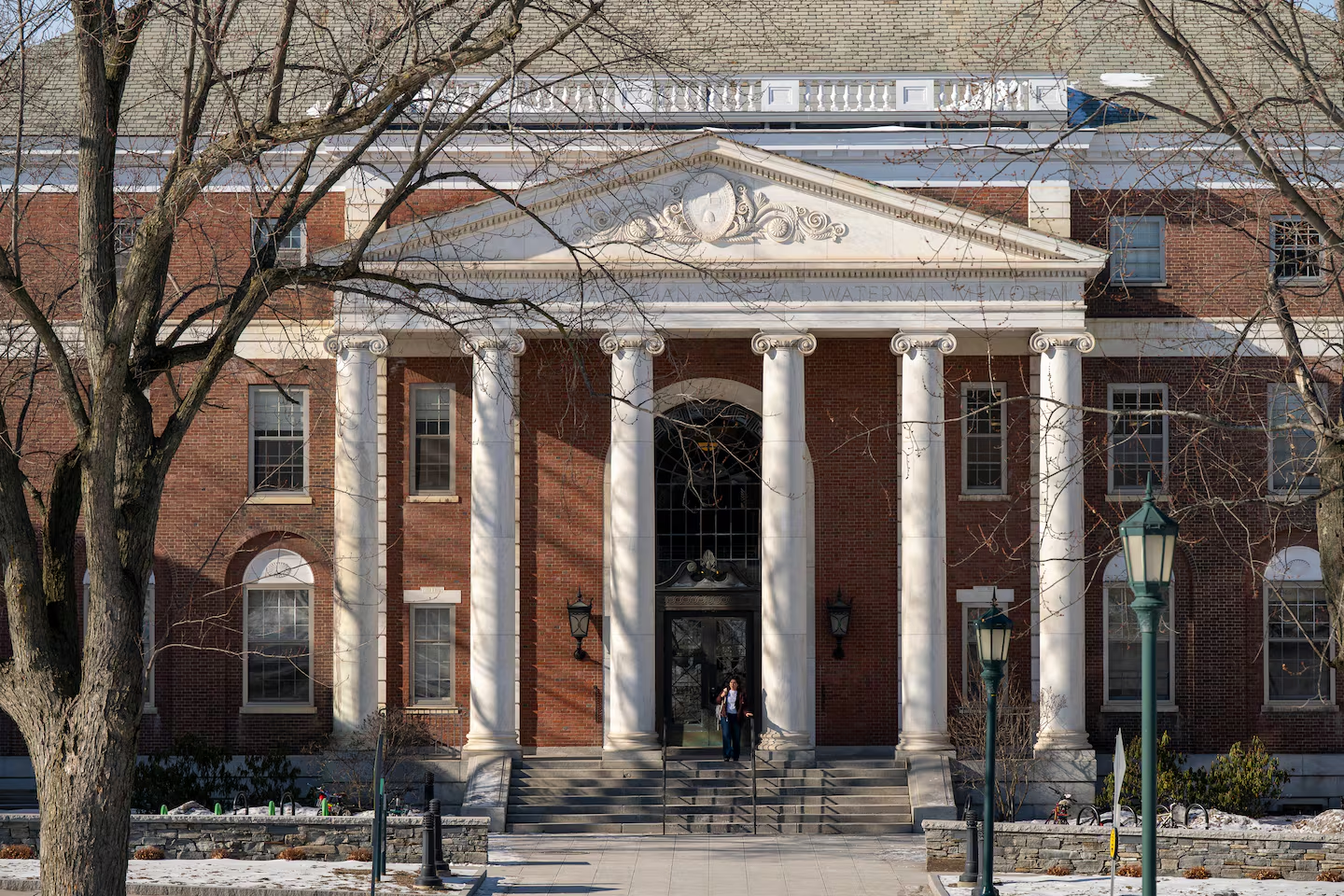
The University of Vermont is struggling. Will spending $175 million for athletics help?
In May, the president of the University of Vermont, Marlene Tromp, asked state lawmakers for $12 million for the school’s athletics and recreationalrenovations.
Read more Virginia company plans to bring battery farms to six towns in Mass.
The money, she pleaded, was about much more than sports.
Aging locker rooms, uncomfortable arena seats, and a dearth of treadmills are “impacting students’ willingness to come to UVM,” Tromp said. “We need those students for the future of this state.”
The request encapsulates UVM’s strategy to withstand the forces hammeringhigher education: Schools are closing; federal support is going away; and the shrinking population of college-aged young adults is leaving all but the most elite schools fiercely competing for students. This “demographic cliff” is a five-alarm bell higher education insiders have been ringing for decades, and UVM, the flagship school of a greying state, is feeling the heat. It is suffering through a $12 million budget deficit and expects the incoming class of freshmen students to decline by 15 percent this fall.
At this ominous moment, UVM is betting that athletic amenities,such as a bouldering wall, hydrotherapy pools,and a new basketball court, will help balance the scales.
Tromp ultimately got the state money and says donors have lined up an additional $51 million. (UVM still needs another $32 million for the renovations.)
Once completed, the project will transform the school’s athletic complex and create the largest indoor venue in Vermont, a 5,000-seat space for concerts, events, and sports games of all levels. There will be more gym space for students, shinier offices for coaches, and a hospitality suite for athletics donors. University officials estimate the improvements would and serve both students and everyday Vermonters.
Yet more than anything, the project is a not-so-secret admissions ploy, as sportsand the social culture around it become ever-bigger factors in where applicants decide to go to college.
“A lot of this is about enrollment needs,” said Dominique Baker, a higher education policy expert at the University of Delaware. “It’s about trying to ensure that if a student is admitted to both UVM and another institution, that Vermont has a fighting chance.”
This is not exactly a new phenomenon. Even in the ’80s, the so-called Flutie effect — named for Boston College football great Doug Flutie — illustrated how a single star athlete can drive a bump in applications. Sports powerhouses, including Alabama and Michigan, draw eyeballs and multimillion-dollar profits from athletics. And smaller local schools, including Stonehill, Nichols College, and the University of New Haven, have beefed up sports programs to lure students.
UVM is not expecting to challenge the powerhouses of the NCAA. It does not have a varsity football program, by far the richest of college sports, but is known instead for hockey and basketball. Its men’s soccer team is highly ranked, winning the NCAA Division 1 national championship in 2024, and skiing at nearby mountain resorts is a bonus for many applicants.A high number of UVM students, about 2,500 of 14,000, also play club sports.
But Katelyn Figueiredo, a member of the women’s soccer team, said fans at UVM games are mostly other athletes.
“The study body is less interested in traditional sports,” said Figueiredo, who is also a marketing intern for UVM athletics.
In a state with an aging population, UVM has long relied on recruiting students from outside Vermont.Currently, almost 80 percent of UVM students come from out of state, the highest share of any flagship public school.
But prospective students from elsewhere in New England are increasingly drawn to the tailgate culture and lower tuition costs of Southern schools. And losing them would be a crisis.
With little state funding, UVM already ranks among the most expensive public universities nationwide, at $70,000 a year for out-of-state students. Most of its revenue is from tuition, although nearly half of current students who are Vermont residents attend school tuition-free. Before 2024, the university had not increased tuition for five straight years.
While many universities have emphasized new amenities over the years, the expense of gyms and climbing walls inevitably adds to the ever-higher price for families, research shows.
But at UVM, the recreational areas for students are a key weakness. Admissions tours skip the athletic facilities, and with just 7,500 square feet of fitness space, UVM lags other New England public universities. Students in surveys blast the facilities for being “antiquated” and “too crowded.” Some prefer to pay for private, off-campus gym memberships instead, according to a UVM student government resolution.
In a statement, university spokesperson Adam White called the renovation of the multipurpose center “essential to the high-quality campus experience today’s students expect.”
Strategically investing in recreational facilities is a way for UVM to attack its challenges, rather than give in, said Krista Trofka, a government and education expert at commercial real estate firm JLL.
“That being said, we are in something of an arms race related to athletic investment,” she said. “Is it fully sustainable?”
When Tromp, the UVM president, lobbied state lawmakers, she cited the small facilities in a recent decision to limit participation in a high school robotics competition. TheHarlem Globetrotters told the school it may no longer be able to play there, she said.
Tromp recalled even musicianSting once joked that playing at UVM gave him a weird tinge of nostalgia.
“It’s been a long time since I played at a high school gym,” she quoted him saying in 1991.
Upgrading the facilities has long been on UVM’s agenda. The school began construction in 2019, but the COVID pandemic interrupted the work. Steel beams for new buildings went unused, although UVM has completed some piecemeal updates in recent years, including revamping the locker room for hockey and adding training facilities.
In the May legislative hearing, UVM director of government relations Wendy Koenig estimated that, once the funding is in hand, the construction would take three years to finish.
“You can tell by what we’re saying this morning that we are motivated to get this done,” she said.
Until then, a banner near the existing basketball court that reads “the wait is almost over,” put up five years ago, is “a running joke on campus,” said UVM student government president Kennedy Connors.
“Like, when is the wait over?”
Meanwhile, UVM is cutting costs elsewhere. It reduced its annual budget by 3.25 percent this spring and chose to forgo raises for senior leaders. The university is also reevaluating its vast real estate portfolio in Burlington and rural Vermont. It had previously eliminated low-enrollment humanities classes.
Brit Williams, an associate professor of education at UVM, said she supports using state money for forward-thinking moves. She also noted the athletics complex will benefit Greater Burlington, which “does not have as many spaces and places to host events, to build community.”
“We can’t cut our way to a successful financial future,“ Williams said. “I cannot confidently say that [athletics] will be the solution. Not one thing will change the trajectory of our institution. But a bunch of small changes could help move the needle.”
And Vermont and its colleges need to make bold moves to galvanize shrinking cities and retain residents, said Kevin Chu, executive director of the Vermont Futures Project, a nonprofit think tank that promotes economic growth in the state.
Green Mountain, Goddard, and Sterling colleges all closed recently, and the Vermont towns around them are struggling in their absence. The school-age population in the state is also declining at an alarming rate.
In that sense, Chu said, $12 million is an investment in the next generation of Vermont talent. Given the state’s small size, even a small amount goes a long way.
“Part of the pitch is that the investment would yield returns for Vermont,” Chu said. “We’re either going to be a leader for what to do or what not to do.”
In the meantime, students such as native Vermonter Oliver Szott are excited for the changes. The success of men’s soccer boosted pride in Vermont sports, and games for Vermont Green FC, a pre-professional team that has its home matches at UVM, sell out “practically immediately,” Szott said.
For applicants to UVM, Szott can see how athletics would be a “differentiating factor” against other options, he said.
“Whether it will be successful in increasing enrollment,” he said, “that is yet to be seen.”




Post Comment