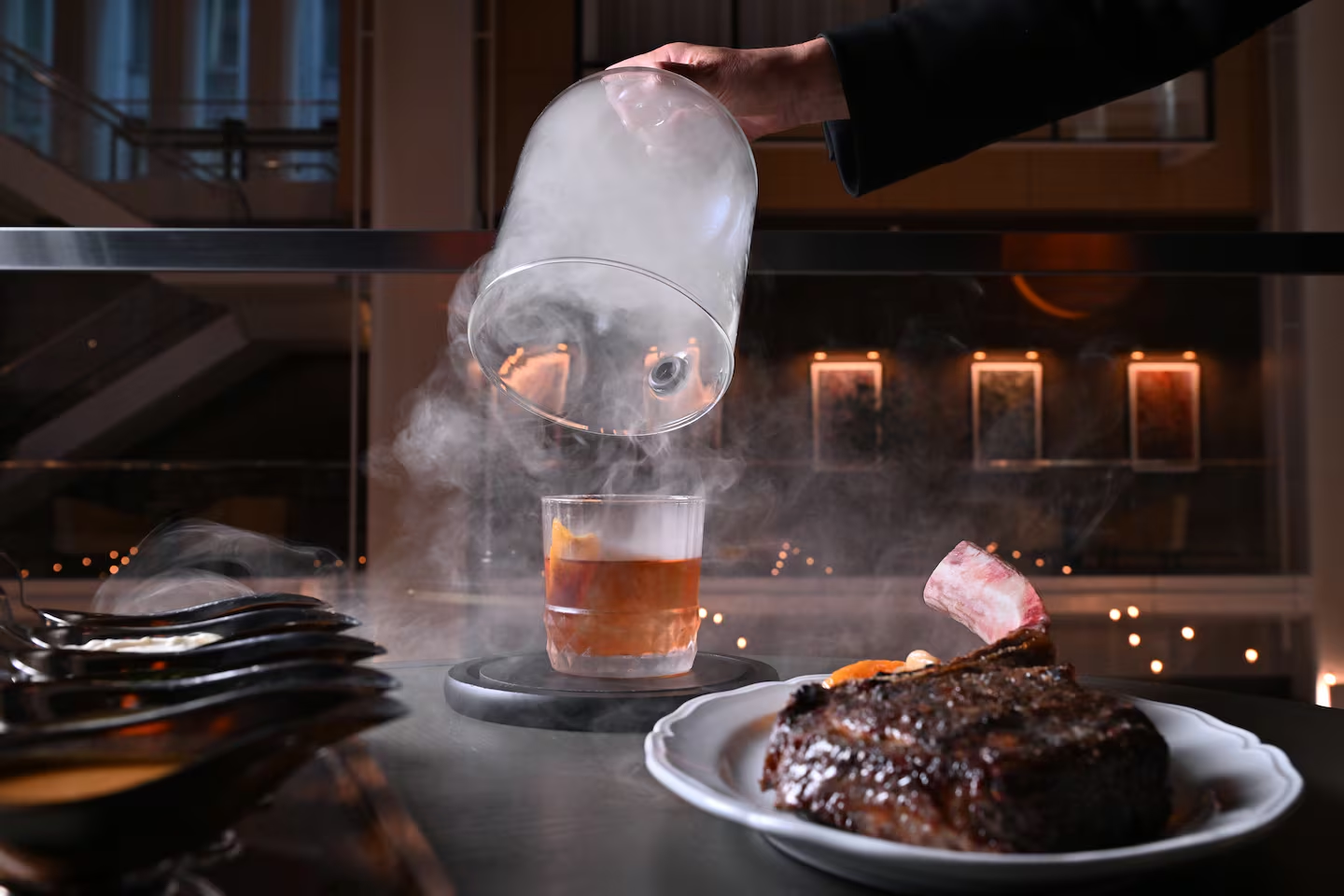
Why luxury steakhouses are such big business in Boston
When Hawksmoor opens in Boston this fall, the celebrated London-based steakhouse operator won’t be entering a market that’s starving for beef. The 200-seat restaurant will join a growing crowd of more than two dozen steakhouses, all making the same bet that Boston can support yet another temple to cold martinis and dry-aged ribeyes.
Read more Grading the Celtics’ first-round draft picks of the last decade
While many restaurants are struggling to make the economics work, steakhouses have emerged as one of the industry’s most attractive categories. Investors are funding them, developers are helping bankroll them, and restaurateurs keep opening them. They’re all convinced that Boston’s expanding pool of wealth will embrace another wave of luxury dining.
The evidence in favor of the steakhouse’s success is everywhere. The Boston area has long had a roster of both independents and chains, like the iconic Grill 23 & Bar, Mooo, The Capital Grille, Rare at Encore, Del Frisco’s, Frank’s, Fogo de Chão, and STK. Abe & Louie’s is a showy social hotspot, and Bogie’s Place, hidden behind a downtown bar with a no-phones policy, an industry favorite.
Now, both local and national brands are flooding the market. More recently, Boston has added Maple & Ash, Vermilion, The Zebra Room, and Prima Italian Steakhouse. More, such as Hawksmoor and Bar 23, are on the way.
But even with Boston’s affinity toward meat and potatoes, can the market really sustain such an extreme proliferation of steakhouses?
Veteran operators like Chris Himmel, president of Himmel Hospitality Group, which owns Grill 23, believe the answer is yes. Diners have become more risk-averse since the pandemic, Himmel said, favoring dependable experiences over culinary experimentation.
“They’re saying, ‘If I’m going to spend my money, I want to make sure it’s worth it…. I don’t want to spend $400 and roll the dice,’” said Himmel.
Grill 23 has the elegant appeal of a bygone era: dark wood, stark white linens, tuxedo uniforms, and a wine cellar worth roughly $4 million. There are clear expectations of great service and high-quality food when you dine somewhere like this, making the investment of going out less risky. Even as consumers pull back elsewhere, reliability is paying off.
Himmel’s four restaurants each posted record sales last year. But Grill 23’s numbers are especially strong, Himmel said, “significantly, significantly above” those of 2019 — a rarity for restaurants in the post-pandemic world.
Grill 23 is such a hit that “basically, we’d be crazy not to take on a new adventure,” said Himmel.
That’s why Himmel will soon expand to the flashy Seaport District, and open Bar 23, a mini version of Grill 23, as well as Le Boulevard, a French restaurant. Himmel isn’t deterred by the new competition of steakhouses; Grill 23 can’t rest on its laurels, he said. In an added flair of hospitality, his team built a small bar in the restaurant’s wine cellar — which for years was closed off from the public. Sometimes, they’ll surprise guests, and bring them down to the restaurant’s depths after dinner for a nightcap.
Boston’s renewed love for steakhouses mirrors what’s happening in New York City, said Dennis Tucinovic, who owns Delmonico’s, the nearly 200-year-old Manhattan steakhouse. Behind the boom, he said, is a sure profit.
“Steakhouses tend to have strong average check sizes, reliable beverage programs, and broad demographic appeal,” said Tucinovic. “They can work for corporate dinners, tourists, local regulars, and milestone celebrations. From an investor perspective, that makes the category feel more stable and scalable than trend-driven concepts that may have a shorter lifecycle.”
Roger Berkowitz, who long ran Legal Sea Foods and now owns Roger’s Fish Co., argued steakhouses have few moving parts, recognizable economics, and a clear path to returns. Plus, they offer investors something aspirational.
“Everyone wants to own something hot,” Berkowitz said. “And investor bros want to have a piece of their own club.”
Himmel has secured roughly a dozen investors to back the Seaport expansion, raising “less than a few million” for Bar 23, he said, and between $3 to $4 million for Le Boulevard. Most backers are individuals who are Grill 23 regulars, he said, and some have supported the group’s previous projects. While most backed both concepts, Himmel said the investors’ excitement is mostly focused on the mini steakhouse.
“People were like, ‘Great, I want to talk about Le Boulevard, but can we get back to Bar 23 for a second?’”
The boom is happening, bafflingly, at a time when the cost of the main ingredient is skyrocketing. Median steak prices at Boston restaurants were up more than 8 percent in May compared last year, according to Toast data. Yet people are willing to pay.
The surge in steakhouse concepts reflects a broader bifurcation within the restaurant industry, said R.J. Hottovy, who heads research at Placer.ai, which tracks foot-traffic analytics. Higher-income consumers are increasingly seeking “premium” experiences, he said. “This demand has allowed the fine-dining category to outperform other sectors, despite rising costs.”
Steakhouses also provide an air of status and nostalgia. The average restaurant customer is getting older, noted Tufts University food economist William Masters, and the appeal of steakhouses is “lodged somewhere deep in the brain where we return as we age.
Read more France restricts public alcohol consumption and outdoor sports as heat wave bakes parts of Europe
“Some younger people nowadays also like tuning in to more primal feelings, climate change and heart disease be damned,” said Masters.
Plus, he said, most diners can’t afford so many fancy dinners these days, so higher-end restaurant owners pivot to “whatever signals indulgence to older rich people.”
One new Boston entry, Maple & Ash, leans heavily into the “baller” mindset. The Chicago-based chain opened in the Seaport this spring, and the menu includes fire-roasted seafood towers costing up to $300, a $225 porterhouse, a cocktail named for actress Syndey Sweeney, and a $175 tasting menu literally called “I don’t give a f*@k.” Pair it with the “IDGAF Old Fashioned” cocktail for $75. It comes with 24-karat gold. At some of Maple & Ash’s other locations, there are gold-plated Tommy guns cradling magnums of Champagne.
Danny Grant, Maple & Ash’s corporate chef and partner, admitted that the economics aren’t obvious. In the US in general, “margins for a steakhouse right now are terrible,” he said. “I actually think a steakhouse in this economy is one of the most inappropriate genres of restaurants to be opening.”
But in Boston, he sees people who are willing to spend.
“I love seeing the bar full at 4 o’clock on a Tuesday,” Grant said. “These people are here to enjoy life, the finer things, have a drink after work, dive into really good food.” To hook them, steakhouses now have to go beyond great meat and service. “Just as important is the vibe and the feel, the music, the art, the way the lights flicker in the evening.”
Investors aren’t the only ones taking risks on these restaurants. Developers, too, are finding ways to bankroll steakhouses, seeing food as an amenity that can help lease offices, attract residents, and elevate their properties.
That’s the case at the Winthrop Center, a billion-dollar downtown skyscraper that partnered with New York City chef John Fraser — known for his Michelin-starred vegetarian cooking — to run Vermilion, a 120-seat steakhouse with an extensive cocktail program. The building developers “own the restaurant with me,” said Fraser. “It’s not a rent-type situation.”
When asked if he could have expanded to Boston without this partnership, Fraser was direct: “Not at that stage. No.”
The forces fueling the steakhouse boom could also be the result of broader shifts in the local economy. For years, Boston has attracted wealthierresidents, new companies, and opulent housing.
Massachusetts has long ranked among the states with the highest incomes, and its wealth is rising quickly. Seventeen municipalities reported median family incomes above $250,000, up from just eight towns five years ago, per recent census estimates. Out-of-state companies are taking note.
Two years after opening Vermilion, Fraser calls Boston “a sophisticated market” that’s hungry for more.
“So many educated people [and] quiet wealth,” said Fraser. “Those people need places to go.”
Before the pandemic, steakhouses were largely fueled by corporate expense accounts and martini lunches. While operators say drunken business parties are much more tame these days, modern steakhouses are increasingly trying to attract younger people, women, and a social media-driven clientele that’s searching for great vibes. That’s the angle that Coje Management Group took when it recently opened The Zebra Room, a 42-seat steakhouse hidden behind a bookshelf at Yvonne’s, its cocktail bar. Inside, diners dig into salt-crusted prime rib and a buttery baked lobster Savannah in a deep red dining room with flashy decor — including the head of a zebra named Hank — while waitstaff wear white tuxedos. Coje founder and CEO Christopher Jamison said the group spent $1.75 million to open it.
The Zebra Room’s buzz so far has been strong. Still, Jamison is realistic about the limits of the city’s steakhouse fever: “How many seats can Boston actually support for that same general experience?”
Masters, the Tufts economist, is more blunt: “Lots of these steakhouses will fail.” For him, it’s just a question of which ones.
“Those who arrive late to the trend might be most at risk, unless they are dramatically better than the incumbents who have an established clientele,” said Masters.
While sipping a Sam Adams in a Seaport hotel lobby, Hawksmoor co-founder and CEO Will Beckett rattled off reasons he chose to expand to Massachusetts: a solid post-pandemic recovery, return-to-office momentum, growth in lucrative industries like the life sciences, and a belief that the Fort Point neighborhood, where Hawksmoor will reside, is having a moment.Also, he and his English cohorts “just really love Boston.”
Despite his excitement, Beckett acknowledged that the Boston Hawksmoor is entering a saturated market, and said it likely won’t be an instant success.
“Do we come in here and think it’s an instant slam dunk financially? Frankly, no,” he said. “But this is a long-term bet on Boston.”
Read more Nestle executive relocates to Mass. to lead Ocean Spray as CEO




Post Comment