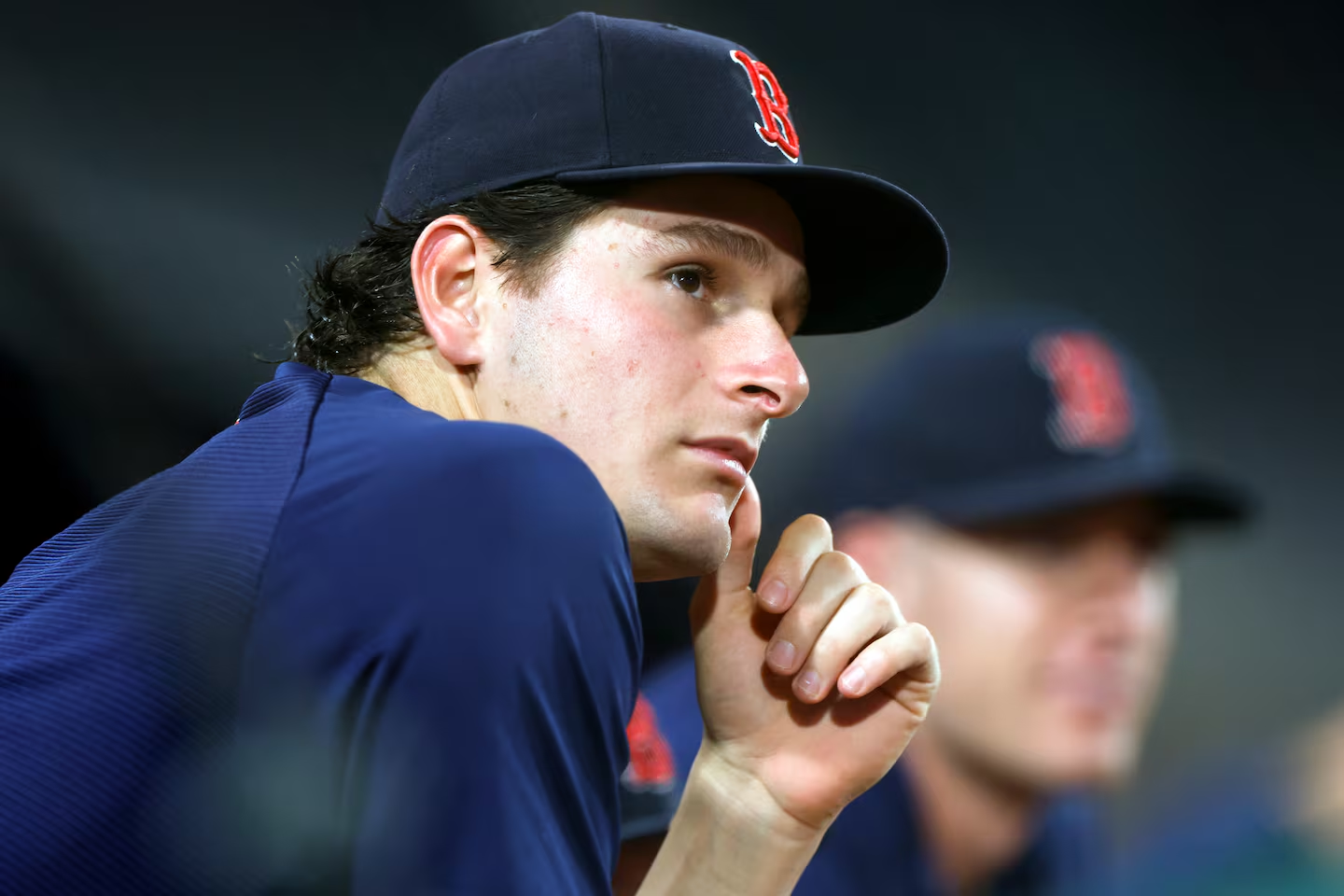
What exactly is ailing Roman Anthony? And when might he be back with the Red Sox?
If you’re still confused about the injury that has sidelined Red Sox outfielder Roman Anthony since May 4, you’re in good company.
Read more Ex-Bruin Milan Lucic officially calls it a career
For six weeks, Anthony’s injury has engendered confusion and uncertainty both about the precise nature of what happened and the timeline for his return. Much of that owes to the rarity of what happened to the 22-year-old on an awkward check swing against the Tigers.
The injury — described by the Sox as a “right wrist sprain” when Anthony was placed on the injured list May 7 — is more precisely described, according to Anthony, as a partial tear of the ligament in the right ring finger at the carpometacarpal (CMC) joint.
How is that different from a right wrist sprain?
“Much of this is just semantics,” said Dr. Mark Cohen of Midwest Orthopaedics at Rush University. “The CMC joint is the connection of the hand to the wrist. Whether you call that a hand injury or a wrist injury is dealer’s choice. There’s no difference.”
And the difference between a sprain and tear?
“That’s all semantics, too,” said Cohen. “A sprain, a strain, a stretch, a tear, they’re all the same problem along a continuum. We typically talk about a Grade 1, Grade 2, or Grade 3 tear. That’s just sort of a made-up way to try to identify the severity and describe the injury, a 1 being a tiny strain or tiny tear to an intact ligament; a 2 being a tear to the ligament, but some fibers remaining intact — so a partial tear; and then 3 being a complete tear where the ligament is completely torn. We don’t use ‘sprain.’ That’s more of a colloquial term than a medical term.”
So, a tear is a sprain, and a ligament injury at the CMC joint can be classified as a hand or wrist injury. So far, so good.
Harder to resolve: when Anthony might return.
Most sports injuries fall into familiar buckets with well-established healing timelines. Had Anthony broken his ring finger, his return to baseball activities would have come with clear expectations. A partial tear of a ring finger ligament at the CMC joint, however, lacks precedents that offer a clear timeframe.
“I’ve been doing this 32 years. I actually have never heard of a ring finger-isolated CMC ligament tear,” said Cohen. “The joints in which the ligaments get injured are usually not the CMC level … They’re at the knuckle or joints within the fingers. If you look up ring finger ligament sprain, you’ll find nothing — zero — because it’s not a common injury.”
That absence of a case history, in turn, prevents a defined timetable for return. Indeed, once Anthony was examined by Dr. Matthew Leibman in Boston in May, they formalized that recognition.
“The hand doc said at the beginning, specifically, we weren’t going to put a timetable on this to where it was like, ‘OK, this is a 4-6-week [healing process],’ or ‘This is a 6-8-week [healing process],’ ” said Anthony. “[The doctor said], ‘We’re not going to put a timetable on it because one, we just don’t know the exact timetable, and two, we don’t want to get to a point where if we say it’s four weeks and we get to four weeks and it’s not there, then everyone panics.’ ”
Read more Down to the wire: Filing period closes with last-minute candidate for N.H. legislative race
That said, there was false hope early. Anthony, who was dealing with a hand injury for the first time and thus unfamiliar with recovery, received a cortisone shot in mid-May. He was optimistic it would allow him to play pain-free, particularly given that he didn’t feel any discomfort as he resumed other baseball activities such as throwing.
But then, as Anthony tried to start swinging again roughly two weeks after the injury, he immediately experienced discomfort, similar to what he’d felt when he suffered the injury. That led to a realization that Anthony’s return would not be quick.
Subsequent dry swings have come with discomfort, with the result that, six weeks after his injury, Anthony still isn’t able to hit a baseball even off a tee.
“It doesn’t hurt when I’m walking around, or it doesn’t hurt me to throw a baseball,” said Anthony. “But the minute I do certain weird things and turn my steering wheel a certain way with the hand and forget that I have a torn ligament, then I’m like, ‘Oh [shoot], there it is.’ It’s just a weird injury, and just unfortunately there’s not much else I can do.”
Cohen noted the typical timetable for collagen to heal in a true ligament tear is 8-12 weeks, so it’s not surprising a player would experience pain six weeks after an injury. Anthony has been told the same.
“We’re not to a point where we’re past a time where we’re like, ‘Oh [expletive], this is something more serious than what we thought,’ which is a good thing,” said Anthony. “But it’s also an annoying thing for me [not to have a timetable].”
Aside from a reexamination through more imaging, there is little for Anthony to do but wait for the ligament to heal.
“I’m doing everything I can in terms of recovery, sleep, and all the things that go into [recovery]. I’m putting my part into it. I’ve just got to let the body do its thing,” said Anthony. “It’s just been slower than I imagined.”
Read more Elon Musk, trillionaire and avatar of the AI Gilded Age


Post Comment