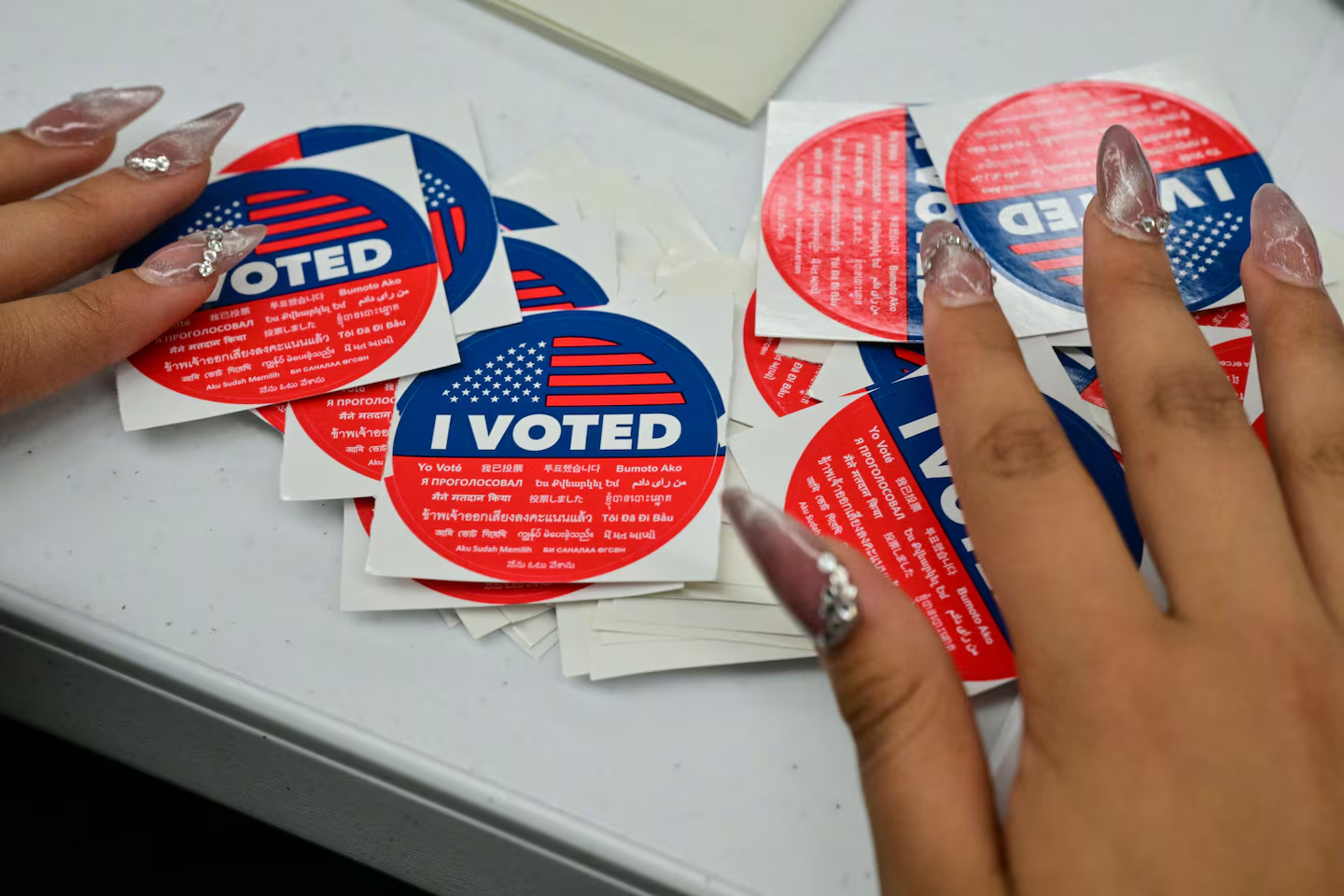
Influencer elections are here: How 2026 campaigns are tapping creators to spread their message
Two political influencers, Kaitlyn Hennessy and Beatrice Gomberg, were scrolling their social media feeds on Mother’s Day when they noticed a collection of content supporting Tom Steyer, then aDemocratic candidate for governor of California.
Read more Yankee doodle dandy of a World Cup opener for the United States
The accounts producing the posts had been created only few days before and had very few followers. Gomberg, who runs a small business and supported Democrat Xavier Becerra, was surprised to see that the creators in question were based outside of California. Becerra went on to win the June 2 primary and will face Republican candidate Steve Hilton in the November general election. Still, the posts nagged at Gomberg.
“Ultimately, it comes down to it being deceptive,” she said. “Why is someone who’s registered in Pennsylvania telling you who to vote for in California?”
The two creators then discovered the Steyer campaign’s job listing on SideShift, a creator hiring platform, which offered $1,000 per month for daily posts from May through early June, following specific guidelines. It was later edited to note that creators must include disclaimers of payment under California state law.
By definition, an influencer is someone who has amassed a supportive following on social media. And the Federal Trade Commission disclosure of any financial, employment, or personal relationship with the brand.
The same rules apply for political influencers, who post about current events or civic issues, and command a growing audience online as one in five Americans regularly look to them for information, Pew Research found in 2024.
In an age where half of adult social media users seek out theseplatforms to find like-minded people and 42 percent use the apps to get involved in issues they care about (a rising percentage since 2023), it’s no secret that campaigns value online engagement. As the influencer economy continues to grow, politicians are looking for ways to advertise to new audiences, and the influencers themselves stand to benefit.
Digital strategist Caleb Brock, who worked on digital-forward campaigns for Democrats Representative Ro Khanna of California and Senator Ed Markey of Massachusetts, said this election cycle “really is the first ‘we are paying influencers’ election.”
“It’s the same thing as buying an ad. It’s just, in my opinion, more beneficial, more connected, and you can get really granular in it, in terms of how you connect to voters or stakeholders,” he said about this form of media buying.
Unlike with television advertisements, the Federal Election Commission does not require individuals to disclose any payments or sponsorships behind their political posts. The lack of federal campaign rules has allowed candidates without state-based guidelines to operate freely in their absence.
Massachusetts campaign finance law requires disclaimers when social media marketing exceeds a market value of $250, but does not have specific directives for influencers.
“This is misleading voters,” said Saurav Ghosh, director for federal campaign finance reform at Campaign Legal Center. “When an influencer is posting something on TikTok or any social media, that doesn’t look like a typical ad, but if it’s being paid for by a candidate or a super PAC, voters need to know that.”
In 2023, the FEC imposed disclosure rules on advertisements on digital platforms but decided not to regulate influencers. The commission’s argument likened social media to a soapbox for an influencer to speak freely to a broad audience, rather than a form of paid advertising, although two commissioners . The FEC currently has just two acting commissioners out of the standard six positions.
In an attempt to spur congressional action on the matter, Democratic Representative Mark Takano of California introduced the Promoting Authenticity with Influencer Disclaimers Act on June 2. The proposes amending the Federal Election Campaign Act of 1971 to require disclaimers of payment in a “clear and conspicuous manner” on an influencer’s account.
“When you think about the fact that this is aiming at emerging technology and dealing with it, it’s a bit ironic because technology moves pretty quick and the updates of federal rules is kind of the opposite,” Ghosh said.
While the federal laws lag behind the cultural shift, some states have implemented laws to force influencers to disclose if they are being paid for an endorsement.
The Texas Ethics Commission, an independent body that enforces the state’s campaign finance laws, voted 7-0 to require disclosure after Gen Z influencers were paid to defend then-Attorney General Ken Paxton during his impeachment in 2023.
Read more Meet New England’s lone women’s pro softball player: Boston University pitching great Kasey Ricard
The California Fair Political Practices Commission adopted in 2024 that a person paid to post content “shall include a disclosure with that content stating that the committee paid the person in connection with the post.”
Steyer’s gubernatorial primary campaign tested the efficacy of the new regulation. In addition to the legion of smaller influencers, Steyer campaign spending documents revealed larger sums paid to reach bigger audiences.
Culture account TheShadeRoom received $25,000 for a post to its over 28 million followers. Latino influencer Carlos Eduardo Espina endorsed Steyer to his 14 million TikTok followers after he was hired as a campaign consultant for $100,000. Although Espina announced the partnership in April, neither creator’s posts originally mentioned any financial affiliation with Steyer.
Hennessy and Gomberg have filed an official complaint with the California Fair Political Practices Commission, according to Politico. Steyer denied wrongdoing, writing on Substack that the influencers support his policies and he pays them “for their work and their time,” not their endorsements. His campaign filed its own complaint against Becerra for paying one creator, Jordan Gonzalez, without abiding by disclosure rules. Steyer has since endorsed Becerra.
“I think every candidate in that race is engaging in that,” Brock said. “It’s becoming more normalized, which I think is acceptable because I think creators deserve to get paid for their work.”
Josh Cook, president of Good Influence, a creator agency that advises progressive candidates and organizations in digital strategy and influencer partnerships, said his organization only connects campaigns with creators that are already politically aligned.
He noted that Good Influence is focused on creators who are effective communicators of these issues, rather than strictly political influencers.
Still, Jesse Lehrich, a strategist who co-hosts the political podcast Nobody Knows Anything and worked as foreign policy spokesman for Hillary Clinton’s 2016 presidential campaign, said accepting payment would feel like a betrayal to his audience.
“The reason that your voice carries value is because people trust you and think you’re an honest broker, and so it just doesn’t feel right to me to make money to be basically providing paid services that you’re not telling people are paid for,” he said.
Both party conventions in 2024 gave credentials to creators, and paid and unpaid influencer posts abounded during the presidential race. Campaigns are required to disclose the purpose of disbursements to the FEC, but there is no standard category for influencer advertisement.
The NRCC paid over $120,000 to conservative influencer network Creator Grid between 2025 and 2026 with the description “media.”
Democratic Senate campaigns for Representative Seth Moulton of Massachusetts as well as Mallory McMorrow and Representative Haley Stevens, two candidates from Michigan, have spent thousands on creator and consulting agency Good Influence.
Democrats are “still catching up on a new generation of leadership” that is more digitally savvy, and the majority of campaign spending still goes to television, according to Cook.
“We’re still spending hundreds of millions of dollars on TV. The idea that we’re outraged that campaigns are supporting independent voices online to try to help disseminate their message in collaboration … I think it’s a little silly,” he said.
Candidates will continue to vie for attention using new media with niche audiences at an even greater scale ahead of elections in 2026 and 2028, strategist Jesse Lehrich predicted.
“I don’t think people have processed just how messy it’s going to be,” he said.


Post Comment