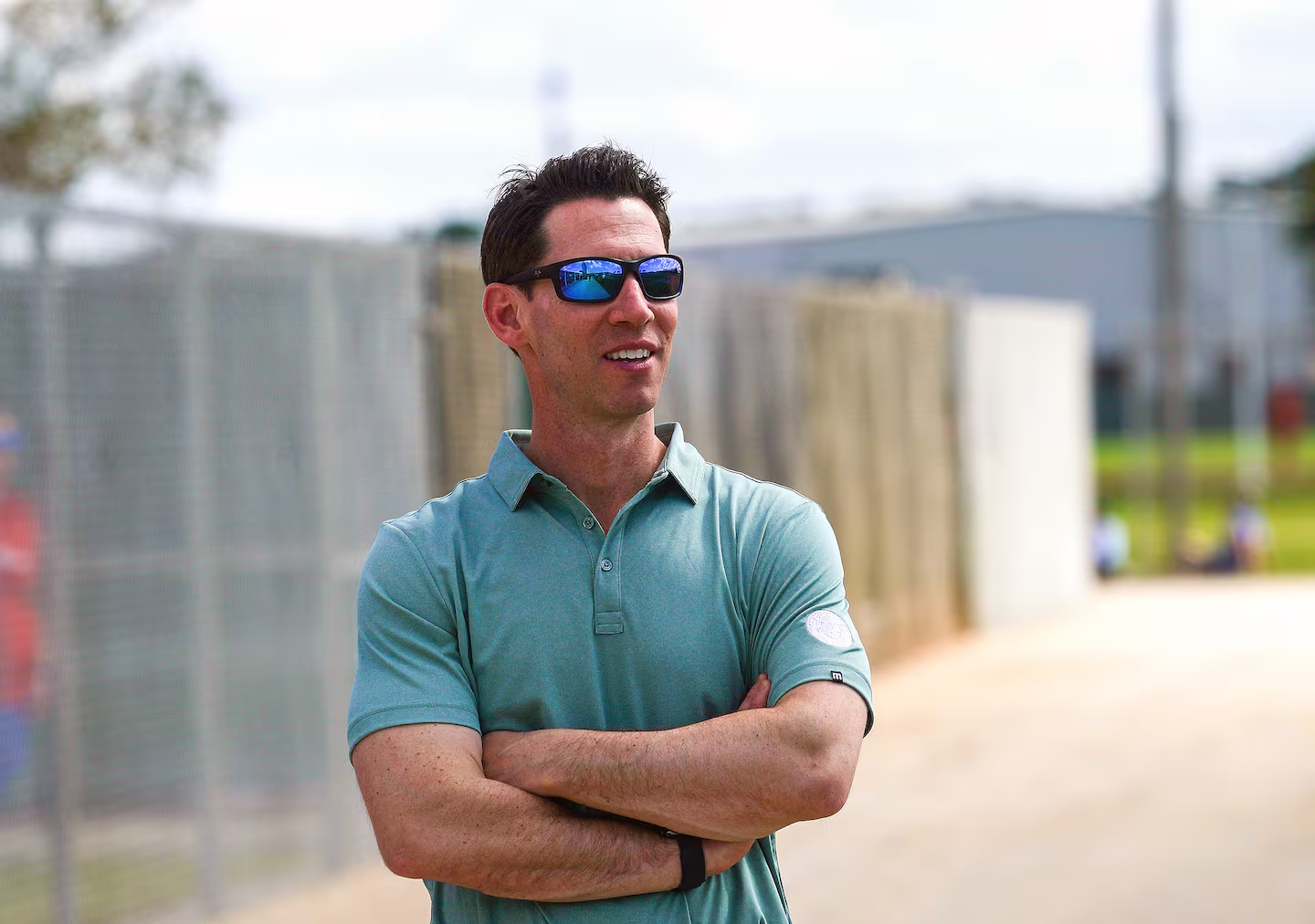
Are the Red Sox better off now than when they hired Craig Breslow as chief baseball officer? Here’s a closer look.
From his suite perched high above the field at Fenway Park, Craig Breslow watches it all.
On the mound, Sonny Gray and Ranger Suarez, veteran starting pitchers brought in to help turn a good rotation into an elite one, a piece of the plan that has worked.
In the infield, Caleb Durbin, the Red Sox’ third third baseman in as many years, disappointing as a key part of Breslow’s signature trade tree.
In the dugout, an injured Roman Anthony, and at shortstop, Marcelo Mayer, two of the ballyhooed big three prospects who ― a year after their debuts — have not performed to expectations.
More than ever, a month-plus after he fired manager Alex Cora and six coaches, and as another trade deadline season approaches, what Breslow sees is a club built in his vision.
It all raises a key question: Are the Red Sox better off now than when they hired Breslow as chief baseball officer after the 2023 season?
“It’s difficult for me to be the person who evaluates that,” Breslow said in an interview with the Globe. “I came here with a pretty clear vision for the work that needed to be done.”
A survey of a swath of executives and evaluators from across the majors, including some who work or worked with Breslow, reveal pieces of a complicated answer. In some ways, sure, the Sox have made noteworthy progress. In other areas, including in the standings in 2026, not so much.
Midway through Year 3 under Breslow, the answer seems not to be a clear and obvious yes.
Pitching and hitting
When Breslow came aboard to “kind of restore the Boston Red Sox,” as he put it, foremost among his priorities was developing a pitching pipeline. This century, the only homegrown Sox hurler to post multiple seasons of at least 120 innings and 2.0 Wins Above Replacement, as calculated by FanGraphs, is Jon Lester — and that was so long ago that he will be on the Hall of Fame ballot this year.
Although three years is not long enough for it to fully filter up to the majors, there are signs of success. Rival executives largely agree with Breslow that the pipeline is beginning to flow.
Rookie lefthanders Connelly Early (drafted by Chaim Bloom’s Sox and developed by Breslow’s) and Payton Tolle (drafted and developed under Breslow) have helped stabilize the rotation and keep the season afloat.Anthony Eyanson looks like the fastest-rising member of a potential next wave, growing from the 87th draft pick to a top-50 prospect in all of the minors, according to Baseball America, in less than a year.
The results are real enough that the Mets hired the Sox’ director of pitching, Justin Willard, as their pitching coach last offseason. An official with another big-market club indicated having a pair of homegrown — and therefore cheap — rotation arms was envy-inducing.
“We invested resources and kind of overhauled how we thought about pitching development. Some initial returns are positive,” Breslow said. “We’ve seen guys move through the organization pretty quickly and contribute at the big-league level.”
Breslow has told Sox people, a team source said, that he believes strongly enough in their ability to backfill that he is OK trading depth pieces, even if they excel elsewhere. Quinn Priester (3.32 ERA for the Brewers last year) and Kyle Harrison (1.57 ERA for the Brewers this year) are two such examples.
“They get a pass [on trading depth starters who later blossom] because they clearly draft and develop well,” a rival executive said.
Lagging behind the Sox’ pitcher development is their hitter development. Several of the sources surveyed wonder if that is because Breslow, a former pitcher, doesn’t understand that side of the game in the same way he does his own.
Consider: How might 2026 fortunes feel different if even one or two of Anthony, Mayer, and Kristian Campbell (a poster boy for the position player program after a breakout 2024) were playing at the level anticipated? That group was presented as a pillar of the post-rebuild Red Sox.
Anthony followed a strong half-season in 2025 with a slow start this year, then hurt his hand/wrist. Mayer has been strong in the field but not at the plate. Campbell has toiled in Triple-A for nearly a year. They remain young and able.
“We have a very strong farm — we had a very strong farm system. A lot of players have kind of graduated to the big leagues,” Breslow said. “Really good minor league players often become really good major league players. The job we have as an organization is to shorten the timeline it takes for that to happen.”
Dedication to data
Breslow’s supporters and detractors agree: He is heavily reliant on analytics. He is either an “extremely principled” executive who deploys “model-based decision-making,” as one friendly put it, or woefully beholden to algorithms, as the less-than-friendlies do.
He pushed back on the hardline analytics perception.
“I — we — try to use information to make decisions, try to make consistent decisions, disciplined decisions,” Breslow said. “If you are blindly following a model and knowing that the model is imperfect, you are going to make mistakes. The job that I have is to synthesize all of the information sources that we have. And we want to constantly improve all of that information, including a bunch of our models.”
Under Breslow, erosion of the professional scouting department has intensified.
In 2023, the Sox’ last year under Bloom, their media guide listed 14 pro scouts. This year, they listed one domestic pro scout and six “acquisition specialists, professional scouting.” Not all have a traditional scouting background. Further, travel for those employees has been cut significantly, meaning far fewer in-person looks and more video-based work.
In an era in which virtually every club is trying to find a balance between modern analytics and traditional scouting, the Sox’ approach exists in contrast to some industry leaders. The Dodgers and Yankees, for example, are seen as having maintained pro scouting groups with bodies and influence. So have the Rays, long an analytics darling. Other clubs, such as the Brewers and Guardians, have gutted their pro scouting ranks.
Adjacently, the Dodgers, for example, have a tendency to collect former big leaguers as special adviser-types, whose opinions they seek. Their front office second-in-command is general manager Brandon Gomes, a former major league pitcher from Fall River.
The only fellow former player Breslow has hired for any role is pitching coach Andrew Bailey. They grew close as teammates, including with the Sox.
“People talk externally about not a ton of diversity within the operation in terms of experience,” a rival executive said.
Bailey is the only remaining member of the coaching staff who played in the majors; a handful of others played only in the lower minors or college. Nobody in Breslow’s front office, besides him, is a former big leaguer.
Do they need more of that perspective?
“That perspective does help. It’s very helpful,” Breslow said. “There’s credibility that comes with having worn a uniform, having lived the same experiences. I will also say, like, I have.”
When Breslow was hired, he looked like the best of both worlds: an Ivy Leaguer who played — for a long time. But according to people who know him, in this role he has leaned way more into his Yale self than his player self.
“I probably can do a better job of that,” Breslow said of breaking out his big-league side. “Because the reality is I feel more comfortable talking to players and I feel more comfortable in the clubhouse than in the front office, because I did it for longer.”
Multiple officials noted that Breslow, universally regarded as extremely intelligent, might benefit from having an interpreter of sorts, someone with a more traditional baseball “fabric” and personable demeanor who can convey the front office’s message.
“People probably wrongly assume, ‘Hey, he played, he doesn’t need that,’ ” one said.
Within the organization, some believe interim manager Chad Tracy could fill that role, if he gets the permanent job. He has credibility as a baseball lifer — from a baseball family — who understands the sport’s modernities. And he is comfortable pushing back, a source said, if he thinks something the front office wants just won’t work.
“You can trick yourself into thinking it’s however complicated, but at the end of the day, it’s still human beings,” a National League exec said.
Another said: “The risk of rapid organizational change is that people in the clubhouse aren’t capable of following. With that gap or that gulf, [a leader can] choose all the right things, but those right things can still get you the wrong result if you’re not tethered as a group.”
Over the past month, Breslow has made a concerted effort to have more conversations with players and clubhouse-level personnel, he said. Part of the point is telling them he cares about them and winning and he is there to support them.
“Making that clear to players and staff goes a lot further probably than I initially gave it credit for,” Breslow said. “I think I just assumed that that was the case. But actually verbalizing it and sitting down with players and having the opportunity to build those meaningful relationships — I think that’s something that I’ve taken to heart.
“My hope is that players walk away thinking: ‘That guy is really one of us. He’s got a different job, and sometimes that job is really [expletive]. But he’s one of us, and he gets it.’”
The analytics-first approach impacts all tentacles of a vast baseball operation.
For example, the models generally don’t recommend signing hitters in their 30s who play one or zero positions to large contracts. After Breslow opened the offseason by saying the Red Sox needed to add power to the lineup (a de facto replacement for the traded Rafael Devers), they had a video meeting with Kyle Schwarber, did not converse further, and did not make an offer.
(Last month, the 33-year-old Schwarber returned to Fenway with the Phillies, with whom he wanted to re-sign all along, and hit a key home run in each of his team’s two wins. A Red Sox player lamented they sure could use a bat like that — and maybe that one specifically.)
The next domino to fall was Pete Alonso, who signed with the Orioles for five years and $155 million. The Sox’ offer was well short, sources said at the time.
Alex Bregman waited until mid-January to see if the Sox would meet his asking price. At one point late in the process, he offered to return for slightly less than he wound up receiving from the Cubs ($175 million over five years). When the Sox didn’t acquiesce on a no-trade clause and sought salary deferrals, he headed to Chicago.
The Red Sox doubled down on pitching, signing Suarez to a $130 million contract over five years, showing a willingness to spend, and traded for Durbin to play third — setting up an imbalanced roster that has struggled to score. The Devers-shaped hole remains.
“If you’re always rational about every free agent, you will finish third on every free agent,” Dodgers boss Andrew Friedman said 10 years and three World Series championships ago.
Theo Epstein has been disappointed by the Sox’ intense analytical direction under Breslow, multiple league sources said. A minority owner and adviser who led the franchise to two World Series titles as GM, Epstein has long been a mentor to Breslow, hiring him to the Cubs front office and helping him get the Sox job.
“Theo was an all-forms-of-information guy,” said one evaluator who was with the Sox during the Epstein era. “He didn’t just live on Carmine [their internal database at the time]. He listened to people.”
Breslow said his communication with Epstein “ebbs and flows,” but he remains a sounding board and valuable resource.
Winning and losing (and spending)
Ultimately, all that matters is what the Red Sox do on the field. Winning solves plenty of problems, real or perceived.
Breslow’s Red Sox possess a 195-187 record. That .510 winning rate represents a 6 percent improvement over the two seasons before he took over. Overall, the Sox have ticked up, but not shot up.
That is a better margin of improvement than, say, the same period for Bloom’s Red Sox or Ben Cherington’s Red Sox (though he had a World Series championship in his second season). But the Sox hired Breslow, who inherited a highly regarded farm system, to take them out of the Bloom-led rebuild and into a period of perennial title contention — and it hasn’t happened.
“We won more games in ’24 than we did in ’23. We won more in ’25 than we did in ’24,” Breslow said.
Those were tangible steps forward, highlighted by a playoff berth last season. The problem is this year. With the highest payroll in franchise history — a projected $269 million as calculated for the luxury tax, according to Cot’s Contracts — the Red Sox so far have taken a large step backward as they creep toward the halfway point.
“It bothers me incredibly strongly,” Breslow said. “It keeps me up at night. It consumes my thinking. If it didn’t, then I shouldn’t be doing this job.”
In baseball, three years is considered not enough time for a head of baseball operations to fully implement and see through his vision. Red Sox ownership, however, has shown limited patience over the past decade-plus. Breslow’s three immediate predecessors were dumped near the end of their fourth season — and two of them had championship rings.
He said he does not mull his employment fate.
“When you talk about analytics — I can be very practical. Which is to say, OK, is thinking about job security going to make me better at my job or worse at my job?” Breslow said. “I don’t know how it would make me better. So I focus on all the things that are part of this job and ultimately get us where we want to go.”
Then again, last season, the Sox had a 10-game win streak in July and were 79-73 the rest of the time. That was good enough. These Red Sox are a hot streak away from relevancy. Maybe Garrett Crochet and Anthony return from injury and the team figures it out. Maybe they add major pieces at the trade deadline (unlike the past two years).
Such a hypothetical raises another borderline existential question: Does winning a wild-card spot in an expanded playoff field in a weak American League qualify as success?
“When I agreed to take this job, the commitment I made to [ownership],” Breslow said, “was to do everything that I could to improve the long- and the short-term outlooks of the organization, to deliver a team that’s capable of competing for the World Series every year, and to make decisions in the best interest of the organization, no matter how hard they were.”
Read more Patriots quarterback Drake Maye’s first celebrity softball game a big hit, and ‘a fun time’



Post Comment