The Texas Senate contest used to be about Donald Trump. Why it’s now about Susan Collins, too.
Until now, the Texas Senate race has been largely about Donald Trump.
Following Tuesday’s Republican primary runoff, it’s now a story about money and how this single contest could impact every other key Senate race in the country.
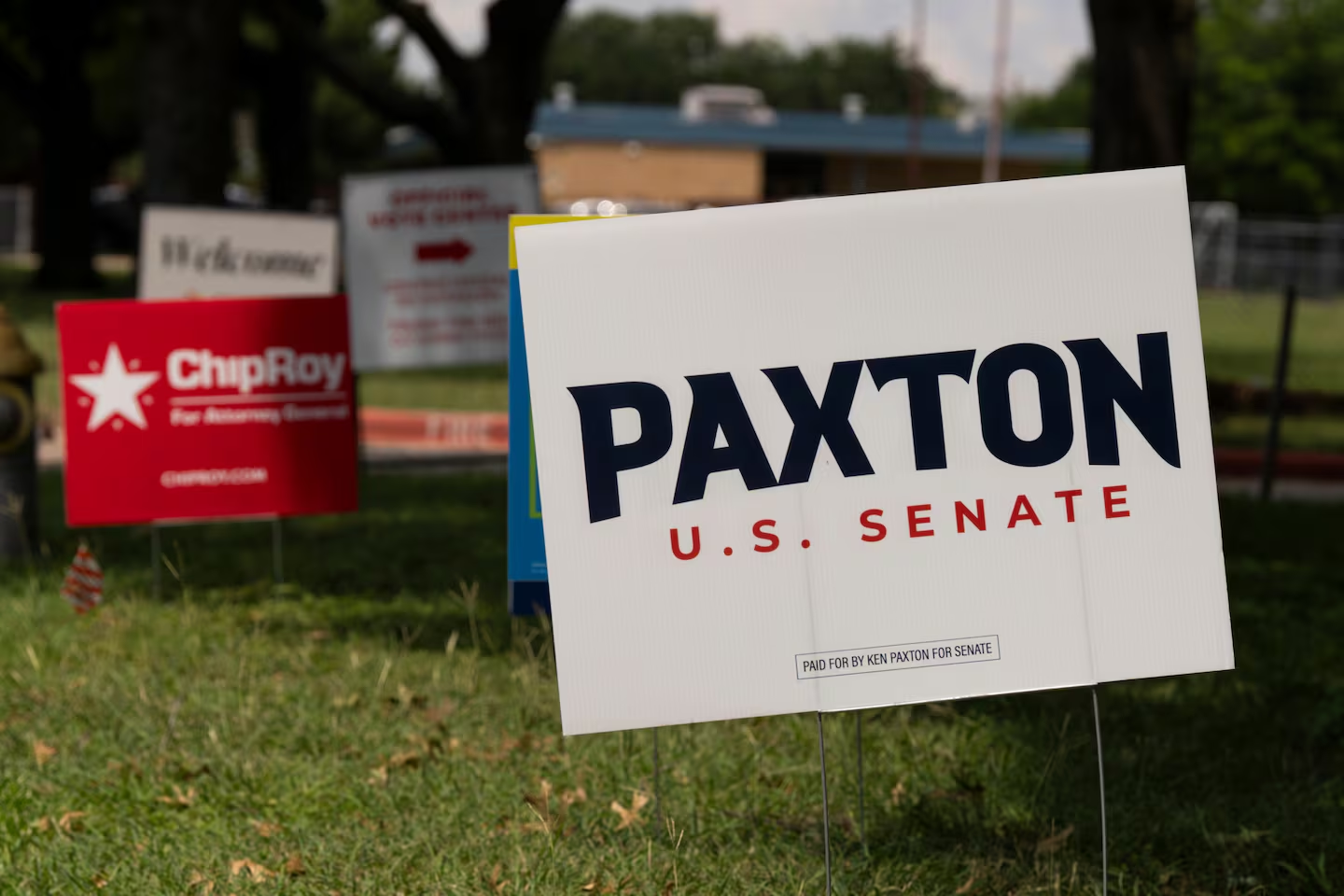
Using Trump’s endorsement last week, the state’s controversial attorney general, Ken Paxton, ousted fellow Republican John Cornyn, one of the longest-serving senators in the nation.
Cornyn didn’t exactly do anything in the Senate that drew Trump’s ire. However, after the 2020 election and the January 6 attack on the Capitol, Cornyn said Trump’s days in politics were over. He was obviously wrong about that. Since then, Cornyn had fallen in line enough withTrump that the president withheld an endorsement in this contest for months, even if Trump was personally closer to Paxton.
One thing everyone seems to agree on: Cornyn would have been the stronger general election candidate, to the point that Texas would have remained a major reach for Democrats this year. But with the scandal-ridden Paxton as the GOP nominee — and after tens of millions of dollars were spent by Republicans trashing him in this primary — the state is now very much in play.
The Democrats’ pursuit of a Senate majority, which was dismissed by many last year as fantasy, is slowly becoming plausible. From a national perspective, getting the majority isn’t about personalities or preferences. It’s about math.
Here is the equation: Democrats first need to hold seats in Michigan, Georgia, and New Hampshire. Then they need to flip four Republican-held seats. Until a few months ago, the focus for both parties was on potential flips in Maine, North Carolina, Ohio, Iowa, and Alaska. Texas was interesting in theory, but it was never really on the map.
Until now.
And that development upends the entire fight for Senate control.
The biggest reason why? Money.
Beginning last year through the end of March, more money had been spent in Texas alone by candidates and Super PACs than had been spent in all seven of those other Senate races combined, according to a Globe analysis.
And by the time the full scale of spending in this runoff is known, the sheer amount poured into the contest may have no precedent. More than $135 million has already been spent in the Texas Republican primary alone. Add to that the $44 million Democratic nominee James Talarico raised during the last fundraising quarter, and the general election hasn’t even begun.
For context, most battleground Senate races are expected to cost around $150 million total by the end of the year between the primary and general election, though Maine is expected to roughly double that.
Read more With Garrett Crochet and Roman Anthony out of the lineup, the Red Sox have been lacking star power
The spending in Texas should not surprise anyone casually watching politics there. It is the nation’s second most populous state, and television advertising requires competing across multiple expensive media markets.
In 2024, the Texas Senate race between Republican incumbent Ted Cruz and Democratic nominee Colin Allred saw $262 million spent between candidates and outside groups, according to OpenSecrets, the nonpartisan organization that tracks campaign finance data. In 2018, the contest between Cruz and then-Congressman Beto O’Rourke shattered records with $139 million spent over the course of the campaign.
The fact that Texas has already reached this level of spending roughly six months before Election Day says something about how much more expensive campaigns have become and how the Texas race is on track to set entirely new records.
Unless.
Unless Democratic leader Chuck Schumer and Republican leader John Thune decide they cannot afford to pour so much money into a single contest and instead focus their resources on the seven other key races. After all, flipping sparsely populated Alaska counts exactly the same as flipping Texas. Both parties understand that.
At the same time, Paxton may now be the most vulnerable Republican Senate nominee in the country outside of Susan Collins in Maine. Collins does not carry the same personal baggage that Paxton does, but she also represents a state Trump lost in all three of his presidential campaigns. This provides incentive for Republicans to spend more here to defend the seat than they would in, say, New Hampshire, a race where Democrats have led in every poll.
This is what suddenly makes Texas so dangerous for Republicans. It’s not simply that Democrats now have another path to the majority. It’s that every dollar, every ad buy, and every strategic decision in Texas could ripple outward and reshape Senate races thousands of miles away. By choosing Paxton, Republicans may not have just changed one race. They may have changed the entire map.
Need further proof Republicans aren’t thrilled with the results?
The Thune-controlled National Senatorial Campaign Committee statement about the Texas results on Tuesday night omitted any reference to Paxton.
Read more Boston community groups protest Mayor Wu’s $4.9 billion budget proposal over cut grants


Post Comment