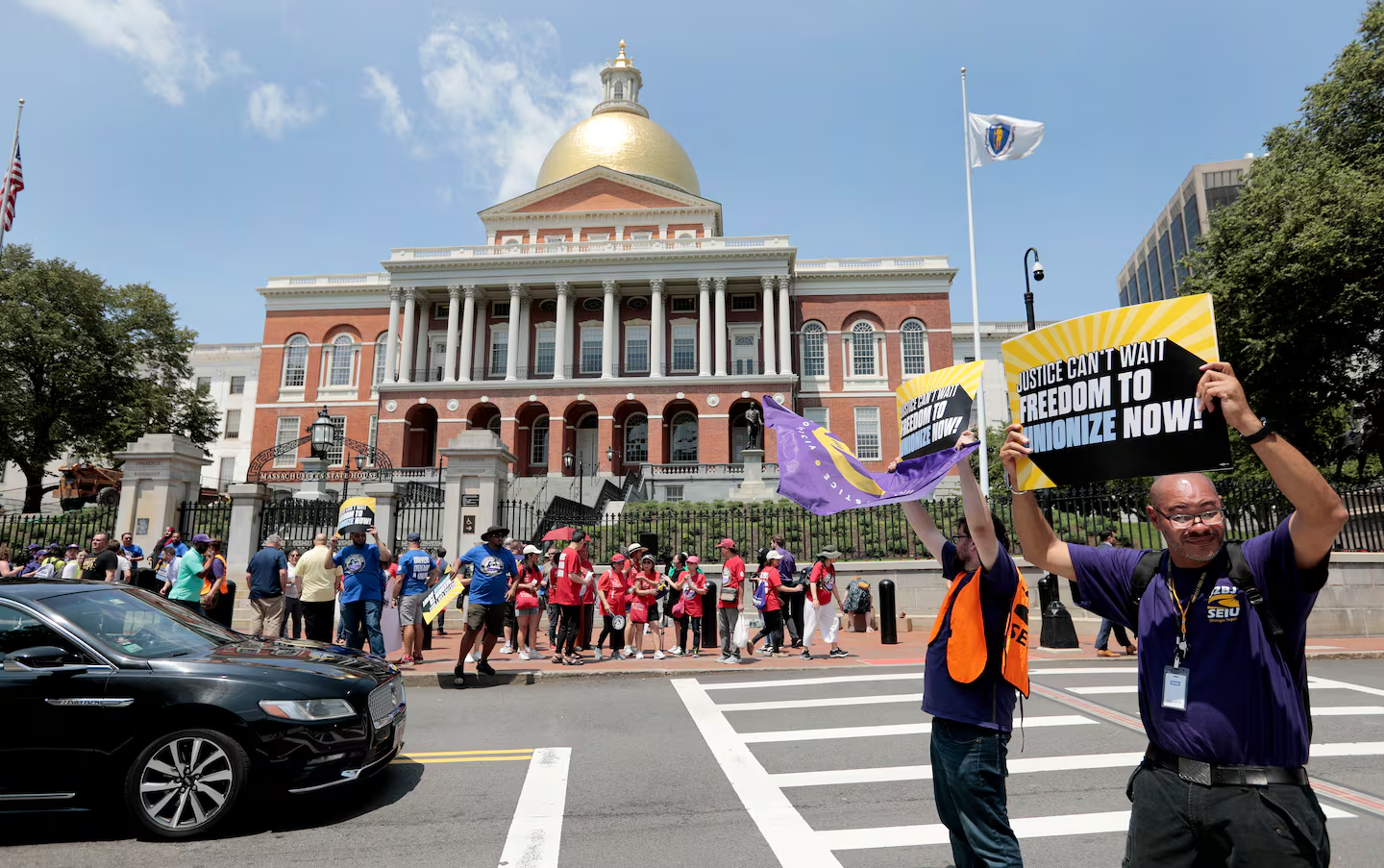
Mass. rideshare drivers just became first in nation to unionize after yearslong push
Uber and Lyft drivers in Massachusetts have officially unionized, a first-in-the-nation move that now sets up what could be the finalstage in a years-long organizing effort.
The newly minted App Drivers Union said Monday it had received state certification to represent roughly 70,000 rideshare drivers who operate as independent contractors in Massachusetts. The union can now begin bargaining with rideshare platforms as it seeks to increase wages and improve job security.
“It’s one of the biggest organizing union victories in the last century,” said Autumn Weintraub, executive director of the App Drivers Union, which received 25percent of support from active drivers across the state, to become their exclusive bargaining representative, according to the Massachusetts Department of Labor Relations.
Rideshare companies have been relatively quiet about the prospect of unionization, offering no resistance to a 2024 ballot question that allowed drivers to bargain collectively despite not technically being classified as employees.
Now, they will have to reckon with the specific demands of unionized drivers who are looking for a larger share of the industry’s earnings.
“As this new process moves forward, we’re committed to engaging in good faith,” Lyft spokesperson CJ Macklin said in a statement. “Lyft does well when drivers do well, and we’ll stay focused on helping drivers succeed while keeping rideshare affordable and dependable for everyone who counts on it.”
For nearly two years, union supporters worked to unify a large and scattered workforce, ultimately submitting nearly 23,000 signatures in support of unionization — enough to meet the standards laid out by the voter-passed law.
The measure allows the union, backed by both the Service Employees International Union and the International Association of Machinists and Aerospace Workers, to progress with only a quarter of driver approval, rather than the typical majority required for bargaining.
Unions among workers who are not classified as employees of a company are rare, and the part-time nature of many drivers’ work further complicates the traditional collective bargaining model. That means the sides will negotiate under circumstances that are unprecedented in many ways.
“This is really the first time that we’ve seen this large-scale recognition of the fact that this is a growing economic phenomenon and these workers need protections,” said Alexandrea Ravenelle, a sociology professor at the University of North Carolina who studies the gig economy.
The App Drivers Union’s bargaining will be overseen by thestate Department of Labor Relations, instead of the traditional private sector referee, the National Labor Relations Board.
Organizerssaid they hope the state’s role will help speed early negotiations, which, while notoriously difficult, in this case are likely to produce a first agreement.
Per the law, both parties will have six months from recognition to bargain, after which mediation and arbitration can be invoked to finalize an agreement.
While the threshold for certification was lower for the new union, any potential deal it makes will face a higher bar: Bargaining agreements must get majority approval from all state drivers who have completed 100 rides in the past three months.
The state’s labor secretary must also sign off if the sides reach a final agreement.
The union does not represent other gig workers, such as food delivery drivers for companies like DoorDash, and all dues will be voluntary, officials said.
Similar union efforts have emerged in other U.S. states, and this victorywill likely act as “a springboard,” said Brian Bryant, international president of the machinists’ union.
In California, app drivers gained unionization rights this year but have not yet completed the formal steps to form a union. The Illinois state legislature is currently considering a similar proposal.
Read more Pope calls for robust regulation of AI in manifesto that ponders the future of humanity
Other companies that must bargain with the new Massachusetts union include microtransit provider Via Transportation, as well as UZURV and SilverRide, two rideshare services for older adults and people with disabilities.
Last year, union officials submitted proof to the state labor department that at least 5 percent of active drivers wanted their representation. In February, the agency shared a list of contacts for all active rideshare workers with the APU, accelerating union outreach.
Still, it was a campaign largely built by grassroots work, officials said.
After shuttling fares for 12 hours a day to make ends meet, 41-year-old Chiem Klot said he spent most of his free time in recent years aiding the massive signup effort, canvassing rideshare hot spots,including Logan Airport and local hospitals.
“We definitely put blood, sweat, and tears into this, and now finally we can have a voice,” Klot said.
Amid shrinking wages, skyrocketing gas costs, and cost-of-living spikes, Klot said the promise of a better future under the union has kept him going.
Many drivers flock to rideshare apps for flexible work schedules, but some said they are increasingly forced to drive long hours just to make the same amount they did in the past. The vast majority of rideshare drivers in the state work full-time hours, according to SEIU President April Verrett.
Last year, both Uber and Lyft collected about 40 percent of ride earnings on average, in some cases taking 65 to 70 percent, by the National Employment Law Project found. Roughly a decade earlier, drivers shared just 25 percent of earnings with their platforms, they reported.
“It’s harder for us now to provide for our families,” said Yolanda Rodriguez, an Uber driver who regularly attends union meetings with her three children.
Unionized drivers said they also want to establish a way to appeal if their platform deactivates their accounts, and ensure protections against the rollout of autonomous vehicles, which are still being tested in Boston by companies like Waymo.
The Department of Public Utilities, which oversees rideshare companies, last month proposed changing regulations to establish a deactivation appeals process. The measure is still being debated, but the union and its drivers said they heavily oppose the changes, believing they would interfere with their bargaining and make it harder for drivers to get their accounts back.
Many other challenges remain, including the sheer size of the union. With tens of thousands of drivers across multiple language barriers, communication and representation may present difficulties, said Mike Vartabedian, a local representative for the machinists’ union.
While largely silent on the union effort, Uber and Lyft have strongly opposed any attempt to recognize drivers as employees, a reclassification that would open them up to labor protections they say would make their products untenable.
A landmark lawsuit in 2020, filed by then-attorney general Maura Healey, sought to make rideshare platforms reclassify their drivers as employees. When the case was settled by Attorney General Andrea Campbell in 2024, drivers won health insurance, paid sick leave, and an hourly minimum wage, now valued at $34.48, but they remained independent contractors.
“Our 2024 agreement with the attorney general demonstrated what we can achieve when we listen to drivers, who overwhelmingly supported that milestone,” said Katie Franger, a spokesperson for Uber, in a statement. “Together, we will ensure that driver flexibility and hard-won benefits remain the foundation of our progress.”
Governor Healey also cheered the union in a statement.
“This is a historic moment for workers, for fairness, and for the future of our economy,” Healey said.
Many drivers themselves rallied against classification as employees, fearing it would strip them of their independence and flexibility on the job. Uber itself has repeatedly portrayed the two aims as mutually exclusive, though some labor leaders say that’s misleading.
“Even the folks in the labor movement who advocated for this [union] arrangement … recognized that that was not ideal,” said Mark Erlich, former head of a regional carpenters’ union and a fellow at Harvard Law School’s Center for Labor and a Just Economy. “But they thought it was better to have a union as independent contractors than no union at all.”
Read more One year into his big league career, the Red Sox’ Marcelo Mayer remains a work in progress


Post Comment