Under pressure, Mass. convention center chief say he’ll exit controversial $2 billion Springfield courthouse deal
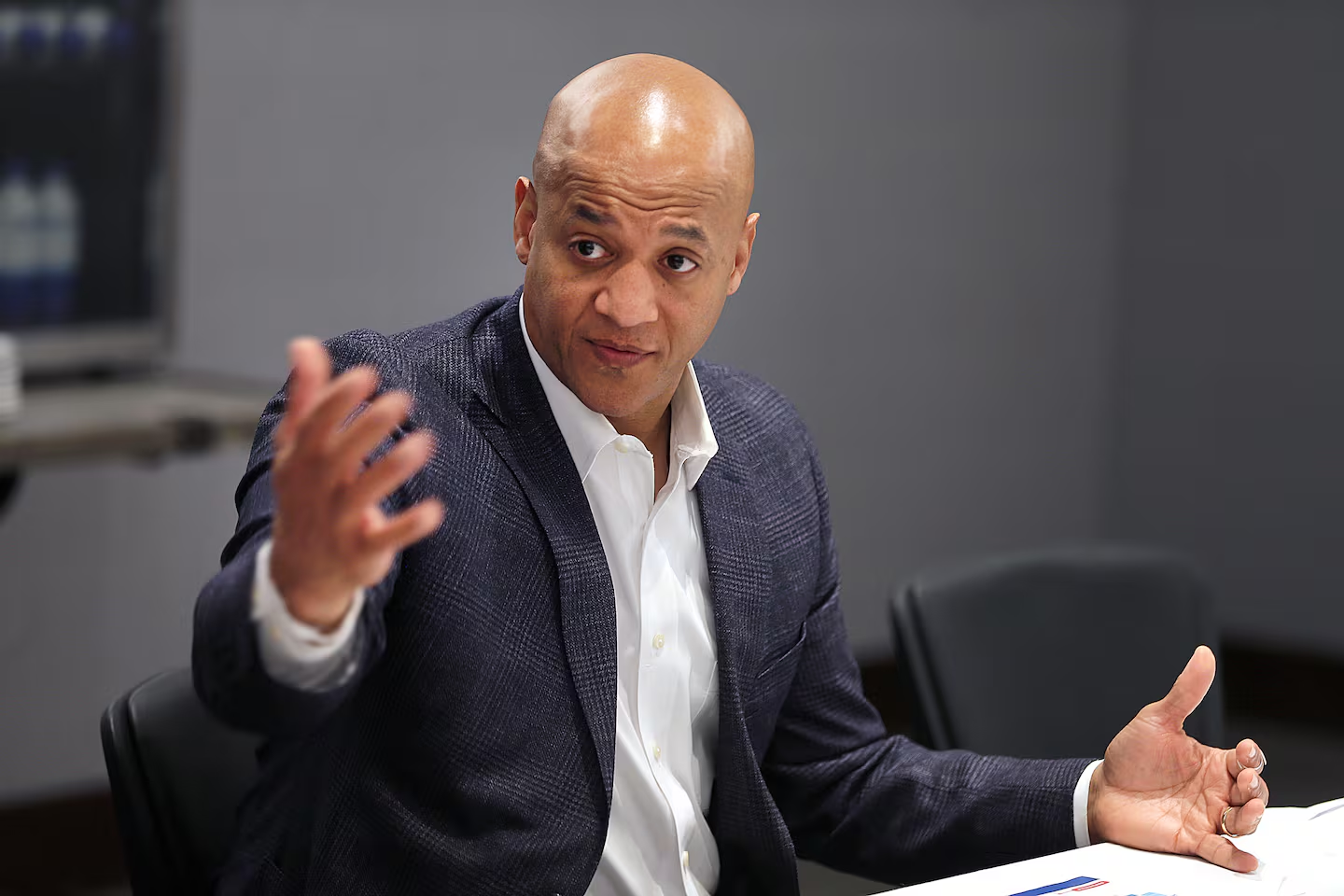
Under immense pressure and an active lawsuit, the head of the state’s convention center authority said Wednesday that he is “divesting” from a controversial $2 billion deal to redevelop a site in downtown Springfield to replace the city’s troubled courthouse.
Read more House adds AI rules, longer runway to primary care bill
John Barros, the interim executive director of the Massachusetts Convention Center Authority, said in a statement through his attorney that he is divesting from the project. He said he is also divesting from CoJo Real Estate — a Boston partnership owned by Barros and Conan Harris, the husband of US Representative Ayanna Pressley — that was part of the team dubbed, Liberty Junction, that won the bid to build the project.
“Notwithstanding the fact that John did everything right and complied fully with the law, he has determined that the significant public benefits that will come from the Liberty Junction Team’s project —a beautiful, safe new courthouse and an engine for economic development in downtown Springfield — outweigh his personal interests,“ his lawyer, Gary Ronan, said in a statement.
“For that reason, John is divesting himself . . . he will not have any economic interest in the project,” Ronan said.
The state began soliciting bids to build a new courthouse in2025, after years of complaints that the outdated Roderick J. Ireland courthouse, which was built in 1971, was mold-infested and making people sick.
Ten groups submitted bids, including groups led by Springfield auto magnate Jeb Balise, Peter Pan Bus Lines executive Peter Picknelly, and real estate investor and developer Dinesh Patel.
The Healey administration announced on July 2 that it had picked Liberty Junction to redevelop 125 Liberty St. in downtown Springfield into a new “Regional Justice Center,” replacing the current courthouse about a mile away.
The group includes Virginia real estate firm FD Stonewater and CoJo Real Estate. The general contractor for the team is Suffolk Construction, whose chief executive, John Fish, is a political heavyweight in Boston and a major backer of Governor Maura Healey. (Suffolk Construction was part of Balise’s bid, too.)
The decision landed with a bang.
Within days, Balise and Patel’s teams sued the Division of Capital Asset Management and Maintenance, or DCAMM, as well as Liberty Junction, asking the court to pause the process until allegations of conflicts of interest and unresolved questions about the property are addressed.
They also alleged that state officials had not been forthcoming with all public documents about the bid process. DCAMM earlier this month posted online what it said are all the documents.
In a statement, the plaintiffs said the news “confirms what we have said from the start.”
“This selection was irrevocably tainted, and no retroactive exit can undo that after the contract is already awarded,” Balise and Patel said. “For this reason, the only fair remedy is to set aside this award and redo the procurement.”
The parties are set to appear in court Aug. 11.
The Liberty Junction group filed a 266-page proposal for DCAMM’s consideration in October 2025. The group proposed a six-story building on the site of a former medical office, located across the street from the Hampden County Sheriff’s Office.
Months later in January — while DCAMM was actively evaluating the proposals — the MCCA board tapped Barros, a one-time economic development chief for former Boston mayor Martin J. Walsh, as the agency’s interim leader.
Barros’s attorney said he never spoke with DCAMM officials about the project, and that he consulted the MCCA’s attorneys as well as the state ethics commission on how to approach holding both his interim role and having an interest in the project.
He was advised, the attorney said, that he could be part of the Liberty Junction team and its proposal, but that he should not participate in any discussions with DCAMM.
Ronan, Barros’s attorney, said he was told that no immediate filing or public disclosure was necessary because DCAMM had not yet selected the winning bidder. He was told instead that he should file a disclosure should his team’s proposal beselected.
On July 1, the day before the winning bed was publicly announced, Barros filed a disclosure with the state’s ethics commission, making his involvement public.
Under state law, state employees cannot participate in a bid for a state contract without making disclosures to the ethics commission.
“My role will continue to be that of a passive investor,” Barros wrote in his disclosure. “As equal owner of CoJo Partners, I will receive indirect financial compensation from the contract lease with DCAMM.”
Read more Massachusetts lawmakers strike deal on bill they say will bolster protections for immigrants
The Executive Office of Administration and Finance, Healey’s budget office which overseesDCAMM, was the root of the alleged conflict, the lawsuit charges. Matthew Gorzkowicz, Healey’s budget secretary, is alsoone of 12 members on the convention center authority’s board, which unanimously appointed Barrosas executive director.
Balise and Patel’s lawyers want the court to declare that the state violated the conflict of interest law, and make the Liberty Junction team ineligible for the contract.
A spokesperson for Healey declined to comment Wednesday and referred a reporter to the Division of Capital Asset Management and Maintenance, or DCAMM, for comment.
In a statement, Hannah Carrillo, a DCAMM spokesperson, said the process was “fair, thorough and competitive” and resulted in “the selection of the bid that was the lowest cost to taxpayers” by $300 million.
“This project will deliver a safe and modern Court House that residents and workers deserve, while delivering the best value for taxpayers,” she said.
The group that chose Liberty Junction – made up of a chief trial court justice, trial court staff, and DCAMM employees – said the winning design is strategically located, maximizes usable space, and is the “most fiscally advantageous” to the state, the panel wrote in itsdecision.
Not all agree. Springfield Mayor Domenic Sarno has said he preferred a riverfront proposal submitted by Picknelly, the Peter Pan Bus Lines executive.
And a group of trial court employees ranked the submitted bids themselves, putting the Liberty Junction proposal toward the bottom of their list, said Hampden County Clerk of Courts Laura Gentile. The group didn’t like the location’s lack of parking, a building layout that put the courtrooms more than two stories above the clerk’s office, and the fact that it would take more than three years to build.
Gentile said Barros’s decision to leave the project was “a day late and a dollar short.”
“It’s a big statement of its own,” she said. “This is too big of a project for people to have these kinds of [ethical] questions.”
CoJo Real Estate was formed in 2023, though it was involuntarily dissolved at the end of 2025 after twice failing to file an annual report with the Secretary of State’s office.
According to state business records, the business was revived on Monday — three days after a Globe reporter asked questions about its ability to do business in the state. Barros’s attorney said it is “not unusual for LLCs to be administratively dissolved and reinstated in this manner — it happens all the time.”
Typically, certificates of good standing are needed to apply for government contracts or make certain financial or real estate transactions.
Barros, who mounted an unsuccessful bid for Boston mayor in 2013, has been working in commercial real estate since leaving City Hall in 2021.
As the MCCA’s interim executive director, Barros earns an annual salary of about $330,000. He also brings in income managing Civitas Builders, LLC and performing consulting work for two Boston-based investment firms, according to a copy of his most recent statement of financial interest.
Barros also owns a Dorchester-based real estate company, 25 percent stock in a Dorchester Cape Verdean restaurant, and takes in more than $100,000 as a director for a New Jersey bank and a Newton-based construction management firm.
While Barros did not list any offices or ownership for CoJo in his financial disclosure, documents on file with the Secretary of the State’s office list him as a manager.
In a statement, Claiborne Williams, the principal of the Liberty Junction group, lauded Barros’ work on the project and his “willingness to step back for the community’s benefit.”
Read more Michelle Obama and Justice Jackson talk work-life balance and public service
“We wish him well,” he said.


Post Comment