To Winkie’s? The weirdest Los Angeles travel itinerary you’ll encounter this year.
LOS ANGELES — Long boarded up and closed, Caesar’s Restaurant in Gardena is the stuff of nightmares.
Read more When your beach chair is a wheelchair: These are the best accessible New England beaches
David Lynch’s nightmares, to be precise. The late filmmaker used Caesar’s as the setting for an unsettling exchange in “Mulholland Dr.” in which a character recounts a terrifying dream and then relives it in an alley behind the restaurant, in what is at once a seemingly incongruous scene and one of cinema’s greatest jump scares.
Today the restaurant just south of Los Angeles sits abandoned. Plywood covers some windows, the Caesar’s sign above the roof is broken, and trash litters the ground. The stairs that led to Dan’s doom are intact, but nothing scary lies at the bottom. We snap a few photos and hit the road toward the next attraction.
Welcome to the weirdest Los Angeles travel itinerary you’ll encounter this year.
This is David Lynch’s LA — a field guide to some of the spots he used in his films and his TV series “Twin Peaks.” If you think this is a bizarre travel itinerary, know that there are legions of people (maybe it’s a cult) out there who hunt down filming locations, particularly for Lynch’s work. And this is by no means a comprehensive list — and not just because my LA-based friend couldn’t be persuaded to drive me to Sunset Ranch Hollywood, the spot perched above Mulholland Drive where the famous “Cowboy” scene in “Mulholland Dr.” was filmed. No, it’s because LA is as much a character as the humans are in some of the surrealist’s movies, and there are simply too many filming locations to point out.
With that, your tour begins. It starts at the southern end of LA and heads north, and you could do it all in one long day. Beware: Movie spoilers ahead.
Eat at Rudy’s – 558 East Anaheim St., Wilmington
In the final episode of the 18-part “Twin Peaks: The Return,” FBI Agent Dale Cooper stops at a diner in Odessa, Texas, called Eat at Judy’s and has a violent encounter with three locals. The diner is actually Eat at Rudy’s in LA’s Wilmington neighborhood.
The place is bustling on a Sunday morning, with customers filling nearly every seat, a family celebrating a milestone with karaoke, and waitresses cheerfully topping off mugs. Rudy’s serves up a huge array of omelettes, waffles, and breakfast burritos, and the kind of “damn fine coffee” that would please Agent Cooper.
Caesar’s Restaurant – 1016 El Segundo Blvd., Gardena
Here is the setting of the famous “Winkie’s” scene in “Mulholland Dr.,” in which a man named Dan describes a nightmare to a guy who may be his therapist. “I just wanted to come here,” Dan says. “To Winkie’s?” his companion asks. “This Winkie’s,” Dan replies.
“This Winkie’s” is, in fact, an old Caesar’s Restaurant (and, before that, a Denny’s) that was shuttered a decade ago and now sits neglected. I couldn’t resist the temptation to walk down the steps behind the restaurant in search of “the man in back of this place … the one who’s doing it.” Alas, only a clean alley is there now.
Doheny Mansion – 10 Chester Place
The Doheny Mansion, which served as the opulent home of Laura Dern’s fictional actress Nikki Grace in the film “Inland Empire,” is on the campus of Mount Saint Mary’s University, which is all but impossible to get onto unless you belong there. Built in 1899, the mansion is open for limited tours, which you can book online. The mansion features in the film a few times, most notably for an extended, disquieting scene in which a neighbor played by Grace Zabriskie visits Nikki and starts spouting what appears to be nonsense but later takes on greater meaning.
Tower Theatre – 802 South Broadway
The historic Tower Theatre opened in 1927 and hosted the premiere of “The Jazz Singer,” the first “talking picture.” That history probably explains why Lynch used the theater’s lush interior in “Mulholland Dr.,” “Inland Empire,” and “Twin Peaks: The Return.”
Alas, today the theater is — what fresh heresy — an Apple store. Apple did preserve the beautiful interior, including the balcony, where visitors can sit and soak in the building’s majesty, as long as they don’t mind watching an employee demonstrating the iPhone 58’s new features on a giant screen.
Banks-Huntley Building – 634 East Spring St.
This office building — supposedly the first in LA with central air conditioning — served as the exterior of Ryan Entertainment, the fictional firm involved in fictional director Adam Kesher’s fictional movie in “Mulholland Dr.” The parking lot to its right is where Kesher used a golf club to destroy the windshield of a limo owned by his nemeses.
Read more Boston loves to read: These are the 12 best bookstores to visit
Palace Theatre (rear) – 633 East Spring St.
Just across the street is the rear entrance of the Palace Theatre, which opened in 1911 and hosted such performers as Harry Houdini. Fitting, because Lynch used it for the exterior of Club Silencio, a late-night spot in “Mulholland Dr.” whose illusions were part of the film’s climax.
The MacArthur – 607 South Park View St.
This 1920s building, long the Park Plaza Hotel, was originally an Elks lodge and has more recently been used as an event space. Rock musicians performed and shot videos there, and the interior and exterior have been featured in dozens of TV shows and movies, including Lynch’s “Wild at Heart.” The infamous gruesome opening scene of that film depicts Nicolas Cage beating a man to a bloody pulp in the lobby.
All Season Brewing – 800 South La Brea Ave.
Now the site of a craft brewery, this building was a Firestone tire and auto repair shop when it stood in for Arnie’s garage in the film “Lost Highway.” It figured prominently in the film as the workplace of mechanic Pete Dayton. Though it’s now a brewery and taproom, it still has the look and feel of an auto repair shop, so you can easily picture Balthazar Getty and Richard Pryor bantering while you sip your hazy IPA and munch on an organic taco.
Il Borghese – 450 North Sycamore Ave.
The entrance to this apartment complex will be familiar to fans of “Mulholland Dr.” In the movie, it’s 1612 Havenhurst, where Aunt Ruth lives and lends her apartment to Betty. Peering past the gate, you can imagine rental manager Coco Lenoix (played by Golden Age actress Ann Miller) yelling at a tenant named Wilkins because of what his dog has dropped in the courtyard.
Pink’s Hot Dogs – 709 North La Brea Ave.
A line 30 people deep snakes down the sidewalk as lunchtime customers line up outside this LA landmark for dozens of varieties of dogs and burgers, including a “Mulholland Dr. Dog” that comes with onions, mushroom, bacon and nacho cheese. The spot figured in another seemingly out-of-place scene in Lynch’s impenetrable but critically popular movie.
Paramount Pictures – 5515 Melrose Ave.
You can’t get inside this giant complex of sound stages where some of Hollywood’s most famous movies have been produced unless you book a $71 tour or you work there. But all you really need to see today is the entrance, which figured into “Mulholland Dr.” in a scene that is an ode to “Sunset Boulevard,” one of Lynch’s favorite films.
Dorothy Lamour star — 6332 Hollywood Blvd.
The Hollywood Walk of Fame star of actress and singer Dorothy Lamour is the spot where Laura Dern’s character Nikki Grace is stabbed with a screwdriver toward the end of “Inland Empire.” Nikki pulls the screwdriver out of her side and drops it on Lamour’s star. This is likely a reference to Lynch’s obsession with Judy Garland, who played Dorothy in “The Wizard of Oz” and was abused and exploited by the Hollywood machine.
Hollywood & Vine
The historically significant intersection of Hollywood Boulevard and Vine Street is synonymous with the entertainment industry. Movie and music businesses — including the iconic Capitol Records building — began concentrating there in the 1920s, and the Walk of Fame crisscrosses there. After being stabbed in “Inland Empire,” Nikki Grace stumbles through the intersection and then collapses in front of a shuttered storefront on the Walk of Fame. Metaphors abound.
David Lynch’s house – 7035 Senalda Road
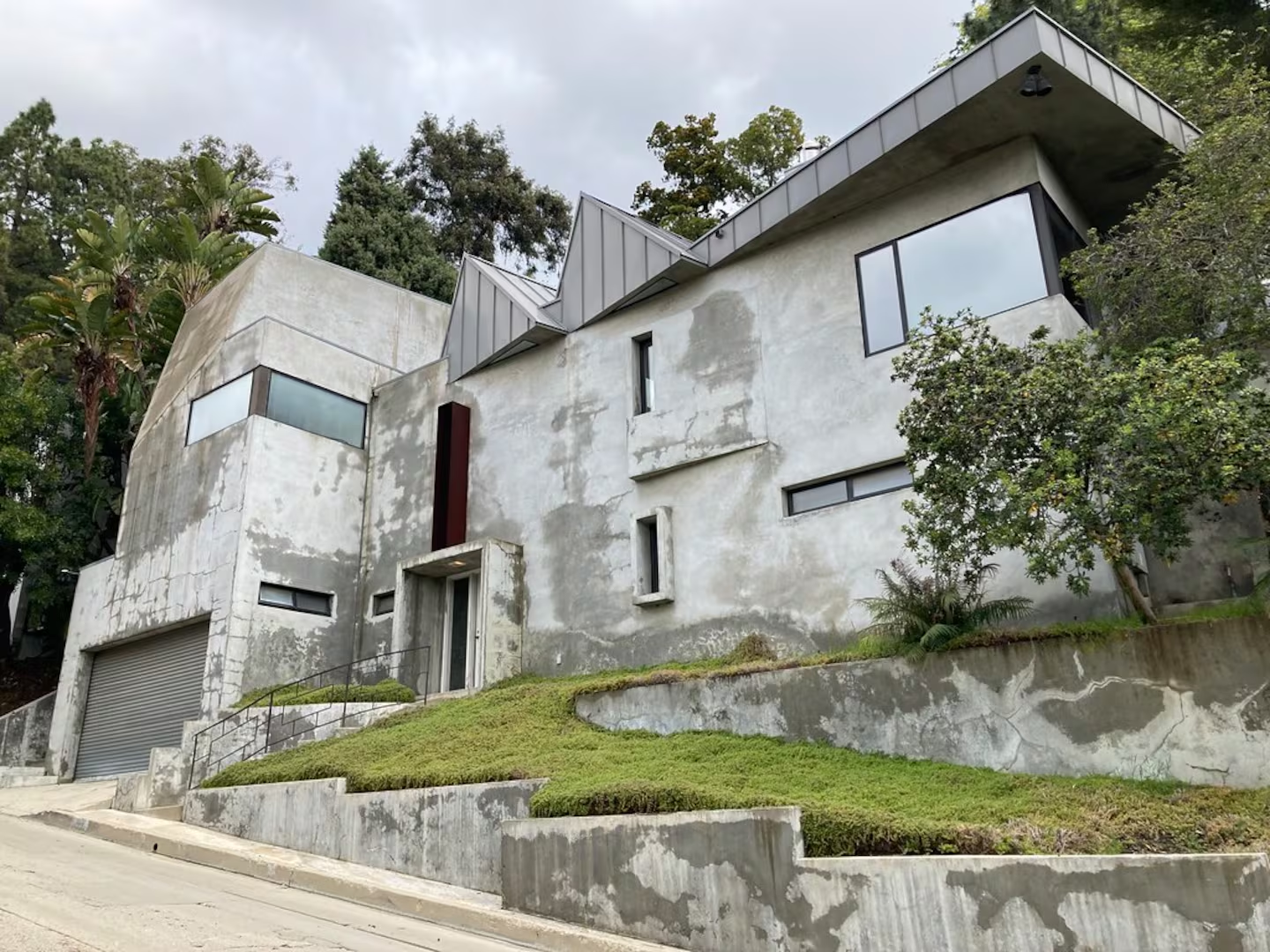
This gray, Brutalist house just off Mulholland Drive is itself a star of “Lost Highway.” It also happens to be part of the three-house compound in the Hollywood Hills where Lynch lived and worked until his death in 2025. The compound, which sold for $13 million this year, has recently been scrubbed from Google Street View, perhaps because of people like me who want to view it online before walking by. And walking by this creepy home is a surreal experience. I was tempted to walk up to the door, press the intercom and say, “Dick Laurent is dead,” but I imagine that’s been done 60,000 times since “Lost Highway” came out in 1997.
Snow White Cottages – 2900 Griffith Park Blvd.
The so-called Snow White Cottages — a complex of eight little homes — was designed to look like fairy houses. In “Mulholland Dr.,” the property becomes the Sierra Bonita apartments, where Betty and Rita (or whoever they are) find a dead body rotting in a bed. If you stop by, don’t disturb the residents by walking onto the property; you can see it easily enough from the road.
Los Angeles Police Museum – 6045 York Blvd.
This quiet building in the hip Highland Park neighborhood served as the exterior of the police station in Buckhorn, S.D., in “Twin Peaks: The Return.” The museum is open to the public for a $10 admission fee but happened to be closed the week we visited. Maybe next time.
Steve Greenlee, a former Globe editor, is a journalism professor at Boston University. He can be reached at [email protected].
Read more Ken Martin hunkers down at the Democratic National Committee as a storm gathers around party leader



Post Comment