The New Hampshire primary fight that Massachusetts is watching
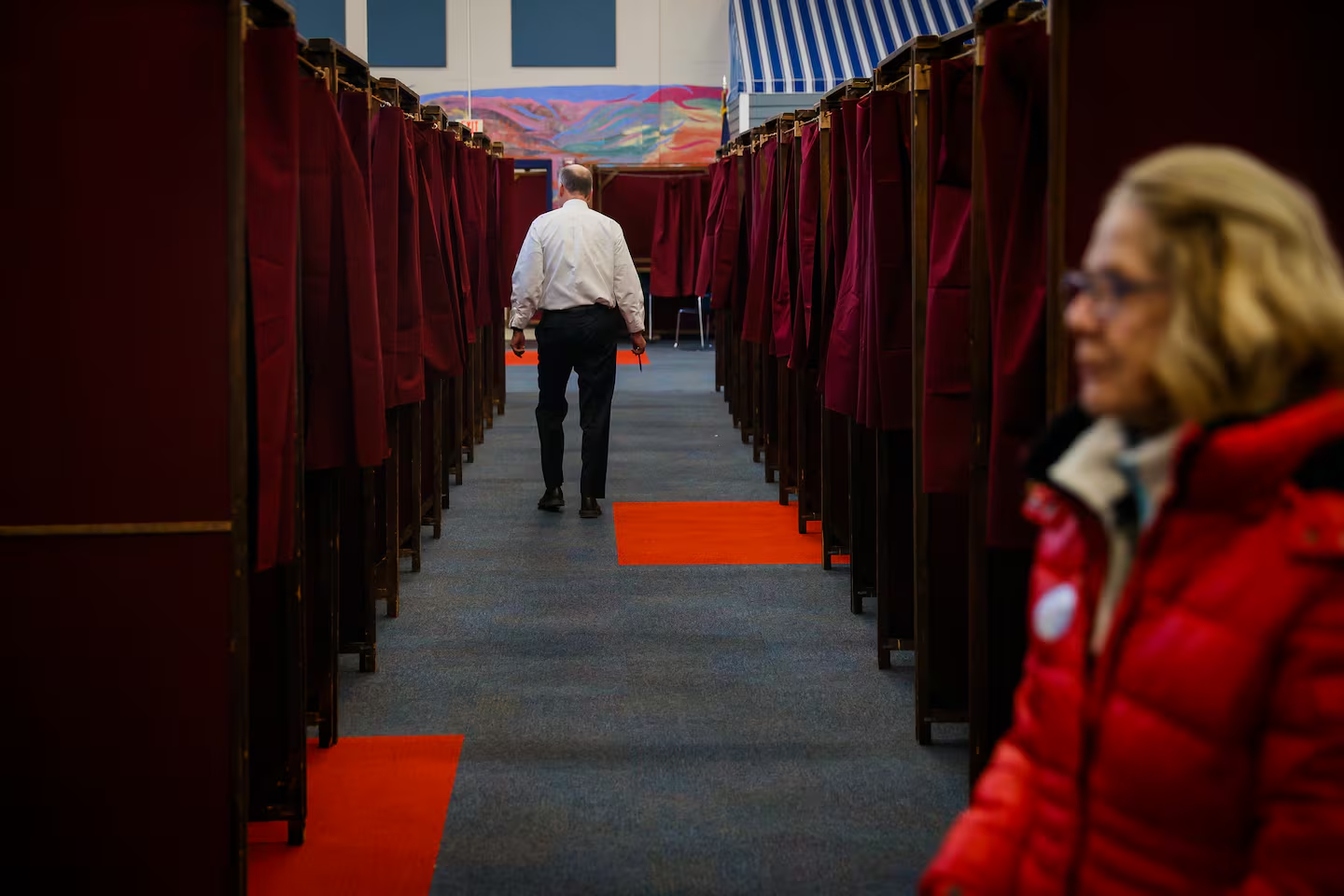
New Hampshire Democrats are up in arms over the Democratic National Committee’s latest plan to bump the state’s beloved first-in-the-nation primary to third on the party’scalendar behind South Carolina and Nevada. But the fallout wouldn’t stop at the Granite State’s southern border.
Read more New and coming soon: 27 new restaurants and bars in R.I. to try this summer
New Hampshire’s long-held place as the party’s opening primary — and the national attention it attracts — has helped fuel the political economy in neighboring Massachusetts. It opened up job opportunities for the deep-blue state’s political operatives, and boosted the ad revenue flowing into the Boston media market. For ambitious Massachusetts politicians eyeing national campaigns of their own, stumping for their preferred candidates on the closely watched stage helped juice their ownnational name recognition.
Pushback over the DNC’s plan to have South Carolina go first in the presidential nominating contest is about more than a bruise to New Hampshire’s political ego. The earlier contest has long forced candidates to compete there when the field is crowded and the stakes are high — meaning more staff, more candidate visits, and more campaign cash flowing through the region. Move the primary later, and much of that attention could disappear.
“The consequences of this, if it happens, are far and wide in Massachusetts,” said Mary Anne Marsh, a Democratic political analyst. “There are political consultants from Massachusetts who have worked in New Hampshire for years. It’s an industry of its own.”
National candidates who are competing for Granite Staters’ attention often have to buy airtime in the Boston media market to reach voters in the southern part of New Hampshire. It could be significant; Republican campaigns and outside groups alone spent more than $77 million on advertising in the run-up to New Hampshire’s GOP primary in 2024, CNN reported at the time.
For the Massachusetts politician considering higher office, “it’s an easy visit to get up there,” said Thomas McGee, a former Massachusetts state senator and former state Democratic Party chair, “particularly if you’re taking a serious look at running for president.”
Not that it necessarily means Massachusetts-based candidates always perform well there. US Senator Elizabeth Warren, a one-time frontrunner in the 2020 presidential election, finished fourth in the New Hampshire primary, and Deval Patrick ended his long-shot bid after struggling to gain tractionthere and elsewhere. US Representative Seth Moulton, the other Massachusetts politician in the race that year, had ended his campaign months before the first primary ballots were cast.
The state also exports volunteers who stream north from Massachusetts to knock doors and staff field offices.
“There are across Massachusetts not only volunteers, but whole cities and towns who have adopted a city or town in New Hampshire and for years have traveled there and do door-knock and organize,” Marsh said.
The decision to push back New Hampshire’s place on the primary scheduleisn’t set in stone yet, however. The proposed calendar, approved by the DNC’s Rules and Bylaws Committee, still needs sign-off from the full Democratic National Committee, which is set to meet in August.
Some party leaders argue the reshuffle better reflects the party’s increasingly diverse coalition after decades of Iowa and New Hampshire — states with overwhelmingly white populations — dominating the opening contests.
Moving the primary isn’t so simple, however. New Hampshire law requires the state to hold the nation’s first presidential primary, setting up the same standoff Democrats faced in 2024 after the DNC elevated South Carolina to the top of the calendar.
The state ignored the national party and held its primary anyway. President Joe Biden skipped the contest, but supporters mounted a successful write-in campaign. DNC officials eventually diffused the debate, and allowed New Hampshire’s delegates to join the party’s convention that summer. Running that play again in what’s expected to be a wide-open 2028 Democratic primary could be trickier, with no guarantee national Democrats would once again recognize the state’s delegates.
But New Hampshire Democrats don’t have many levers to pull. Republicans control state government, and Secretary of State David Scanlan, a Republican, made clear last week the state will follow its law, not the DNC’s preferred calendar.
SEEING RED: In southeastern Mass., Republicans find a reddening enclave of working-class cities and towns by Chris Van Buskirk, The Boston Globe: Situated at the intersection of two reddening counties, southeastern Massachusetts is slowly transforming into fertile political ground for Republicans, offering a haven for local conservatives amid the party’s muted influence on deep-blue Beacon Hill. It’s also made the region more than just a pit stop on the statewide campaign trail, but a potential foothold for the GOP to grow.
President Trump made some of his strongest gains in Massachusetts in Bristol and Plymouth counties, the two areas where he performed the best in 2024. The Massachusetts Republican Party flipped a state Senate seat in the area that same year after it had been held by Democrats for decades. And some of the state’s few remaining Republican county officials hold elected office in the region.
PAYBACK TIME: Moulton is cashing in some political chits.
The Salem Democrat is rolling out endorsements from four members of Congress whose campaigns got a boost from his Serve America PAC — including one from New England.
Representatives Seth Magaziner of Rhode Island, Pat Ryan of New York, Chrissy Houlahan of Pennsylvania and Derek Tran of California are endorsing Moulton in his challenge to US Senator Ed Markey, according to Moulton’s campaign.
Moulton “has been a great colleague and a true partner to Rhode Island and all of New England,” Magaziner said in a statement. “He understands the unique challenges facing our region and has a proven track record of delivering for his district.”
Read more Globe readers: What do you think is wrong with audiences these days?
MAINE EVENT: Troy Jackson sweeps Maine Democratic Convention, sets up Senate showdown with Susan Collins by James Pindell, The Boston Globe: Eighteen days after the collapse of Senate nominee Graham Platner’s campaign amid credible accusations that Platner raped an ex-girlfriend, Maine Democrats on Saturday turned the page by nominating former state Senate President Troy Jackson to take on longtime Republican incumbent Susan Collins this fall. Jackson is a fifth-generation logger and union organizer, who led Bernie Sanders’s presidential campaign in the state and espouses the same ideological outlook as Platner. He backs Medicare for All and has an economic populist message on housing and wages.
FIRST SUFFOLK, TAKE ONE: Amid reelection fight, Southie state senator pitches rival property tax proposal by Gintautas Dumcius, WBUR: State Senator Nick Collins is back for another round in his fight over Boston tax policy with Mayor Michelle Wu. His proposal would increase property tax exemptions and raise the limits on income and asset eligibility for older homeowners.
FIRST SUFFOLK, TAKE TWO: Wu-backed state Sen. candidate is Beacon Hill lobbyist by Tim Dunn, Boston Herald: Latoya Gayle is running to unseat incumbent Collins in a race that also includes fellow Democrat Juwan Skeens. “My day job is at a nonprofit. So, if you are trying to push policy or legislation or are going to just meet and speak with legislators you have to register as a lobbyist. That’s the rules,” Gayle said.
ICYMI: In addition to alcohol-related and tax-rebate policies they hooked onto it, state Senators loaded up their $575 million economic development bill last week with policy riders (while notably ditching some proposals). A few moves you might’ve missed:
In: A redrafted version of state Senator Mike Rush’s amendment that would require large AI companies to submit to independent safety evaluations. That’sa win for AI giant Anthropic, which was pushing for it to pass.
Out: Governor Maura Healey’s proposal to strengthen the state law restricting noncompete agreements. The Senate, like the House, nixed the provision from its version of the bill following opposition from some of the state’s largest employer groups, per the Globe’s Jon Chesto.
Also out: The data center moratorium that state Senator Michael Moore proposed. Moore also withdrew another amendment that would have required data centers be powered with 100 percent renewable energy. Senate leaders cautioned him thathis moratorium proposal might not survive inter-chamber negotiations, CommonWealth Beacon’s Jordan Wolman reports.
GRIP ON THE GAVEL: Spilka to lead Senate into a ninth year, first since Bulger by Colin A. Young, State House News Service: When she walks into the State House this week, Senate President Karen Spilka will be doing something no one has done — or been allowed to do — since the mid-1990s: leading the Massachusetts Senate into a ninth consecutive year. When she took the gavel, the Senate had a rule adopted 25 years earlier barring anyone from holding onto it for more than eight consecutive years. Had the rule not been wiped away by Senate Democrats three years ago, it would have forced Spilka to give up her power this past weekend.
CURB APPEAL: More concrete barriers and parking enforcement: Wu outlines street safety plans after cyclist’s death by Niki Griswold, The Boston Globe: In an open letter released Friday, Wu laid out plans to install more concrete barriers on bike lanes and fix sidewalks and curb ramps in the wake of a crash earlier this month that killed city planner Louisa Gag.
Wu said she is dedicating two senior staff members — Chris Osgood, the city’s former chief of streets and now a senior adviser for infrastructure, and Tali Robbins, Wu’s deputy chief of policy — to the city’s so-called Streets Cabinet. Both will meet monthly with advocacy groups to gather feedback on the city’s safety efforts, and Wu said she is also convening a group of advisers to look at the department’s organizational structure and resources to determine how the city can “improve and accelerate” its street safety work.
BENDING THE RULES: City Councilor calls for Boston Police changes to boost staffing by Grace Zokovitch, Boston Herald: Boston City Councilor Ed Flynn will move to propose measures related to waiving Boston Police Department residency requirements and allowing retired officers to take shifts as the department faces ongoing staffing challenges.
The T paratransit service changed its bag policy. RIDE users say it’s made grocery shopping nearly impossible. by Diti Kohli, The Boston Globe.
ICE agent involved in fatal Maine shooting should not have passed vetting if allegations of violent behavior are true, Trump border czar said by Allyson Chiu, The Boston Globe.
Trump’s offshore wind freeze leaves Mass. with idle terminals, soaring energy bills by Tréa Lavery, MassLive.
Wading into clerk’s ethics fight, Springfield mayor recalls ‘$10 and a fish sandwich’ vote scheme by Jim Kinney, The Republican.
Stoughton police chief, town manager face intense scrutiny amid turmoil by Laura Crimaldi, The Boston Globe.
Inside the Phone-Throwing Drama at the Troubled, Broke Democratic Party by Shane Goldmacher and Reid J. Epstein, The New York Times.
Read more Mass. utilities are raising rates in August. Here’s who’s affected.
Thanks for reading The Scrum.
This newsletter was edited and produced by Matt Stout.
Have a question for the team? Email us at [email protected].
Delivered Monday through Friday.


Post Comment