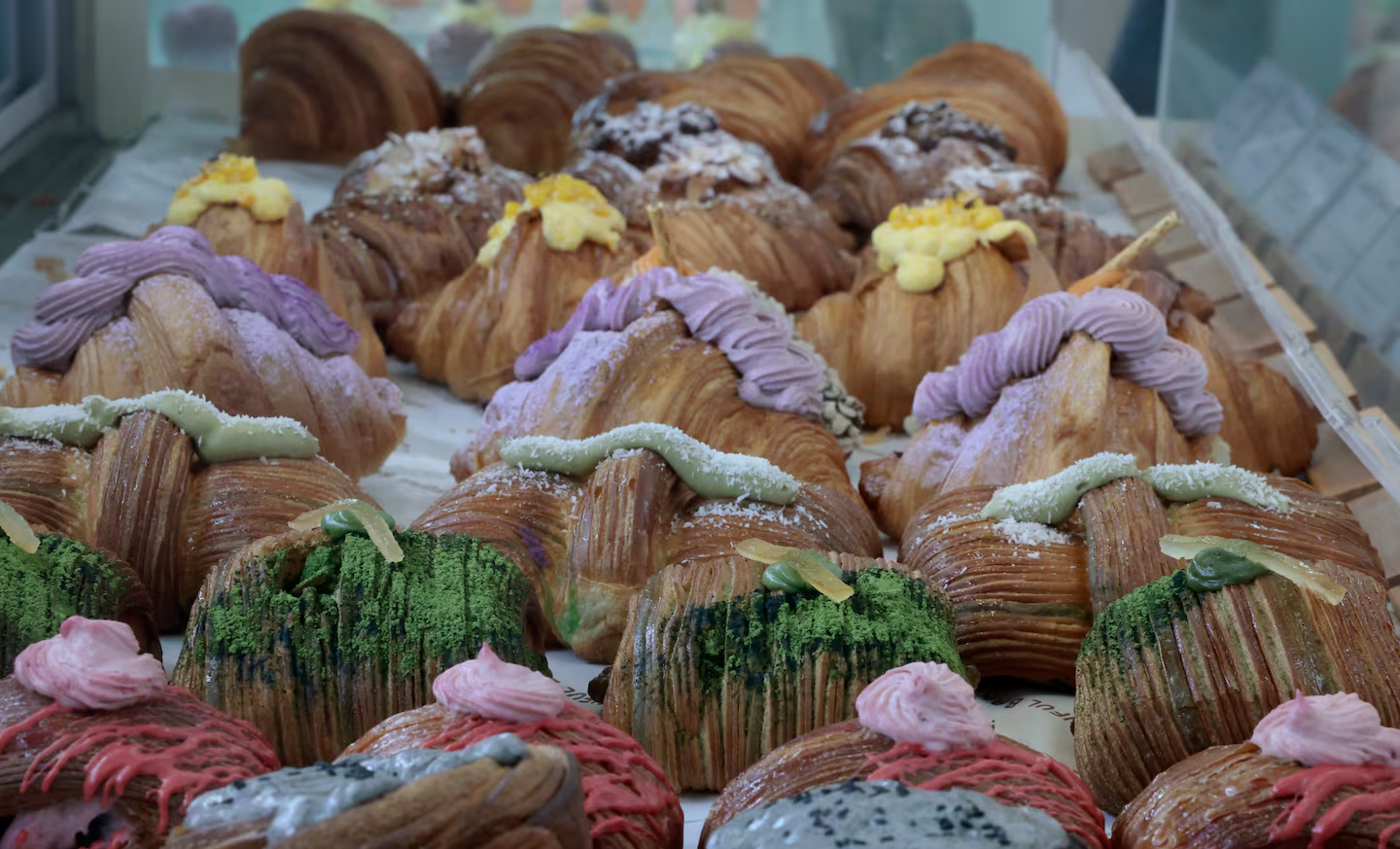
It’s not a French croissant. It’s a French-Asian croissant.
A growing number of bakeries in and around Boston are blending French and Asian traditions, making French croissants, other buttery pastries, and beautiful little molded desserts called entremets filled with Asian-flavored ingredients. Colorful and bold, these treats are unlike anything you’d expect from a traditional bakery.
Read more Why elephants are coming to Boston
Creative pastry chefs are whipping up creams, custards, and mousses with ingredients once considered rare in New England, such as matcha (the ubiquitous green powder made from special green tea leaves), pandan (a Southeast Asian tropical green plant with a grassy, woodsy, vanilla-like flavor), and ube (an earthy-sweet purple yam from the Philippines). You might see a round croissant filled with a layer of azuki, sweetened red bean paste, topped with a pillow of fluffy whipped cream. That nutty dark paste is black sesame, and the tart citrus you taste is not lemon but yuzu, a small, aromatic East Asian fruit.
Although the grand dame of French-Japanese baked goods in Greater Boston, Brookline’s Japonaise Bakery, has been delighting customers for over 40 years, there’s been a wave of new, ambitious additions in the last three years. The newest is Fuful Bakery in downtown Boston, which opened last December. Other newcomers since 2023 include Niveaux Patisserie in Quincy, Komugi Bakery & Cafe and Maprang Bakery & Cafe, both in Somerville, and Petite Sakura in the South End. Lakon Paris Patisserie, which opened its first shop in Newton in November 2020 — just as matcha was making headway in the American market — now also operates locations in Brookline, Brighton, and Boston’s Seaport.
The growing presence of these bakeries mirrors trends in other US cities, and may be attributable in part to Boston’s growing Asian population, which rose by 6 percent between 2023 and 2024, census data show. Their popularity may also be due to Bostonians’ culinary curiosity and a social media-amplified fascination with things foreign.
Lakon was at the forefront of this trend in Boston six years ago. Remembering back to its 2020 start, Thai cofounder Urupong (Kope) Kharuharat says, “It was the right place and perfect timing to do something different. Boston has a more educated and well-traveled population, so many people had tasted these ingredients.” As a result, he adds, “Many people understood what we were trying to do.”
Co-owner and pastry chef Vichaya (Jenny) Kiangkaew, also from Thailand, is classically trained in French pastry at Le Cordon Bleu in both Bangkok and Paris. Her intent was to serve French pastries, some with Asian ingredients like matcha, pandan, ube, lychee, and Thai tea. Her most recent offering is a croissant filled with sticky rice and jasmine tea custard, mango gelee (a firm jelly), and diced fresh mango.
A newly popular style of French viennoiserie — the term for classic French baked goods made from raised or laminated dough — is the croissant-like pastry called pain suisse. Unlike a croissant, whose multitude of dough layers are visible when it’s cut open, pain suisse is typically rectangular or shaped like a bowtie and very flaky. “It’s beautiful because you see all the layers on top,” says Lakon’s Kiangkaew.
Fuful Bakery owner Janet Lu learned her craft at Le Cordon Bleu in her hometown, Shanghai. Her Asian-inspired pastries include matcha-yuzu pain suisse; pandan bowtie pain suisse, with pandan cream and coconut flakes; and Thai milk tea croissant. “The cream fillings are purposefully not too sweet,” Lu says of her pastries.
Niveaux Patisserie, owned by pastry chef Robert Gonzalez and JP Fuji Group of Quincy, offers a selection of croissants with Asian flavors, including yuzu meringue; ube; and matcha-strawberry. “The Asian flavors appeal to many customers, especially the younger crowd,” says Gonzalez.
Gonzalez’s entremets (pronounced ahn-truh-may) are stunning to look at, but it’s the inside where the real magic happens. Each one reveals layers of mousse or custard, fruit puree or gelee, and sponge cake. These petite desserts belong to French tradition and technique, but Niveaux and Fuful in particular take the flavors and textures up a few notches. Niveaux’s selection includes Golden Mango, with mango mousse, passion fruit gelee, and coconut sponge cake; Cloud 9, a pink bubbly-looking square filled with lychee gelee, strawberry mousse, and hazelnut cake; and Lilikoi, with layers of passion fruit, guava, and coconut.
“I’m Latin, and there’s a lot of crossover with ingredients, fruits especially, between Latin and Asian flavors,” says Gonzalez.
Fuful’s beautiful entremets come in various shapes and flavors, including green apple, pear, and mango. Lu makes one with yuzu mousse, passion fruit gelee, guava puree, and sponge cake; another, called Coco Island, contains coconut mousse, crushed pineapple, and passion fruit puree.
The oldest Boston-area bakery of the bunch, Japonaise, opened its doors in 1985 by founder Hiroko Sakan. Since taking over in 2016, her son Takeo Sakan has expanded the product line, including filled breads shaped and decorated as anime characters.
During an apprenticeship in Japan, Sakan learned about the extensive influence of French pastry traditions on Japanese bakeries. “They look at countries best at something and try to do it just as well,” he says of Japan’s bakers. “When people come [to Japonaise Bakery], ideally they’re getting something authentic.” Takeo makes a variety of French croissants, including some shaped into rounds and filled with azuki and whipped cream as well as matcha whipped cream.
Read more Tariffs: the war Trump might actually win
At the South End’s Petite Sakura, owner Kyoko Yamamoto makes cakes and cupcakes using miso, yuzu, matcha, hojicha (roasted green tea), black sesame, and lychee. (Her baked goods are available at the South End gift store Trove on Tremont as well as by custom order.) Other confections include yuzu meringue kisses and French macarons in matcha, yuzu, miso, and strawberry. Another specialty is kohakuto, jewel-like jelly candy similar to French pate de fruit. “There’s a lot of international students in Boston, and people are curious about trying new things,” says Yamamoto.
Somerville’s Maprang Bakery & Cafe has been a welcoming neighborhood spot for three years, winning customers with its black sesame croissants and small, colorful, cylindrical cakes with alternating layers of chiffon cake and flavored whipped cream. They conjure images of English trifle and French mille-feuille, but Thai owner Pilin Junsangsri adds flavors including coconut-pandan, Thai tea, ube, and sweet corn.
Nearby in Somerville, May Tanaka specializes in Japanese breads, using special flour from Japan, at Komugi Bakery & Cafe. Open less than one year, Komugi offers a few French croissants, including two flavors, matcha and strawberry, made with traditional Japanese milk cream. Popular sweet breads are baked with a flavored sugar-cookie crust.
In addition to these independent shops, several larger-scale Asian chains have staked a claim in Boston’s pastry scene. Four companies — South Korea’s Tous les Jours and Paris Baguette and Japan’s Beard Papa’s and Uncle Tetsu — collectively operate 13 bakeries in Greater Boston. The Korean chains sell a variety of croissants, breads, buns, and danishes. Beard Papa’s is notable for its sole product: a style of French cream puff with glazes such as green tea, ube, and honey butter.
Uncle Tetsu, a tiny bakery in Chinatown, describes its specialty cheesecake as a cross between rich American-style cheesecake and an airy French souffle. You’ll also find French madeleines the size of small muffins, and little cookie-like tarts with fillings of black sesame, matcha, and ube. Coming to Allston this summer is the Korean Cheungso bakery chain, opening its second store in the US.
Expansion continues for the independent bakeries too. Niveaux is planning a second location in downtown Boston this fall, as is Lakon, whose fifth shop will adjoin the new Harvard Book Store in the old Yankee Publishing building near Faneuil Hall.
It’s not that Bostonians are bored with traditional French pastries (or are they?), but they’re eating more adventurously than ever. The intertwining of French and Asian pastry traditions gives us something new and tasty to crave.
Bakeries to visit
Fuful Bakery, 274 Franklin St., Boston, www.fufulbakery.com
Japonaise Bakery, 1020 Beacon St., Brookline, 617-566-7730, www.japonaise.squarespace.com
Komugi Bakery & Cafe, 68 Prospect St., Somerville, bakerycafekomugi.com
Lakon Paris Patisserie, 1169 Walnut St., Newton Highlands, 857-297-2181; 1410 Beacon St., Brookline, 617-487-5316; 407 Washington St., Allston, 617-870-7912; 113 Autumn Lane, Seaport, Boston, www.lakonparis.com
Maprang Bakery & Cafe, 51 Union St., Somerville, 617-319-5975, www.maprangbakerycafe.com
Niveaux Patisserie, 406 Hancock St., Quincy, 617-328-8883, www.niveauxpatisserie.com
Petite Sakura, at Trove On Tremont, 592 Tremont St., Boston, 617-851-2868, www.petitesakura.com
Read more Trump is set to defend his economic policies in Michigan, where new Canadian tariffs may sting




Post Comment