Inside the rushed effort to get Trump his new Air Force One
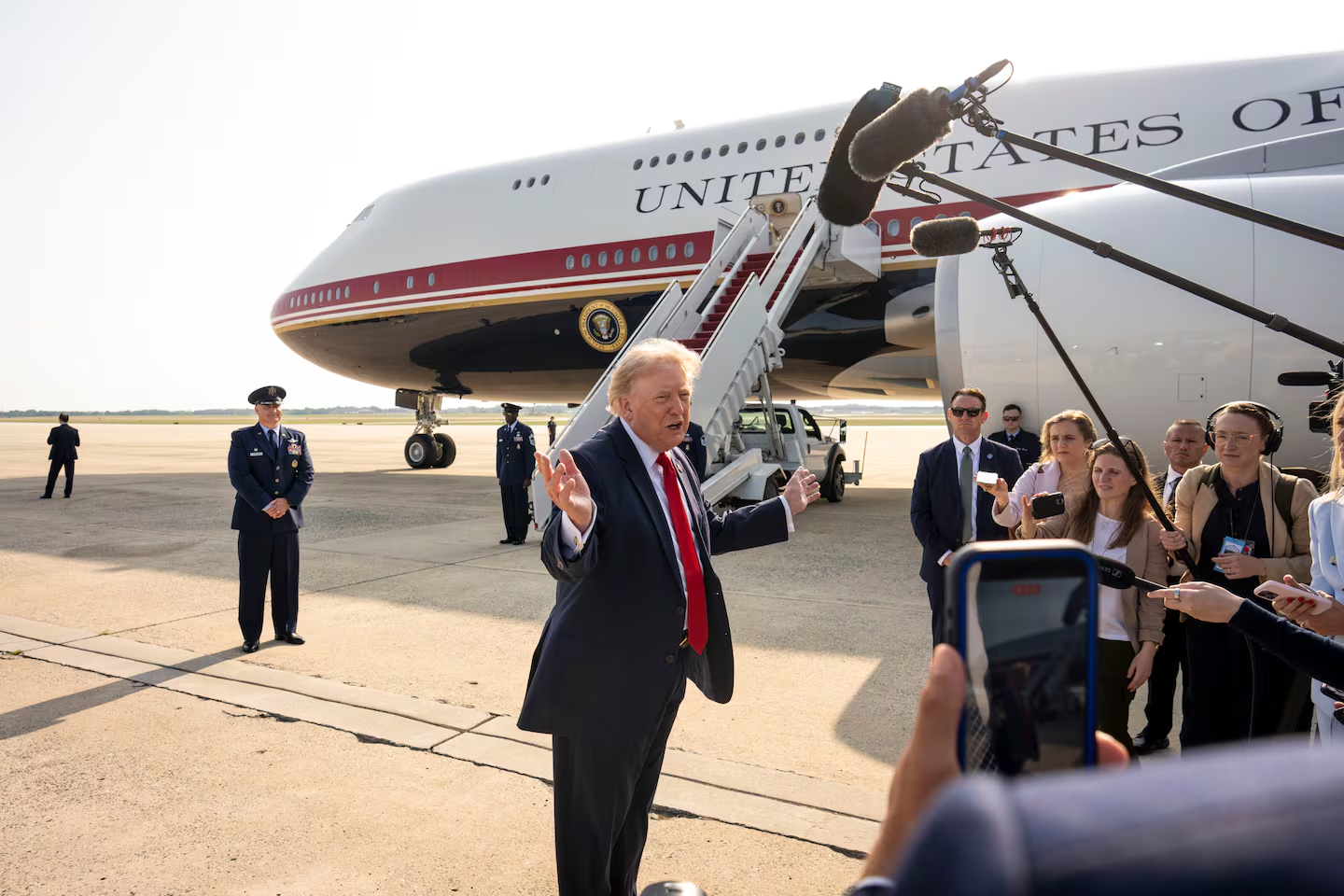
WASHINGTON — President Trump was entranced. It was a few weeks into his second term, and he was on the tarmac of the Palm Beach, Fla., airport, getting a tour of a luxury Boeing 747-8 that had been flown from Doha, Qatar, for his perusal.
Read more As cyclosporiasis spreads, America says no thanks to salads
The double-decker jet, which had been outfitted for the Qatari royal family, had a spacious bedroom adorned with leather and wood and a lounge featuring a chandelier and another with suede seats.
Two planes being built by Boeing to replace the aging Air Force One fleet were years behind schedule, and Trump’s team had asked the US Air Force to find a temporary aircraft. This was the one, the president decided.
Trump’s February 2025 tour of the Qatari jet led to a frantic sprint inside the White House and the Pentagon. The administration sought to upgrade the plane in time to meet his demand for it to be ready by the nation’s 250th birthday this summer, with an accelerated retrofit.
An investigation by The New York Times found that the president’s push to get the luxury aircraft quickly led to ballooning costs and trade-offs in safety features that potentially left Trump and others who travel with him on Air Force One vulnerable.
Among the findings:
— Trump was personally engaged in making decisions about the retrofitting of the donated plane, giving the final approval on the features and security measures that would be included, according to people familiar with his role. They and others interviewed for this article described the sensitive information about the process and the plane on the condition of anonymity.
— Several key security and safety features on the Boeing planes that have been used for decades as Air Force One are not visible on the upgraded jet, including a lower-level exit for high-risk situations, additional backup power capacity, and an advanced antimissile system, public Air Force records and photographs examined by the Times show. The planes currently being built to serve as the permanent presidential fleet are all set to have such features, federal records show.
— The 747-8 plane was overhauled on a compressed timeline of just about eight months. Experts said the jet would have needed several years for a full upgrade.
— Because the Qatari jet was being pushed into service so quickly, some White House officials initially expected it would only be used for domestic travel or to visit allied countries with US military bases.
— The government spent hundreds of millions of dollars to purchase equipment needed to train pilots to fly the 747-8 plane so quickly, on top of the approximately $400 million cost of the upgrades that the administration has publicly acknowledged. The Pentagon has tried to mask the total price tag, including from Congress, by taking the funds from a classified budget for nuclear modernization.
The truncated overhaul of the jet came after Qatar agreed to give it to the Defense Department as a gift. It is eventually slated to go to Trump’s presidential library, an unorthodox donation that has been criticized as a way for the Middle Eastern country to curry favor with the president.
The security trade-offs of the new Air Force One burst into public view when Trump was forced to fly out of Turkey this month on a different jet, a swap made at the urging of the Secret Service after officials identified a credible threat to him by Iranian proxy forces. The Times then reported that the new plane lacks some of the same defensive countermeasures as the previous model.
It is unclear what security measures, including new air defense technologies, may have been incorporated onto the plane, which the administration has maintained is safe. Nevertheless, the White House announced this past week that the Qatari-donated jet would be taken out of service this fall for unspecified “upgrades and enhancements.”
“PLANEMAXXING,” the White House declared in a social media post touting the move.
The reversal exposes the potential risks that the government took to satisfy Trump’s demand for an aircraft befitting the grandeur he believes should accompany his office. Experts familiar with the Air Force One program said they were surprised Trump had decided to use the Qatari-donated plane for overseas trips.
“People need to be aware it has a lot of shortfalls compared to Air Force One; they do add a measure of risk,” said Frank Kendall, who supervised the presidential plane modernization project, first as the Pentagon acquisition chief and then the Air Force secretary under President Joe Biden from 2021 until January 2025.
But for Trump, having to use decades-old planes that frequently needed repairs was an embarrassment. The two 747 jets had been in service since the early 1990s, when the first of them carried President George H.W. Bush from Washington, D.C., to Topeka, Kan.
“When you land and you see Saudi Arabia, and you see UAE, and you see Qatar and you see all these — and they have these brand-new Boeing 747s mostly, and you see ours next to it, this is like a totally different plane,” Trump told Sean Hannity during an interview on a flight to the Middle East in May 2025. He added: “And we’re the United States of America. I believe that we should have the most impressive plane.”
Read more Silicon Valley is split over open-source AI and how to react to Chinese AI
Air Force officials have said the rapid retrofitting of the Qatari plane was a success, describing it as safe, secure, and equipped with the most advanced technologies.
“A testament to the Air Force’s ability to innovate and rapidly evolve to ensure the continuity of our government under any conditions,” General Kenneth S. Wilsbach, the Air Force’s chief of staff, said in a statement in May.
The White House has also maintained that the Qatari jet poses no risk for the president and his entourage. In a statement this past week, White House press secretary Karoline Leavitt called the new plane “fully mission-ready and safe for presidential travel today.” She said the enhancements it was set to receive this fall would “ensure it remains the most advanced, secure, and capable aircraft in the world.”
It was December 2016, shortly after Trump’s first election, and he was being briefed on the lengths that the military goes to harden Air Force One.
In a meeting at Trump’s Mar-a-Lago resort, Air Force General Carlton D. Everhart II told the incoming president about the “complex and unique systems” required of the Boeing planes “to ensure survivability and reliability,” according to a copy of a once-secret presentation, reported on earlier by TWZ, a website that covers the Pentagon.
Everhart, who is now retired, said in an interview that Trump asked about the plans for a modernized Air Force One, expressing confidence about his own expertise.
“I know about my airplane, because I fly all the time,” Trump told him, as Everhart recalled, referring to his private plane informally called Trump Force One.
Trump remained fixated on Air Force One when he regained the White House. Just weeks after his reelection in 2024, Trump sent tech entrepreneur Elon Musk to a Boeing airplane hangar in Texas where the two jets were slowly being transformed.
Musk’s assignment was to find a way to speed up the Boeing effort, as he and others believed the project had gotten bogged down by excessively strict security clearance requirements for some of the workers not involved in sensitive features of the plane.
But the Trump transition team also asked the Air Force for a backup plan, according to former and current Air Force officials: to scour Boeing’s list of all 747-8 airplanes in service to see if there was another in the world that could be quickly procured for Trump.
Military officials were already concerned about the number of repairs needed for the aging planes in the presidential fleet. The 747-8, the latest model of the Boeing jet, is different from the one that had been used for decades as Air Force One. It has modernized electronic flight controls, a redesigned wing system and engines, and a larger cabin and upper deck, among other changes. The Air Force limited the choice to this plane because it has four engines, providing an extra margin of safety if one failed.
But even after locating the Qatari jet, the Air Force knew that it would cost more than $1 billion and take years to install the same features as the planes built to serve as Air Force One, according to Kendall and other former Air Force officials.
Pentagon documents show that those Boeing jets must undergo a series of major structural changes to be part of the presidential fleet. Holes must be carefully cut into the fuselage to build a lower entryway, allowing the president to exit and enter in less secure environments. An “autonomous baggage loading” system has to be added to reduce the reliance on foreign ground crews.
Hundreds of miles of electrical wiring and electronic components have to be shielded from an electromagnetic pulse, such as from a nuclear weapon detonation.
The official planes also require a second small engine, known as an auxiliary power unit, to be installed near the rear of the jet to serve as a backup for communication systems and other vital electronics gear. They also need some of the most advanced communications equipment and what the Pentagon has called a “self-defense system.”
All the upgrades are “inherently expensive,” one Air Force briefing said, outstripping the roughly $400 million the military initially estimated it would cost just for the two jets.
The latest total estimate: $5.1 billion for the entire modernization effort, now slated to be completed in 2028 — 13 years after the Air Force first decided to rely on 747-8 jets for the project.
Read more Game 103: Blue Jays at Red Sox lineups and notes
This article originally appeared in The New York Times.


Post Comment