In Michigan primary, the scene is set for another progressive versus establishment showdown
The next major ideological battle for Democrats is playing out in Michigan, as a high-stakes Senate primary once again pits progressive against moderate.
Read more Pro Movers and Storage — your moving company
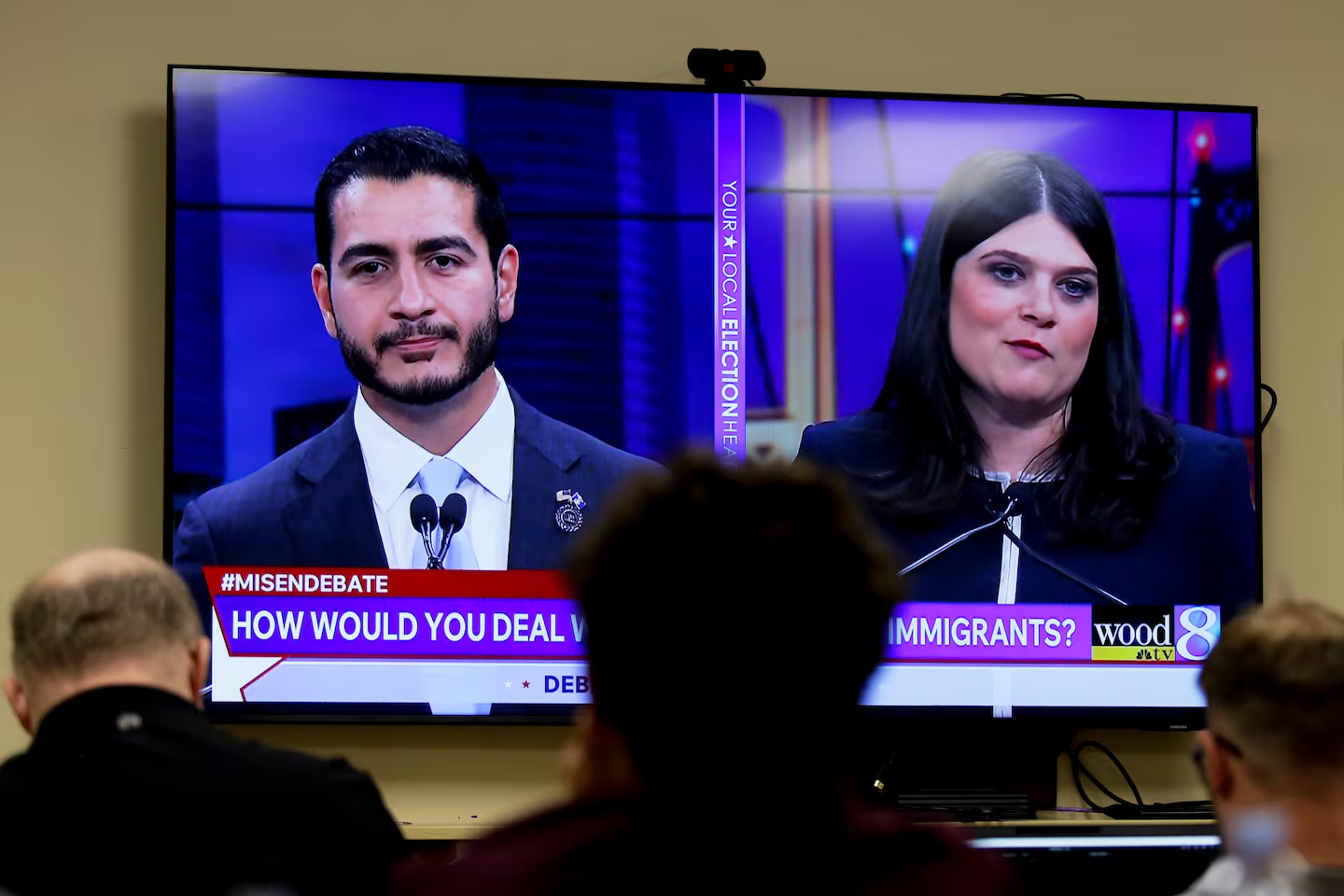
Just two weeks away from the Aug. 4 primary, polls are tight between Dr. Abdul El-Sayed, a progressive former public health official, and four-term Representative Haley Stevens, a centrist. The race has become increasingly expensive, particularly as outside groups pour money into TV ads backing Stevens and attacking El-Sayed.
The winner of the contest will face Republican candidate former representative Mike Rogers in the November general election to fill the seat of retiring Senator Gary Peters, a Democrat.
It’s a crucial seat for Democrats hoping to take the Senate majority this year, but it’s a competitive one. While the state voted for President Trump in 2024, voters also narrowly chose Senator Elissa Slotkin, a Democrat, over Rogers the same year. Cook Political Report classifies the current race as a “toss up.”
As both candidates try to prove they’re the better pick for the general election, prominent voices from the progressive and establishment wings of the party are weighing in.
Senator Elizabeth Warren, Democrat of Massachusetts, endorsed El-Sayed on Monday. Warren previously backed a third candidate, Mallory McMorrow, who dropped out of the race on July 5. Warren told the Globe just last week that she did not have plans to endorse again in the primary.
“He is the fighter Michigan needs in the Senate. … and make no mistake: Abdul is the only candidate in this race who can build the grassroots movement needed to win in November,” Warren said in a video posted to X.
El-Sayed said in a Monday interview that he was grateful for the endorsement and has been discussing potential campaign events with Warren’s team.
“She’s been a champion of having a politics that is about answering for everyday people rather than being dominated by the interests of the richest and most powerful, and the fact that she is lending her name and her vision to this race, I think, says a lot about what we’re all fighting for together,” El-Sayed told the Globe.
Over the weekend, he toured alongside fellow endorsers and progressive leaders Senator Bernie Sanders, Independent of Vermont, and Representative Alexandria Ocasio-Cortez, Democrat of New York.
“I’m trying to get money out of politics, put money in your pocket, pass Medicare for All,” he said. He also wants to abolish ICE.
Although El-Sayed is not a member of the Democratic Socialists of America, critics like Jonathan Cowan, president of the moderate think tank Third Way, argue that El-Sayed’s policies are too progressive to win in the general election.
“I believe Stevens is going to win, but if for some reason Stevens doesn’t win and El-Sayed wins, that is handing a gift to Republicans. They would like nothing better than to run against a defund-the-police, socialist radical,” Cowan said.
Cowan believes Democrats need to take on Republicans from more of a “combative center,” and he claimed progressives lost credibility for supporting Graham Platner, the scandal-plagued former Maine Senate candidate. Fight Agency, the political advertising firm behind the Platner campaign, also works with El-Sayed.
About Platner, El-Sayed told the Globe that “he and I have lived very different lives.” And he rejected the criticism that his policies don’t appeal to the working class.
“I frankly do not care what corporate, you know, Democrats think about what’s good for working people when they’ve sold working people off for decades,” El-Sayed said.
Read more Trusted Dunedin Movers You Can Rely On
On Fox News, Rogers said neither candidate is fit for the Senate and called it a “change election” for Republicans in Michigan.
“While they’re talking about all this nonsense — it really is crazy versus common sense, and I’m going to guess that Michigan’s going to pick common sense in this,” he said in the July 18 interview.
A University of Michigan graduate with an M.D. from Columbia and a doctorate from Oxford as a Rhodes Scholar, El-Sayed directed the health department for Detroit and later for all of Wayne County. He ran for governor in 2018 but lost by a large margin in the primary to Governor Gretchen Whitmer. He also co-hosted a health podcast until 2025.
State Representative Carrie Rheingans, a fellow former public health official who is pushing for a state universal health care plan called “MiCare,” thinks El-Sayed would bring much-needed expertise and data-based decision making to Washington. The current health system is collapsing, she said, in part because of profit incentives, the dismantling of the Affordable Care Act, and impacts on the health workforce during the Covid pandemic.
“We need healthcare for everybody, however we get there — if it’s state by state, or if it’s federal,” she said. “And I think Abdul will be able to help build those coalitions within the U.S. Senate itself, within Congress, as well as on the ground in Michigan.”
Stevens, meanwhile, is backed by the Democratic Senatorial Campaign Committee and Senate Minority Leader Chuck Schumer, Democrat of New York, as well as former senator Debbie Stabenow and former Michigan governor Jennifer Granholm. And last week, she secured support from Peters, who previously told the AP he would be staying neutral. (Slotkin declined to comment on the race when asked last week.)
“Haley Stevens will be ready on day 1 to fight for Michigan, which is why I am excited to announce I am all in for Haley Stevens,” Peters said in a July 13 statement and praised her role on the presidential task force that helped bail out Detroit automakers in 2009. (Many campaign ads by pro-Stevens groups feature a clip of Obama hailing her efforts, although he has not endorsed her in this race.)
Stevens won her congressional seat, previously held by a Republican, in 2018 and has used her record of success in the 11th district to argue she’s the best choice to take on Rogers, who lost to Slotkin by a mere 0.3 percent. She has branded herself as a “workhorse” for Michigan. The Stevens campaign did not respond to requests for comment.
A Detroit News/Glengariff poll conducted from July 8-11 puts Stevens ahead of El-Sayed 48 percent to 41 percent, with 10 percent of voters still undecided. Stevens is viewed more favorably by Black and non-college-educated voters and traditional Democrats, while El-Sayed is getting more support from White, college-educated, and outstate voters, the Detroit News reported.
Although El-Sayed’s campaign has outraised Stevens, according to FEC data, outside organizations have spent nearly $50 million in support of Stevens’ campaign. The biggest spender is United Democracy Project, a super PAC linked to the pro-Israel lobbying group AIPAC.
One challenge on August 4 will be primary turnout, which tends to be “terrible” in Michigan, according to Rusty Hills, a public policy professor at the University of Michigan and former chairman of the Michigan Republican Party. He estimated that “about 20 to 25 percent of the voters turn out, and among younger voters, it’s much much worse than that.”
Union endorsements can help propel turnout, Hills noted. United Auto Workers, Michigan’s biggest union, has endorsed El-Sayed, while other unions favor Stevens.
Ocasio-Cortez told the Globe last week that UAW’s endorsement demonstrates that working people support El-Sayed.
“I think some folks may talk about this in terms of establishment and new, but I just kind of think about this in terms of the politics of the future,” she said. “I think people are kind of done with the politics of big money, and they want to embrace the politics of people.”
Read more Appeals court upholds White House adviser Peter Navarro’s contempt of Congress convictions


Post Comment