Government overhauls teen pregnancy program to focus on marriage and starting families
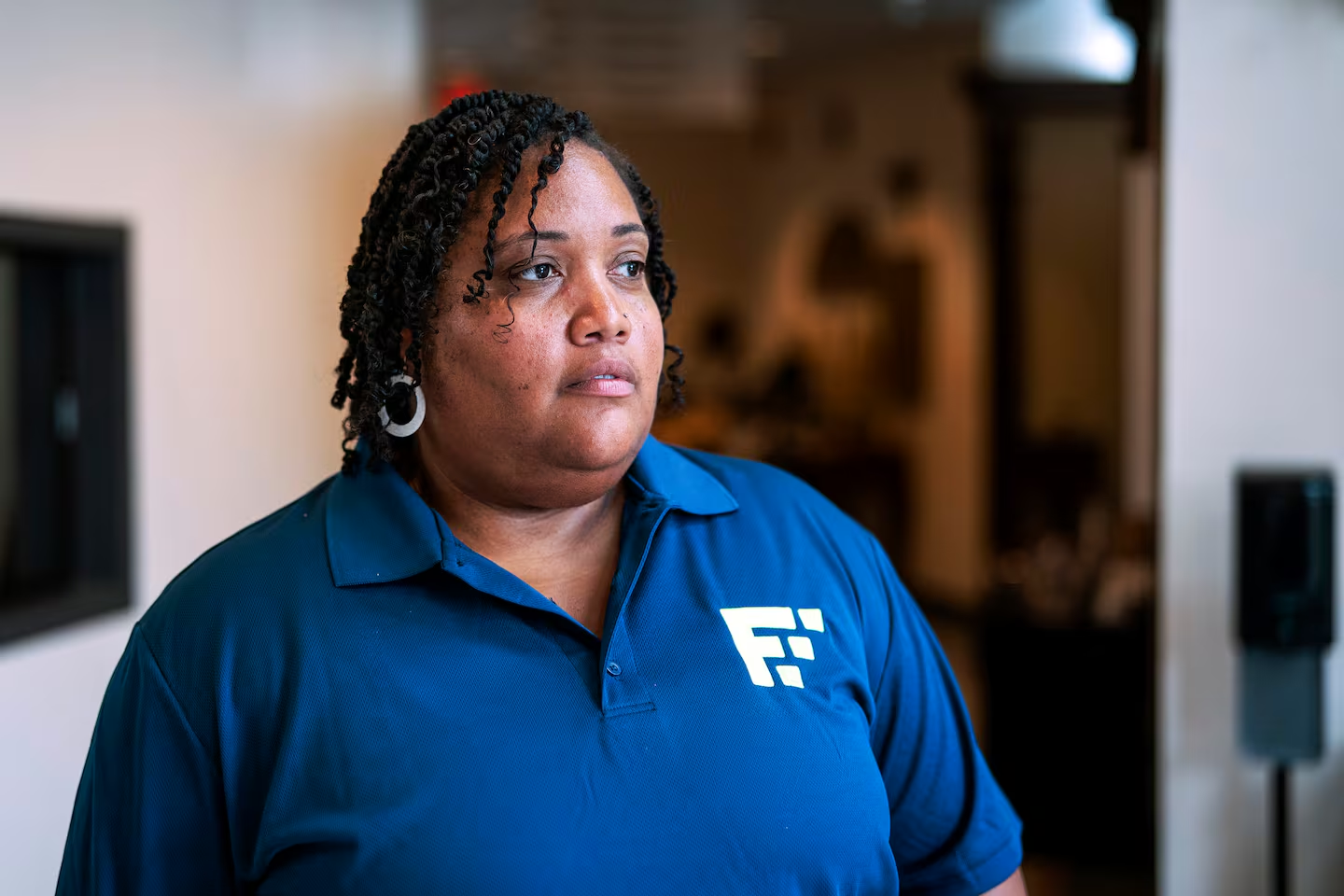
A few weeks ago, Rena Dixon, the head of Fact Forward, a South Carolina nonprofit that offers adolescent health and sex education classes, got a letter from the Trump administration with crushing news. The government was terminating the organization’s $1.6 million grant from a federal program to reduce teen pregnancies, effective immediately.
The administration’s priorities, it said, do not align with “content that encourages, normalizes or promotes sexual activity for minors.”
The move is the latest in a campaign that began in the first Trump administration to defund or overhaul the 16-year-old, $100 million initiative. Courts blocked the effort in 2018, but this time the administration, which abruptly canceled 53 of the program’s 67 grants last month, has been taking steps to be on firmer legal ground.
The letter from the assistant secretary for health accused Fact Forward of including lessons with “advice on making condom use more pleasurable” and discussions that normalize “use of pornography.” A video, it said, contained a “scenario of adolescents engaging in sexual activity.”
“That information was just not true,” Dixon said. The organization had never used the lessons specified, she said. The video “is about one teen telling another that she had had sex, and her friend responding, ‘That’s a big no-no!’”
In interviews, other directors also said the government had distorted their content. They pointed out that the grant had required them to use courses from a federally approved list shown by research to be age-appropriate and effective.
Healthy Futures of Texas, a nonprofit that serves teenagers in Dallas, San Antonio and the Rio Grande Valley, won renewal of its grant less than a year ago, following a rigorous federal review of its material.
“Today those same materials are being cited as the reason for termination, with no opportunity to address those concerns,” said Ginger Mullaney, the organization’s CEO. “So we’re all struggling a little bit to understand.”
Now dozens of grant holders face an existential dilemma, as they wrestle with whether to submit applications due this week for the next round of grants, under the administration’s new rules.
The new criteria say grant recipients must teach abstinence as the only means to prevent teen pregnancy. Courses must stress the importance of marriage and procreation and instruct young people how to safeguard their fertility. They make scant reference to preventing sexually transmitted infections and virtually none to lesbian, gay and transgender sexuality.
The Department of Health and Human Services declined to comment on the new requirements or the litigation. But these conditions mirror blueprints laid out in Project 2025 as well as in other position papers by the Heritage Foundation, which argue that teen pregnancy prevention programs falsely presume that adolescent sex is inevitable and also undermine parental authority.
Last week, three programs that lost funding and a nonprofit that works with them filed a lawsuit in federal court against the Department of Health and Human Services and its secretary, Robert F. Kennedy Jr. The programs seek to block the terminations and the new requirements that, they say, create an ideologically based framework that violates the intent of the federally mandated one.
“Congress plainly did not intend HHS to focus on teaching young women strategies to become pregnant in a pregnancy prevention program,” wrote Democracy Forward, a national legal advocacy nonprofit, in the lawsuit.
Read more Journalists urge correspondents’ association to stand up to Trump at rescheduled press dinner
The five-year projects funded by the Teen Pregnancy Prevention grants had supported topics in sex education, including consent, decision-making and healthy relationships, adjusted for age as well as a local community’s values and culture. Locations ranged from schools to juvenile detention centers to foster care settings. The programs also hold communication workshops with teens and trusted adults.
The teenage birthrate has been plummeting steadily for over two decades. Researchers say explanations are varied, but include increased teen access to forms of long-acting birth control, abortion pills and even smartphones.
Public health scholars and bipartisan congressional committees have also attested to the influence of the federal prevention programs on teen behavior, including delayed sexual initiation.
The birthrate among girls 15-19 has dropped more than 65% during the time the program has been in effect, to 11.7 births per 1,000 in 2025 from 34.3 births per 1,000 in 2010, according to the latest provisional data from the Centers for Disease Control and Prevention.
Yet at a time when the overall American birthrate is declining, a trend decried by many conservatives and others, the new, 89-page grant application requires programs to draw from a curriculum known as “sexual risk avoidance,” which connects abstinence during the teenage years to maturity and readiness for marriage and parenthood.
It often lifts language almost wholesale from The Body Literacy Project, a curriculum praised by some conservative thinkers and religious leaders as an alternative to public school sex education. The project’s website says its courses were developed to align closely with the administration’s priorities for the teen pregnancy prevention program.
Applicants must provide separate modules on male and female reproductive health. Young women should recognize “ovulation as the central event and primary indicator of hormonal health and fertility.” Although gynecologists often prescribe birth control pills to treat irregular cycles and extreme menstrual pain, courses must include “an overview of approaches to managing menstrual health concerns, including the advantages and disadvantages of ovarian suppression.”
Body literacy courses for boys should include strategies for managing “spontaneous arousal in ways that support self-regulation, health and future fertility.” And they should address “how repeated or artificially stimulated arousal may affect neural development and behavior over time.”
Layoffs and cancellations
Fact Forward’s federal grant covered 80% of its pregnancy prevention project. Since receiving the termination letter, Dixon had to lay off half her staff and cancel training for local educators and programming for teen summer activities. The organization reaches some 6,000 young people ages 13-21.
“When people hear teen pregnancy prevention program, they think it’s all about raining condoms from the sky,” said Dixon, who has a doctorate in public health. But in conservative states like South Carolina, where state law requires public school health classes to emphasize abstinence, Fact Forward operates within tight boundaries and has a faith advisory board.
Since the federal grants began in 2010, teen birthrates in South Carolina have dropped 59%. Yet as of 2024, when the latest federal data was completed, the state still ranked at No. 11 nationwide in teen births. Dixon, like some other program directors, has decided to adjust to the new criteria; the funding is too crucial. Fact Forward will turn in its application this week.
“It’s a real disservice to what we know works best in our state,” Dixon said. “But if I can keep some of our programs from closing so that young people are still hearing about healthy relationships, something is better than nothing. I don’t know if we’ll be successful, but at least I’m going to try.”
Read more A tiny Texas town is fighting back on Trump’s border wall plan
This article originally appeared in The New York Times.


Post Comment