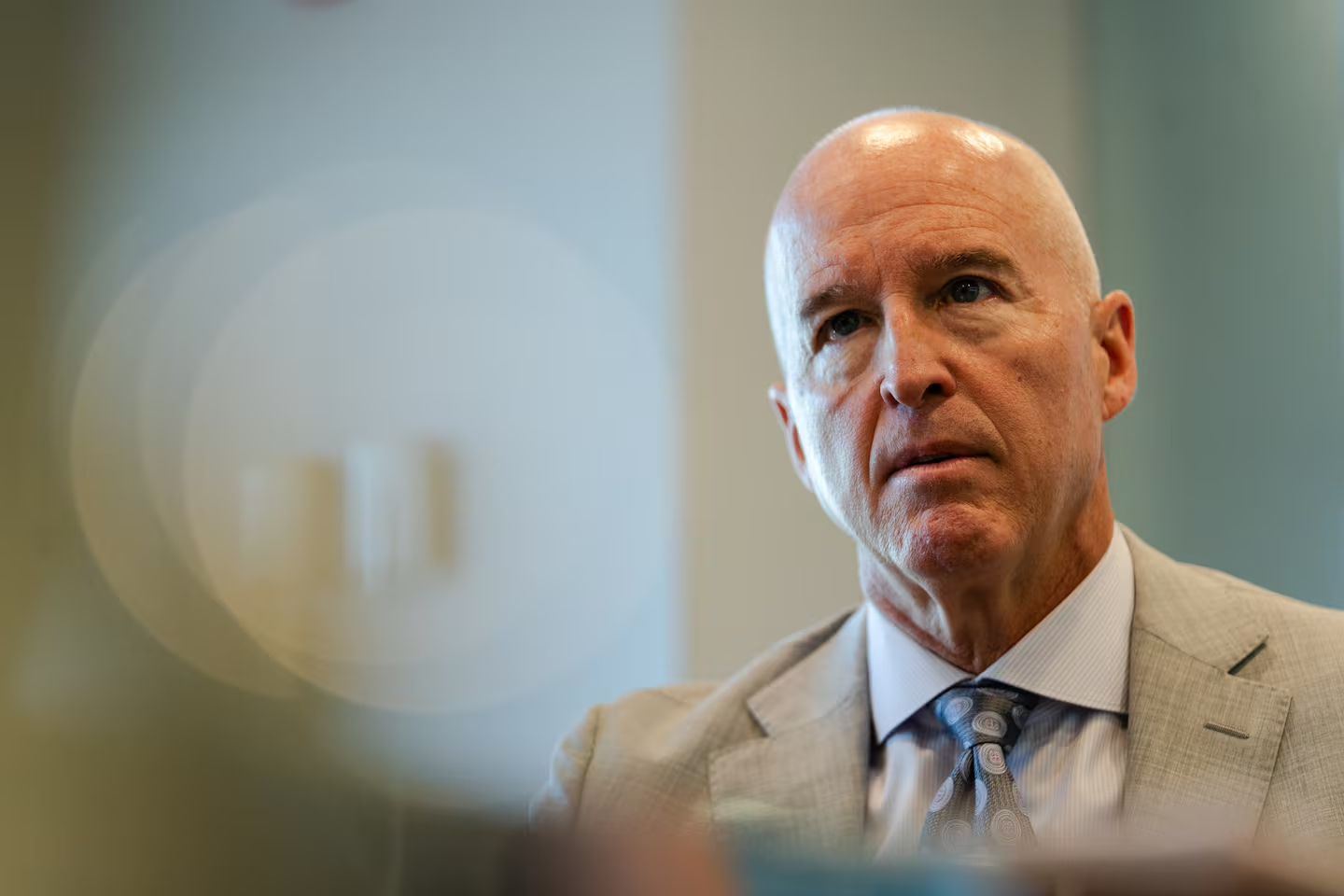
GOP’s Michael Minogue says he has ‘met the criteria’ for disclosing wealth, assets
WESTPORT — Michael Minogue, a Republican gubernatorial candidate and former biotechnology executive, said he has “met the criteria” for disclosing his vast wealth, including out-of-state assets like a $31 million home in an ultra-exclusive club in southern Montana.
The declaration came after the Globe last week reported previously unknown details of his homeownership at the high-end Yellowstone Club.
Minogue’s wealth can be hard to track, in part because he uses trusts that are not easily connected to him. A financial disclosure he filed as part of his run for governor only required him to list assets and properties in Massachusetts. Like other major party candidates in the race, he has also declined to release his tax returns.
After a campaign event in this South Coast city on Saturday, Minogue argued that his income has long been open to inspection because he ran a public company, Danvers-based Abiomed, for nearly two decades until it was sold to Johnson & Johnson in 2022 for almost $17 billion.
“You can see how I made my wealth, how much I made for 19 straight years,” he said.
In his 238-page financial disclosure, Minogue lists properties he owns in Massachusetts, including a pair of homes in South Hamilton and an 81-acre property in Gloucester. He also reported earning at least $300,000 from his consulting firm and other businesses, and at least $818,000 from investments.
But the disclosure did not include the Montana property, which sits in the Yellowstone Club, a members-only community that features thousands of acres of private ski terrain and reportedly includes members such as Mark Zuckerberg and Bill Gates.
And while Minogue previously said he had a ski home in Big Sky, the details, value, and exact location were unknown. In response to Globe questions about whether he would voluntarily share more information about out-of-state assets, Minogue said he had “met the criteria” for disclosure.
“I’ve disclosed all those things,” he said. “I’ve met the criteria and more. Let’s work together so we educate people and make Massachusetts aware of how hard it is to live here.”
The Globe previously confirmed Minogue’s homeownership in the Yellowstone Club with the contractor who built his six-bedroom, eight-bathroom house, through land records, and with one of Minogue’s childhood friends who said he’s repeatedly visited him at the private ski community.
The property, which Montana records show has a market value of $31 million, provided more insight into Minogue’s vast wealth and potential connections as he shuttles millions of his own dollars into his gubernatorial bid. His campaign previously claimed the home’s market valuation was “overinflated.”
Minogue said his wealth does not render him out of touch with voters who are struggling to afford living in Massachusetts.
“I did not grow up with money,” he told the Globe. “My parents struggled. My dad had a mortgage up until the end of his life. He never bought a new car. I wore hand-me-down clothes when I went into the military.”
Minogue amassed his wealth, in part, when Abiomed was sold to Johnson & Johnson in 2022. A federal filing with the US Securities and Exchange Commission shows he made out with more than $240 million in separation payments as part of the sale, including cash to cover any taxes he would incur on those payments.
Other gubernatorial candidates in the race have varying assets.
Brian Shortsleeve, a Republican and former MBTA chief administrator, owns several homes, including a $12 million seaside property in Barnstable, a Wellesley home, and a condo in downtown Boston.
Governor Maura Healey last owned property in 2010, when she sold a Brookline condo for nearly $600,000, according to public records and her campaign. She lives in an Arlington home with her partner, Joanna Lydgate, state records show.
All three candidates have campaigned on platforms that include understanding the struggle residents face in Massachusetts with affordability and housing.
For Mingoue’s part, he said he’s worried that young people won’t be able to buy a home until later in life.
“I’m focused on the homes for people in Massachusetts,” he said. “Young couples can’t afford their heating or air conditioning bills because our energy is so high and our policy is so bad, that’s what people are focused on.”
Read more Trump administration plans to upend Head Start by deregulating it


Post Comment