For the sake of community and fun music, Boston Landmarks Orchestra performs its concerts for free
Much can change in 25 years, and since the Boston Landmarks Orchestra was founded a quarter-century ago, both the world and the orchestra have evolved in several significant respects. However, on one point, Landmarks has remained the same
Read more Senator Bernie Moreno says former son-in-law Max Miller should not serve in the House
“We’ve never charged a dime for any performance,” said music director Christopher Wilkins in a phone interview. “That gets to, really, what I think drives our mission — which is access in every way you can define that term.”
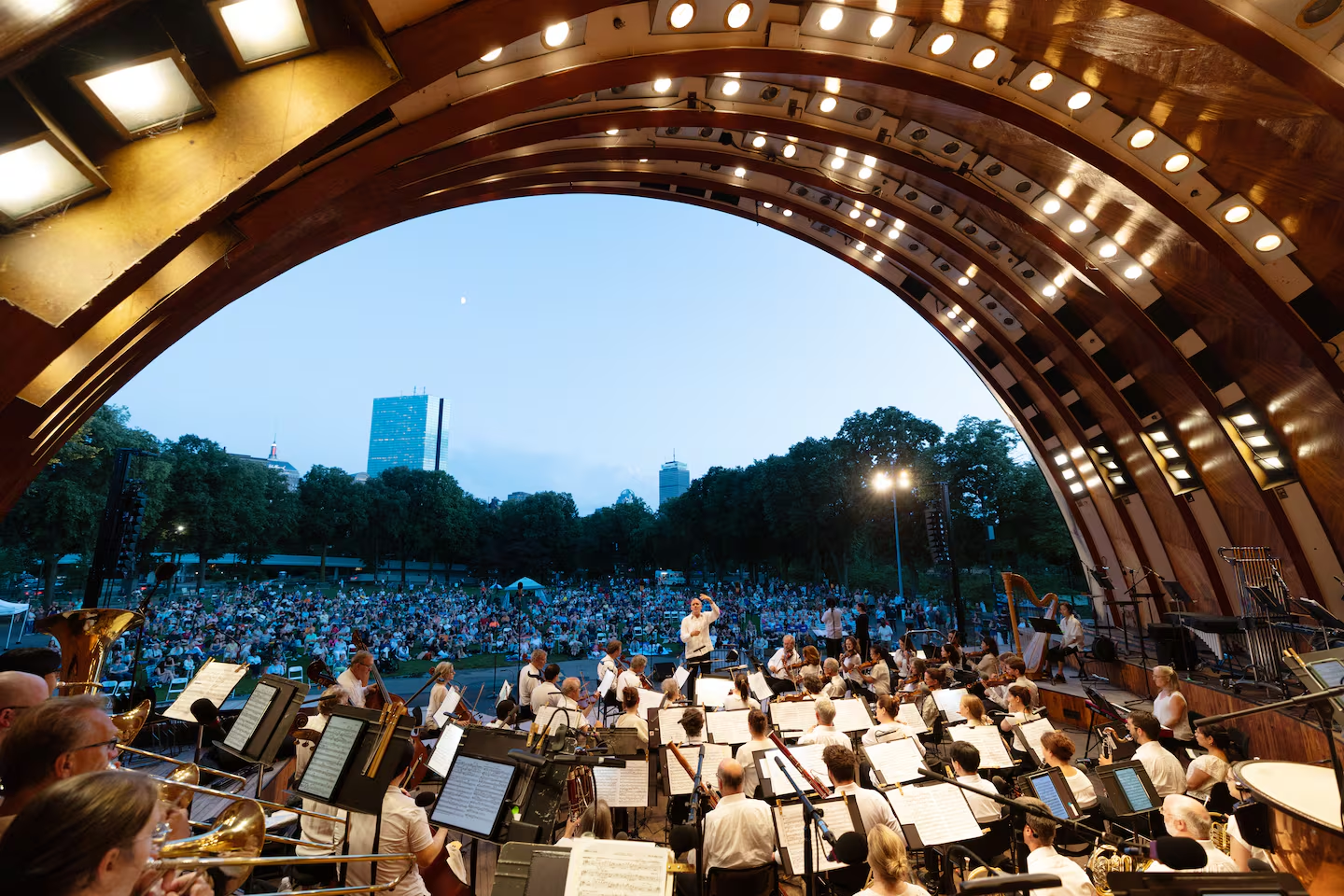
For founding director Charles Ansbacher, that meant performing free concerts of classical music in historically underserved areas in greater Boston during the summer, when the Boston Symphony Orchestra was away at Tanglewood and most school-based ensembles were scattered for the season. For Landmarks at present, that means combining active outreach to various community groups with making it as easy as possible for anyone to attend one of the orchestra’s concerts, which usually take place at the DCR Hatch Memorial Shell on the Esplanade on Wednesday evenings during the summer.
Since Wilkins took over leadership, the orchestra has tried to attract audiences through what he calls a “strategy of participation,” he said.
“Partnerships, and collaborations, and invitations to communities who wouldn’t ordinarily think of symphonic music are very much front of mind.”
In other words, Landmarks is equally as likely to collaborate with the likes of the New England Aquarium, Brazilian drumming project Grooversity, and Haitian and Armenian dance companies as they are to pull in a Boys and Girls club or a local music education program such as Boston Strings Academy. American Sign Language interpreters are present at most Landmarks events. Some concerts even make haptic vests available, to provide a tactile experience of the music for deaf and hard of hearing attendees.
“We tend to program backwards. We first think of who we can get involved, and then we think, ‘What can we program to support that collaboration?’” said Wilkins. “I think it’s been really effective, and fun, and…the orchestra’s stretched artistically, because it’s playing some music orchestras don’t usually play.”
In the earliest years, concerts were slightly more formal and standard-repertoire driven “after the Arthur Fiedler model,” explained Paula Oakes, a violinist who has been in the ensemble since its second season.
Landmarks started regularly performing at the Hatch Shell in 2007, a handful of years after the Pops Esplanade Orchestra (in which several Landmarks players also play) scaled back its summer concerts in the city.
“It’s not a situation where it’s high-falutin’ classical music,” said trumpeter Dana Oakes, another longtime Landmarks player and Paula’s husband. “It’s a really good vibe out there.”
There’s little separation from the sights and sounds of the city, with cars driving along Storrow Drive on one side and joggers and dog walkers taking the Esplanade path on the other. Anyone can leave the concert and come back without consequence. It perhaps follows naturally that there’s barely any enforcement of the usual rules of orchestral concert hall etiquette, even those some might take for granted, such as sitting quietly while the orchestra plays.
Read more A centennial salute to Coltrane and Davis caps a full day at the Newport Jazz Festival
It’s not unusual to see young children with batons in hand “conducting” the orchestra from a music stand near the Hatch Shell (cutely dubbed the “Maestro Zone”) or patrons wandering to a nearby ice cream truck mid-concert; or people listening while they play card games. With a much different atmosphere than Boston’s temples of music like Symphony Hall, the Hatch shell during these concerts feels like a gathering place, where people can choose to socialize in parallel with the music.
And that’s not even getting into the music Wilkins chooses. “With all due respect, Charles had a great concept for the orchestra, but this is something Charles would not have done: reach out to what would not be considered classical by any stretch, and somehow weave it into a program that’s seamless,” said Paula Oakes.
Landmarks’s repertoire mixes symphonies and other large-scale works from the standard repertoire with some film music, the Leroy Anderson-esque fare sometimes called “light classical,” orchestrations of genre-crossing modern tunes, and the occasional world premiere, such as 2018’s “Pegasus Promenade,” which was collectively composed by Gonzalo Grau and four students and alumni of East Boston arts program ZUMIX.
Paula Oakes admitted she doesn’t adore every piece she plays with Landmarks, but that’s not a negative in her reckoning. “It stretches your imagination, it stretches your technique,” she said.
Wilkins “made the programs we play much more challenging, and he just included so many different types of music as well,” Dana concurred.
Because Landmarks’s outdoor season is confined to the short New England summer, the orchestra has been making overtures towards performing more indoor concerts as well during and outside its standard performing weeks. This weekend, the orchestra brings a program including Mozart’s Symphony No. 40 and Max Richter’s recomposition of Vivaldi’s “Four Seasons” to churches in Jamaica Plain and Roxbury; next week, it’s back to the Hatch Shell for Verdi’s massive “Requiem” on the evening of August 5 with the One City Choir and Cantata Singers.
So far, the indoor audiences haven’t been as large as the lawn crowds on the Esplanade, but Wilkins sees it as “not as much about the numbers,” that being more important that people attend in the first place, he said.
“I think for the most part, people understand what our mission is,” he said. “I think it’s pretty obvious that we’re using great music to create community connection.”
Though a summer rainstorm soaked the Esplanade a few hours before showtime on July 22, that community connection seemed to be in abundance at the first concert of the season, which was performed to an all-ages crowd including a handful of multigenerational families and even a few dogs. Many brought sandwiches and other picnic fare; one ambitious group even brought their own table and spread out a Thai takeout feast. A young musician who had performed in the prelude concert happily added a Landmarks Orchestra sticker to the collection of Sanrio characters on her cello case. Couples wandered down the path holding hands, some lingering for a few minutes to listen, some content to enjoy the music as they passed by. A tattooed man in all black ate popcorn out of a plastic bag with chopsticks.
Landmarks season ”is one of my favorite times of year,” said state representative Jay Livingstone from the stage, naming the most crucial key to Landmarks’s success. “Anyone can come down the Esplanade and enjoy it.”




Post Comment